Play Storehouse Solitaire Online for Free (No Signup Required)
The four 2s start on the foundations here, a 13-card storehouse keeps refilling the tableau, and three passes give you a fair 30% win rate.
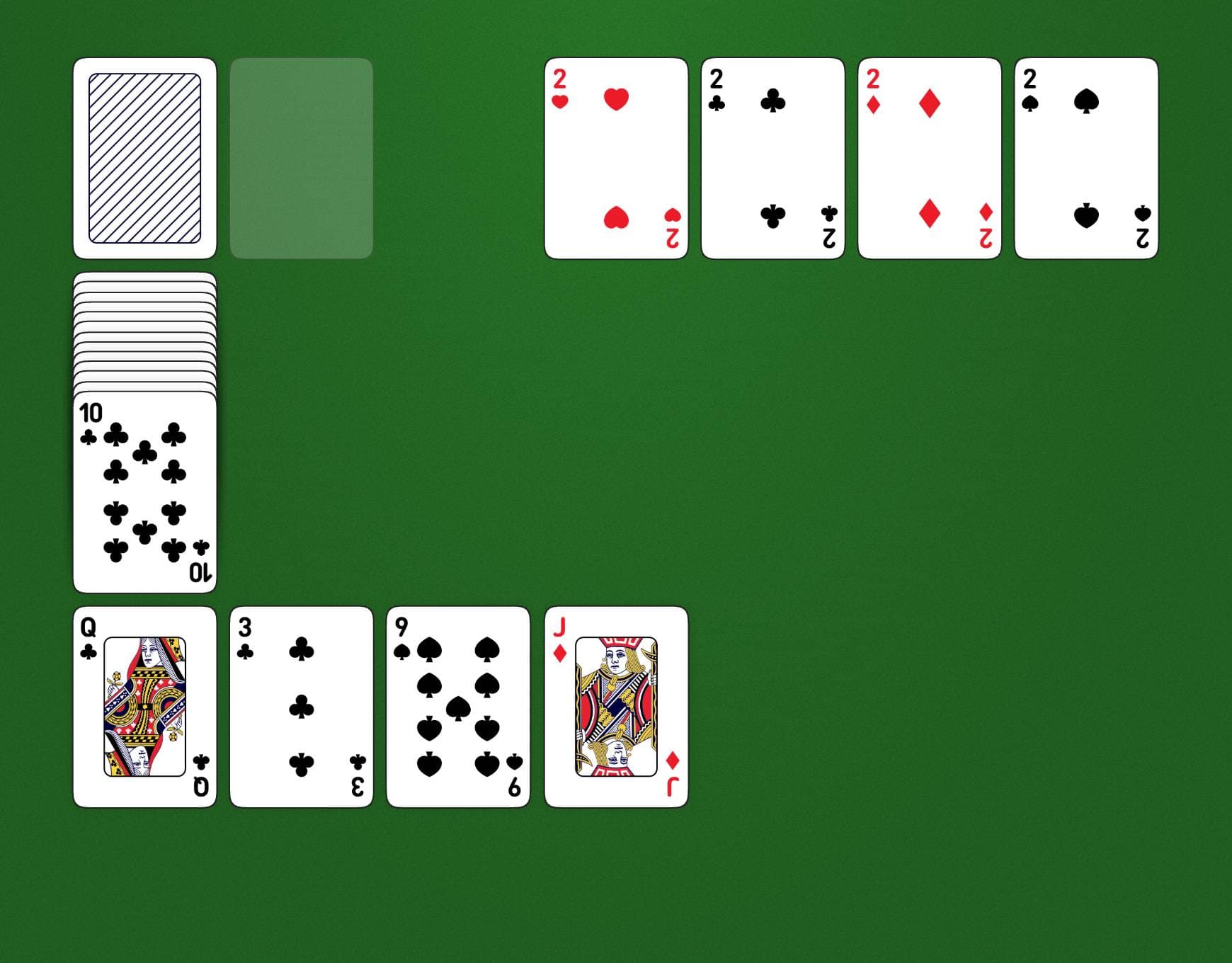
Storehouse Solitaire is a traditional member of the Canfield family that removes Canfield's biggest unknown: instead of a randomly dealt base card, the four 2s are placed on the foundations at the start of every game. The game takes its name from its 13-card reserve — the storehouse — which automatically restocks the tableau whenever a column empties.
What the game gives with one hand it takes with the other: tableau building is in suit rather than in alternating colors, which makes matches far scarcer, though three passes through the stock keep things fair. Difficulty lands at medium here: this single-deck game wins about 30% of the time, with skill and luck sharing credit fairly evenly.
Canfield Solitaire, Double Storehouse Solitaire, and Acme Solitaire are solitaire games that are comparable to this one.
If you run into anything odd or have an idea that would make the game better, please contact me.
Enjoy playing!
How to play Storehouse Solitaire
Layout:
4 foundation piles: Build up in suit from the 2s to the Kings, then the Aces. The four 2s are dealt to these piles at the start of the game.
4 tableau piles: Build down in the same suit. Same-suit sequences may be moved as a group. Spaces are automatically filled from the storehouse; once it is empty, any card may fill them. At the start of the game, each pile is dealt one card face-up.
Reserve: The top card is always available for play on the foundations or the tableau. 13 cards are dealt here at the start of the game.
Stock: Click to turn over one card at a time to the waste. There are two redeals.
Waste: Top card is playable.
Foundation:
There are four foundation piles.
Each foundation pile is given a 2 at the start of the game.
A card can be added to a foundation pile only if it's one rank higher and the same suit as the pile's current top card, wrapping from King to Ace at the end, so the only card that fits on a 9 of clubs is a 10 of clubs. There can be no more than 13 cards in a pile.
The top card of each foundation can be moved back into play if another pile will accept it.
Reserve:
There is one reserve pile — the storehouse — which originally contains thirteen cards. The top card is dealt face-up, while the remaining cards are dealt face-down. No cards may be moved into the reserve. The top card of the reserve can be played to the tableau or the foundation.
Tableau:
Four tableau piles of one card each make up the tableau. Every card is dealt face-up.
A card can be added to a tableau pile only if it's one rank lower and the same suit as the pile's current top card, so the only card that fits on a 9 of clubs is the 8 of clubs. Because Aces rank high, a King may be played on an Ace of the same suit, while nothing may be played on a 2.
Cards on the tableau that are not covered by another card are free to be played onto the foundation or any other tableau pile.
Empty tableau spots are immediately filled with the top card of the storehouse. If the storehouse is empty, any card can occupy any vacant spot.
Groups of cards in sequence from high to low may be moved from one tableau column to another if all of the cards are of the same suit.
Stock and waste:
There is one waste pile and the remaining cards comprise the stock.
When you click on the stock, one card from the stock is dealt to the waste. Three passes through the stock are allowed.
The top card of the waste can be played to the tableau or foundation.


