Play Countess Solitaire Online for Free (No Signup Required)
Twelve reserve cards fan out face-up across four piles, and the stock eases from threes to twos to ones, one deck, 40% win rate.
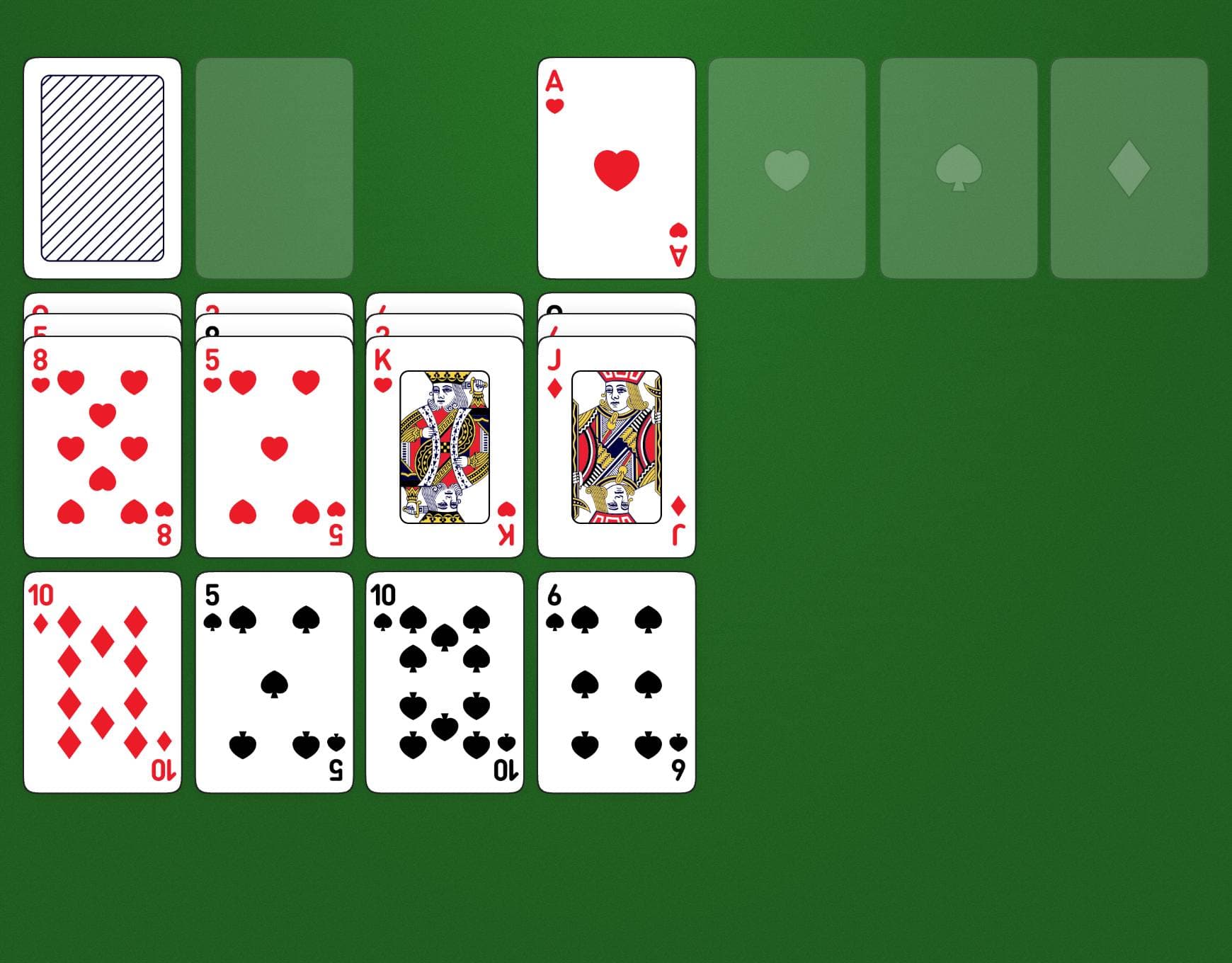
Countess Solitaire belongs to the Canfield family, which traces back to Richard Canfield's Saratoga casino in the 1890s, where gamblers paid for a deck and were refunded for every card they managed to play to the foundations. Countess treats the player far more kindly than the casino original. Instead of one tall reserve with its cards hidden, the reserve is split into four small fans of three cards each, every one of them dealt face-up, so you can plan around all twelve from the very first move.
The stock is gentler too. It is dealt in the easing rhythm of Gold Rush: three cards at a time on the first pass, two at a time on the second, and one at a time on the last, so the deeper you get into the game, the more of the stock you get to see. One deck is in play, and skill and luck split the credit for this one about evenly.
The game is moderately difficult, with about a 40% chance of winning.
Play Canfield Solitaire and Canfield Rush Solitaire alongside Countess for two more takes on the same reserve-and-stock idea.
When you want fewer piles to track, the classic Solitaire is right there.
If you run into anything odd or have an idea that would make the game better, please contact me.
Enjoy playing!
How to play Countess Solitaire
Layout:
4 foundation piles: Build up in suit from the rank of the first card dealt to the first pile, wrapping from King to Ace as needed, until each pile has 13 cards.
4 tableau piles: Alternate color build down. Groups of cards in sequence may be moved together. Empty spaces may be filled with any card. At the start of the game, each pile is dealt one card face-up.
4 reserve piles: Each reserve is dealt 3 cards face-up, and the top card of each is available for play on the tableau or foundations.
Stock: Click to deal three cards at a time to the waste on the first pass, two at a time on the second, and one at a time on the last. There are two redeals.
Waste: The top card is always available for play on the tableau or foundations.
Foundation:
There are four foundation piles.
A foundation pile will be given a card at random. This is the starting card. Begin the remainder of the piles with cards of the same rank.
A card can be added to a foundation pile only if it's one rank higher and the same suit as the pile's current top card, wrapping from King to Ace as needed, so the only card that fits on a 3 of diamonds is a 4 of diamonds. There can be no more than 13 cards in a pile.
The top card of each foundation can be moved back into play if another pile will accept it.
Reserve:
There are four reserve piles, each originally containing three cards. Every card is dealt face-up. There are no cards that may be moved into the reserve. The top card of each reserve may be played to the tableau or the foundation.
Tableau:
Four tableau piles of one card each, built downward. Every card is dealt face-up.
A card can be added to a tableau pile only if it's one rank lower and the opposite color of the pile's current top card, so the only cards that fit on an 8 of hearts are the 7 of spades and 7 of clubs.
Cards on the tableau that are not covered by another card are free to be played onto the foundation or any other tableau pile.
If the cards are alternately red and black, groups of cards in sequence from high to low can be shifted from one tableau pile to another.
Empty tableau spots may be filled with any card. They are not filled automatically.
Stock and waste:
There is one waste pile and the remaining cards comprise the stock.
When you click on the stock, three cards from the stock are dealt to the waste. There are three trips through the stock allowed. The number of cards turned over at a time is lowered by one in each pass, thus in the second pass, cards are turned over two by two and one by one in the last pass. If there aren't enough cards left in the deck at the end of a pass, only the remaining cards are dealt.
The top card of the waste can be played to the tableau or foundation.


