Play Penguin Solitaire Online for Free (No Signup Required)
Dig the fourth base card from the bottom of column one while three others land on the foundations. Seven cells give room to breathe, but empty columns still decide the game.
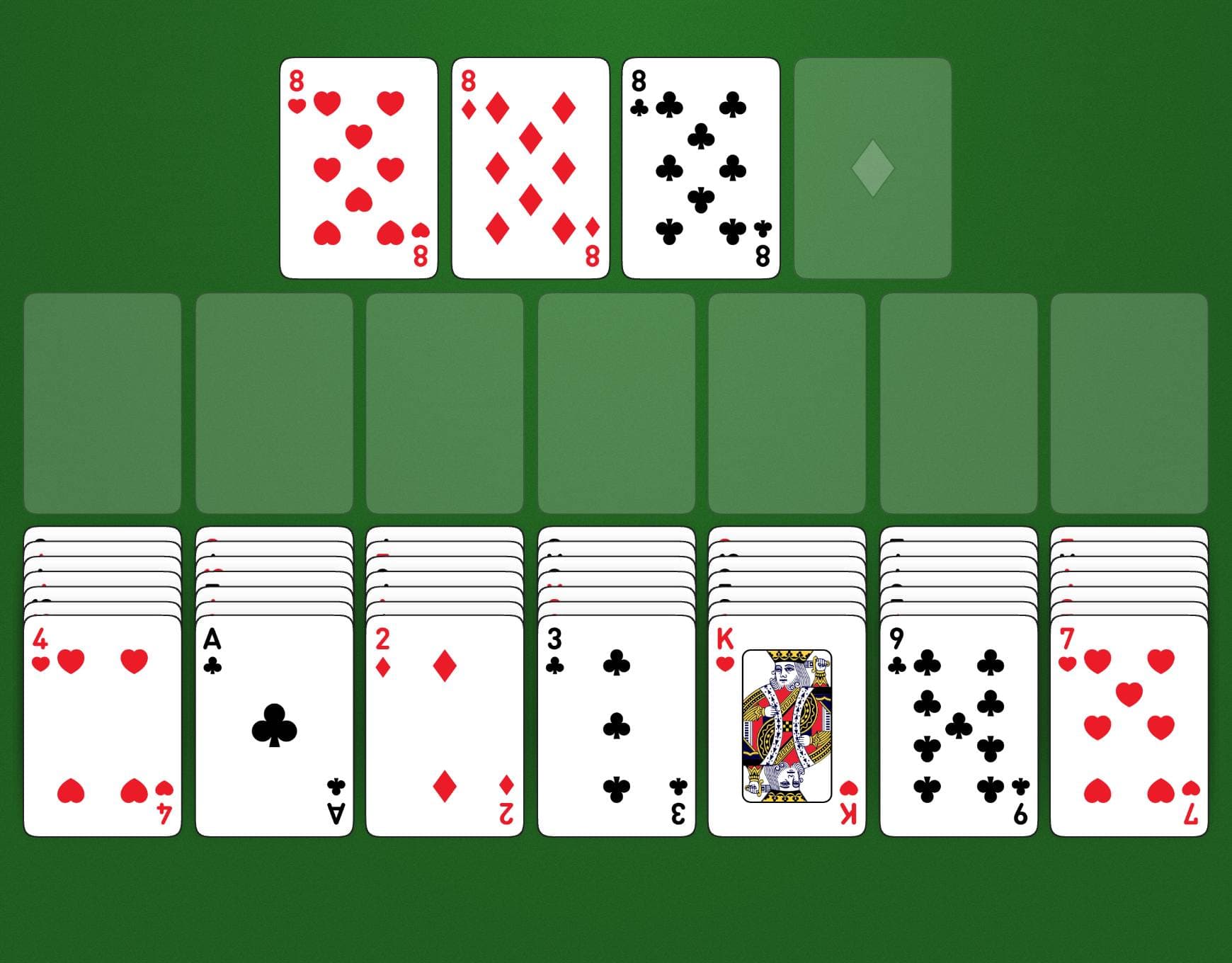
Penguin Solitaire is a seven-cell relative of FreeCell invented by the British games scholar David Parlett. It takes its name from the flightless bird, and its signature is the "beak" opening: the rank of the very first card dealt becomes the base rank for all four foundations. Three of the four cards of that rank are handed to you on the foundations right away, but the fourth is buried at the very bottom of the first tableau column — and digging it out is the puzzle that gives the game its bite.
With seven free cells and a single deck, Penguin is generous with holding space, making it one of the more winnable open builders — though the same-suit tableau keeps it honest. Foundations climb in suit from the base rank and wrap past the top all the way back to the card just below the base, so each pile ends up with thirteen cards.
Empty columns decide the game. A vacant column can be refilled only by a card one rank below the base, so spaces are precious — plan ahead, keep your cells from clogging, and free that buried base card as early as you can.
Other solitaire games comparable to this one include FreeCell Solitaire, Eight Off Solitaire, and Opus Solitaire, which shares Penguin's wrap-around foundations with fewer free cells.
If you run into anything odd or have an idea that would make the game better, please contact me.
Enjoy playing!
How to play Penguin Solitaire
Layout:
4 foundation piles: Built up in suit from the base rank — the rank of the first card dealt — wrapping from the top back around to the card just below the base, until each holds 13 cards. Three base cards start here; the fourth must be dug out of the tableau.
7 free cells: Single-card holding spots that can later feed the tableau or the foundations. All seven begin empty.
7 tableau piles: Build down in the same suit. Move a group of cards in sequence when enough free cells and empty columns are open to relocate them one at a time. Each pile is dealt 7 cards face-up.
Foundation:
There are four foundation piles, and three of them are already seeded with a base-rank card.
A card can be added to a foundation pile only if it's one rank higher and the same suit as the pile's current top card, wrapping from the top rank back around to the card just below the base. So if the base rank is 7, a foundation runs 7, 8, 9, 10, Jack, Queen, King, Ace, 2, 3, 4, 5, 6. Complete all four and you win.
The top card of each foundation can be moved back into play if another pile will accept it.
Tableau:
Seven tableau piles of seven cards each, all dealt face-up, with the fourth base card sitting at the very bottom of the first pile.
A card can be added to a tableau pile only if it's one rank lower and the same suit as the pile's current top card, so the only card that fits on a 9 of clubs is an 8 of clubs.
Empty columns are the key to the game: a vacant pile can be filled only by a card one rank below the base, together with any same-suit sequence beneath it.
Free cells:
Seven cells, all empty at the start.
One card can be stored in each cell. Any available card can be played into an open cell, and a card resting in a cell can return to the tableau or go up to a foundation. The more cells you keep free, the longer the sequences you can move in a single action.


