Play Good Measure Solitaire Online for Free (No Signup Required)
Ten piles of five, two aces already home, and every king tucked safely out of the way: Good Measure eases Baker's Dozen with a friendly 65% win rate.
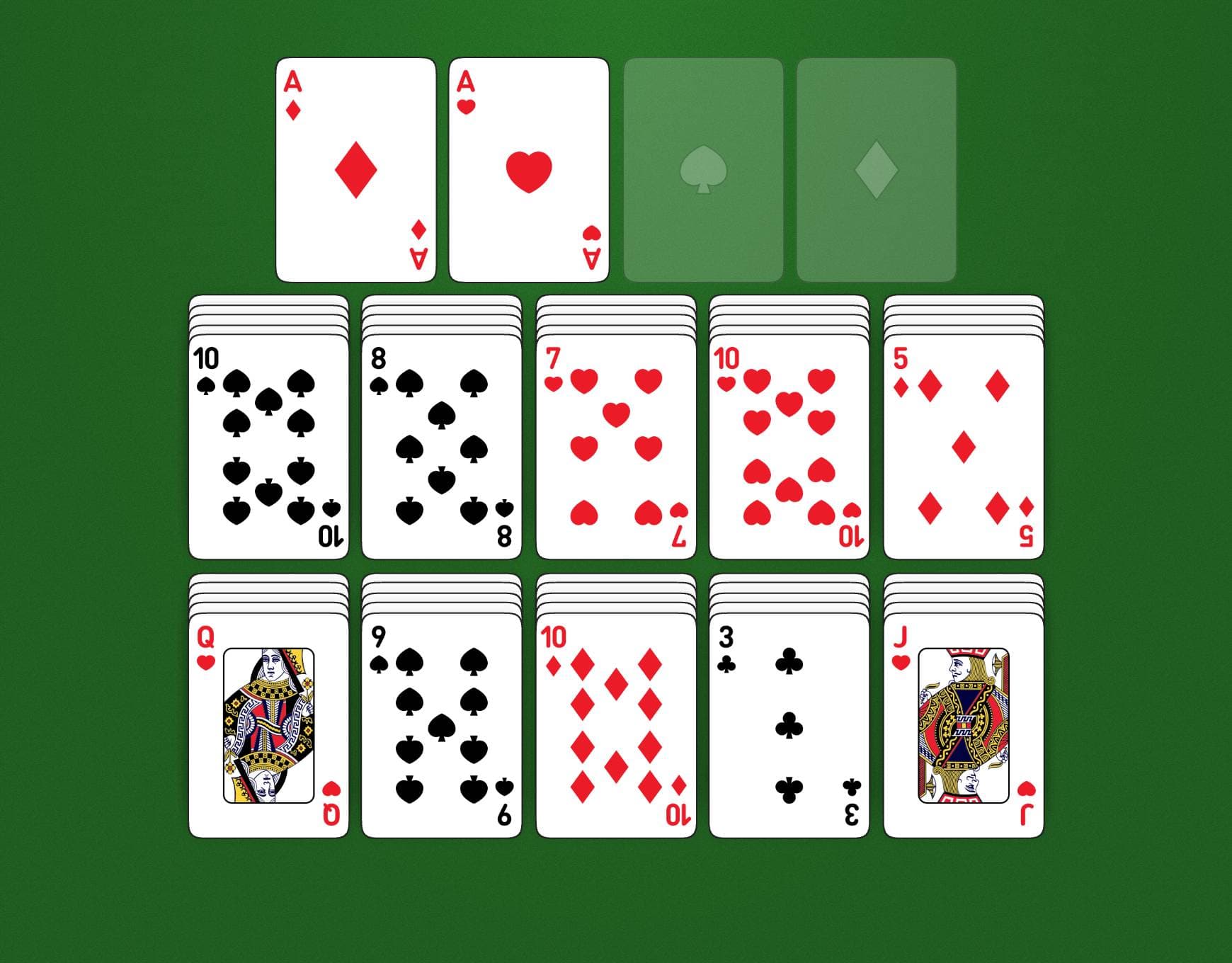
Good Measure Solitaire is a member of the Baker's Dozen family and turns up in solitaire collections from the early twentieth century. Where its parent deals thirteen piles of four cards, Good Measure hands you ten piles of five — an extra card per pile "for good measure" — and sweetens the deal by placing two aces on the foundations before play begins.
The family trademark is preserved: any king dealt into a pile is tucked underneath it during the deal, so a king can never trap the cards below it. Everything else is up to you. All fifty remaining cards are dealt face up, there is no stock to draw from, and an emptied pile stays empty for the rest of the game, so every move can be planned from the very first card. Because nothing is hidden, a lost game can usually be traced back to a single careless move — digging out the two missing aces early is the key to most deals.
You'll win roughly 65% of the time here, playing a single deck where skill, not luck, decides the outcome — moderately difficult, but fair about it.
Next up, obviously: Baker's Dozen Solitaire and Spanish Solitaire.
For a change of pace, the original Solitaire strips away the extra rules entirely.
If you run into anything odd or have an idea that would make the game better, please contact me.
Enjoy playing!
How to play Good Measure Solitaire
Layout:
4 foundation piles: Build up in suit from Ace to King. Two aces are dealt here at the start of the game.
10 tableau piles: Build down regardless of suit. Only the top card of each pile may be moved, and empty piles may not be refilled. Each pile is dealt five face-up cards at the start of the game, with any kings tucked at the bottom.
Foundation:
There are four foundation piles. Two of them begin the game with an ace already in place.
Each pile starts with an ace. A card can be added to a foundation pile only if it's one rank higher and the same suit as the pile's current top card, so the only card that fits on an 8 of spades is a 9 of spades. There can be no more than 13 cards in a pile.
The top card of each foundation can be moved back into play if another pile will accept it.
Tableau:
Ten tableau piles laid out side by side, five cards each. Every card is dealt face-up. Any king dealt to a pile is moved to the bottom of that pile during the deal.
A card can be added to a tableau pile only if it's one rank lower than the pile's current top card, regardless of suit, so any 7 fits on any 8.
Cards on the tableau that are not covered by another card are free to be played onto the foundation or any other tableau pile.
The tableau's empty spaces may not be filled.
Only one card may be moved at a time; sequences are not permitted.


