Play Dover Solitaire Online for Free (No Signup Required)
Fan two decks across eight piles, split clicks over three waste piles, and refill empty tableau spots, unlike Bristol. Moderately difficult, skill and luck both matter.
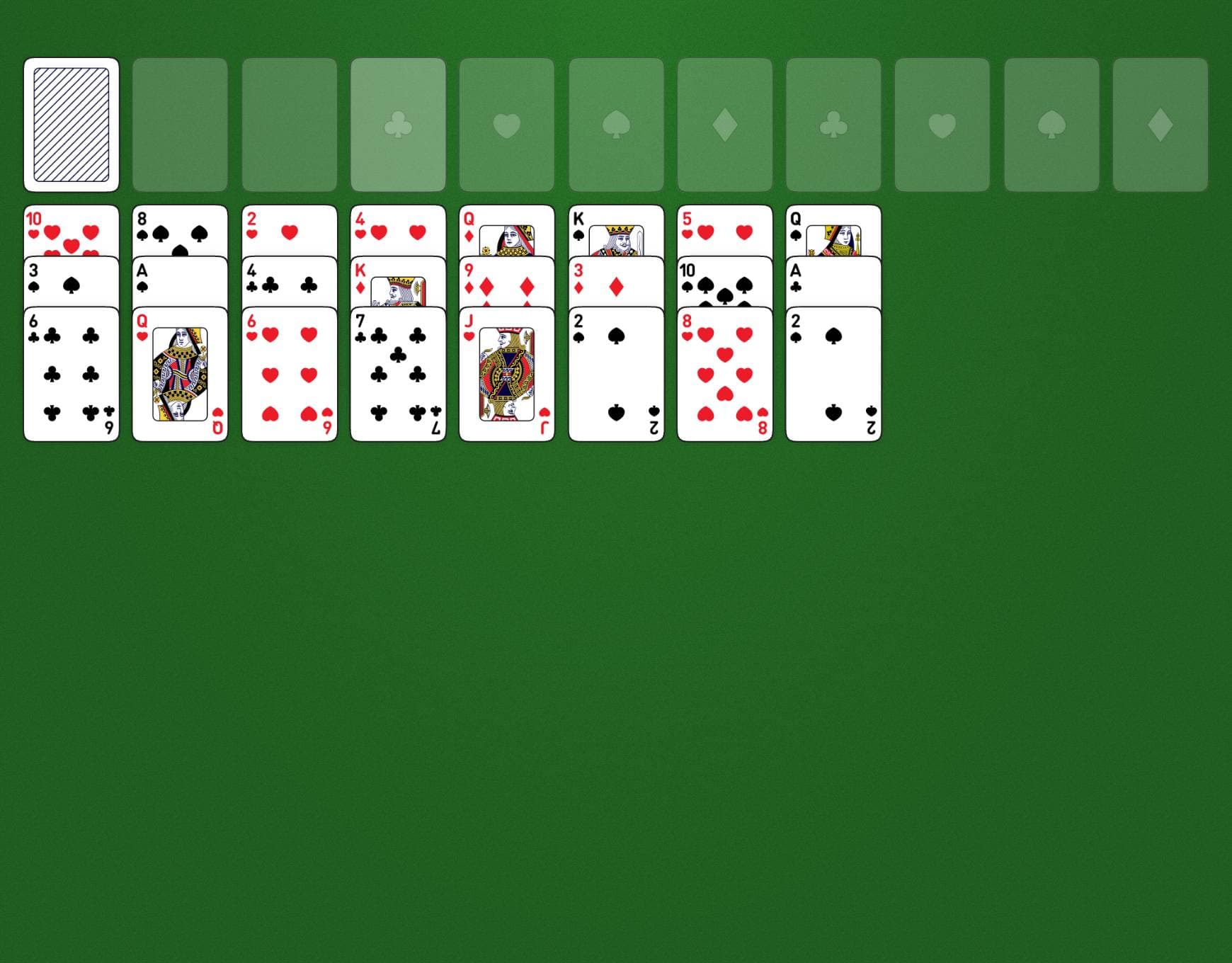
Dover Solitaire is the two-deck answer to Bristol, the fan game devised by Albert Morehead and Geoffrey Mott-Smith. It keeps Bristol's signature three waste piles but doubles the deck to 104 cards, tightens the foundations so they build up in suit rather than in any suit, and — unlike Bristol — lets you refill empty tableau spaces from the waste. It's moderately difficult, and winning rests on a healthy mix of skill and luck.
Every click on the stock drops three cards at once, one onto each waste pile, so the order in which you spend the three top waste cards matters enormously. With only one pass through the stock, a useful card buried under the wrong neighbor may never see daylight again.
The refillable spaces are Dover's great gift. Clearing a short fan gives you a landing spot for an awkward waste card, and because the foundations demand suits, digging out both copies of a low card early can save an entire deal.
You can also play Bristol Solitaire, the game Dover is built on, and Lucas Solitaire elsewhere on the site.
Or take a break from the fans and waste piles with a round of the classic Solitaire.
If you run into anything odd or have an idea that would make the game better, please contact me.
Enjoy playing!
How to play Dover Solitaire
Layout:
8 foundation piles: Build up in the same suit from Ace to King.
8 tableau piles: Build down regardless of suit. Only the top card of each pile is playable. Empty spaces are refilled from the waste. At the start of the game, each pile is dealt three cards face-up.
Stock: Turn over three cards at a time, one to each waste pile, from the stock. There are no redeals.
3 waste piles: Each waste pile's top card is ready for play.
Foundation:
There are eight foundation piles.
Any ace may be moved to any vacant foundation pile.
A card can be added to a foundation pile only if it's one rank higher and the same suit as the pile's current top card, so the only card that fits on an 8 of spades is a 9 of spades. There can be no more than 13 cards in a pile.
The top card of each foundation can be moved back into play if another pile will accept it.
Tableau:
The eight tableau piles fan out downward, three cards dealt to each, all face-up from the start.
A card can be added to a tableau pile only if it's one rank lower than the pile's current top card, regardless of suit, so the only card that fits on an 8 is a 7.
Cards on the tableau that are not covered by another card are free to be played onto the foundation or any non-empty tableau pile.
Empty spaces may not be filled with a card from another tableau pile; play a top waste card into them instead.
Only one card may be moved at a time; sequences are not permitted.
Stock and waste:
There are three waste piles and the remaining cards make up the stock.
When you click on the stock, one card is dealt to each waste pile. You only get one pass through the stock.
The top waste cards can be played to any tableau pile, empty or not, or to the foundation.


