Play Chameleon Solitaire Online for Free (No Signup Required)
A free-color spin on Canfield: build the tableau ignoring suit entirely, in a single-deck game with roughly a one-in-three chance of winning.
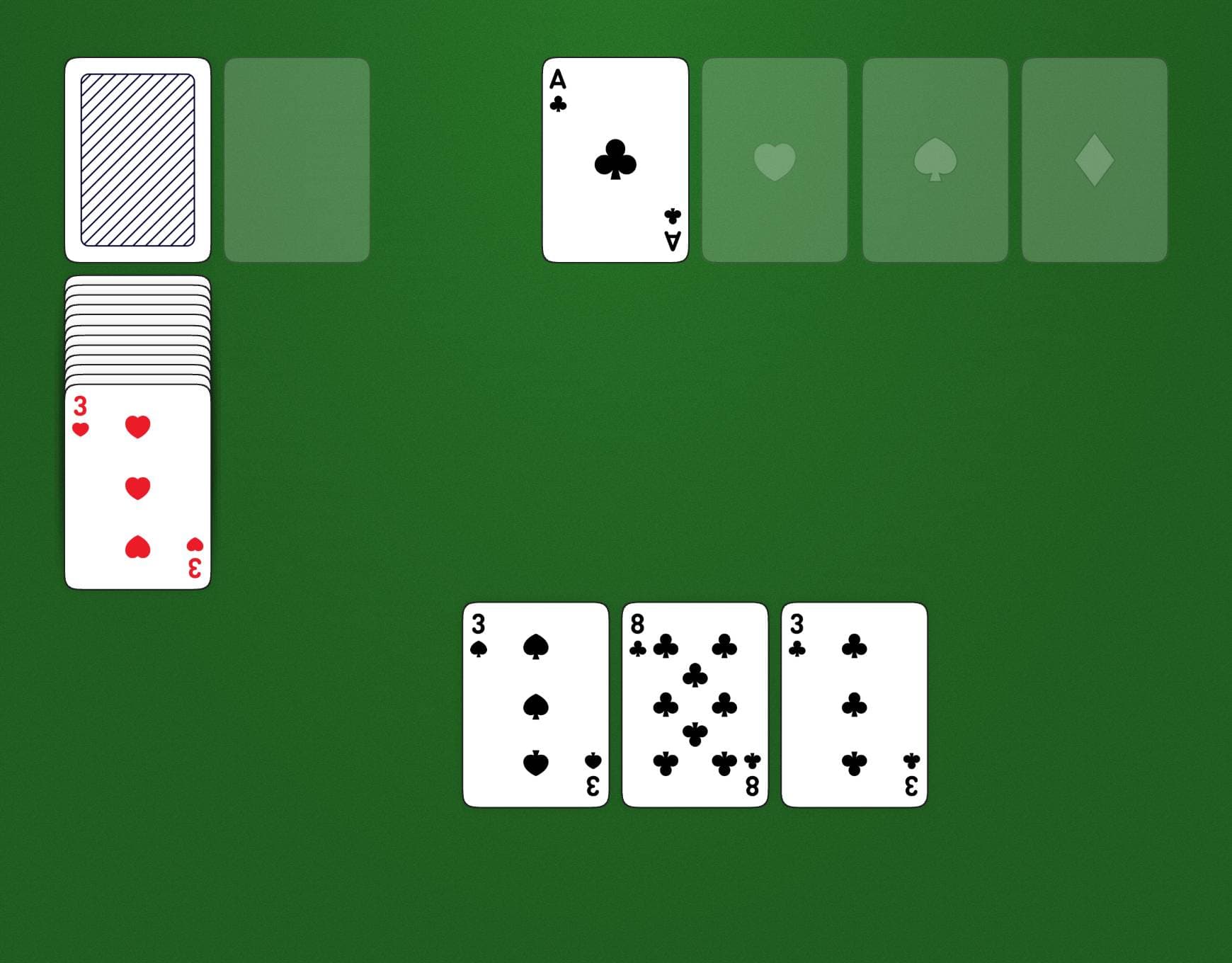
Chameleon Solitaire is a member of the Canfield family and has been appearing in patience collections since the early twentieth century. The name fits: where Canfield demands alternating colors on the tableau, Chameleon lets its piles change color freely, because building ignores suit altogether.
Its other differences from Canfield are just as striking. The reserve holds twelve cards instead of thirteen, there are only three tableau piles instead of four, and the stock is dealt one card at a time in a single pass rather than in threes with endless redeals. As in Canfield, the card dealt to the first foundation sets the base rank for the entire game, and an emptied tableau spot is refilled automatically from the reserve.
This one plays moderately difficult, and you'll win roughly one game in three. It's a single deck, and since luck deals the cards, your skill decides what you do with them.
For more of the same feel, head to Canfield Solitaire or American Toad Solitaire next.
If you enjoy Chameleon Solitaire, the classic Solitaire offers the same foundation-building goal without the color-blind twist.
If you run into anything odd or have an idea that would make the game better, please contact me.
Enjoy playing!
How to play Chameleon Solitaire
Layout:
4 foundation piles: Build up in suit from the rank of the first card dealt, wrapping from King to Ace as needed until each pile has 13 cards.
3 tableau piles: Build down regardless of suit. Spaces are automatically filled from the reserve. At the start of the game, each pile is dealt one card.
Reserve: The top card is available for play on the tableau or foundations. 12 cards are dealt here at the start of the game.
Stock: Click to flip over cards one at a time to the waste. There are no redeals.
Waste: Top card is playable.
Foundation:
There are four foundation piles.
A foundation pile will be given a card at random. This is the starting card. Begin the remainder of the piles with cards of the same rank.
A card can be added to a foundation pile only if it's one rank higher and the same suit as the pile's current top card. Ranking is circular, so a 2 fits on a King. There can be no more than 13 cards in a pile.
The top card of each foundation can be moved back into play if another pile will accept it.
Reserve:
There is one reserve pile, which originally contains twelve cards. Only the top card is dealt face-up. No cards may be moved into the reserve.
The top reserve card can be played to the tableau or the foundations, and whenever a tableau pile becomes empty, it slides over automatically to fill the space.
Tableau:
Three tableau piles of one card each. Every card is dealt face-up.
A card can be added to a tableau pile only if it's one rank lower than the pile's current top card, regardless of suit, so any 7 fits on any 8. Ranking is circular, so a King fits on an Ace.
Uncovered cards are free to be played onto the foundation or any other tableau pile, and a face-up descending run may be moved as a group no matter its suits.
Empty tableau spots are immediately filled with the top card of the reserve. Once the reserve is exhausted, any card or run may occupy a vacant spot.
Stock and waste:
There is one waste pile and the remaining thirty-six cards comprise the stock.
When you click on the stock, one card from the stock is dealt to the waste. There can only be one pass through the stock.
The top card of the waste can be played to the tableau or foundation.


