Play Canfield Rush Solitaire Online for Free (No Signup Required)
The stock thins fast: three cards, then two, then one, across three passes. It's quicker than standard Canfield, but skill still decides your shot at that 20% win rate.
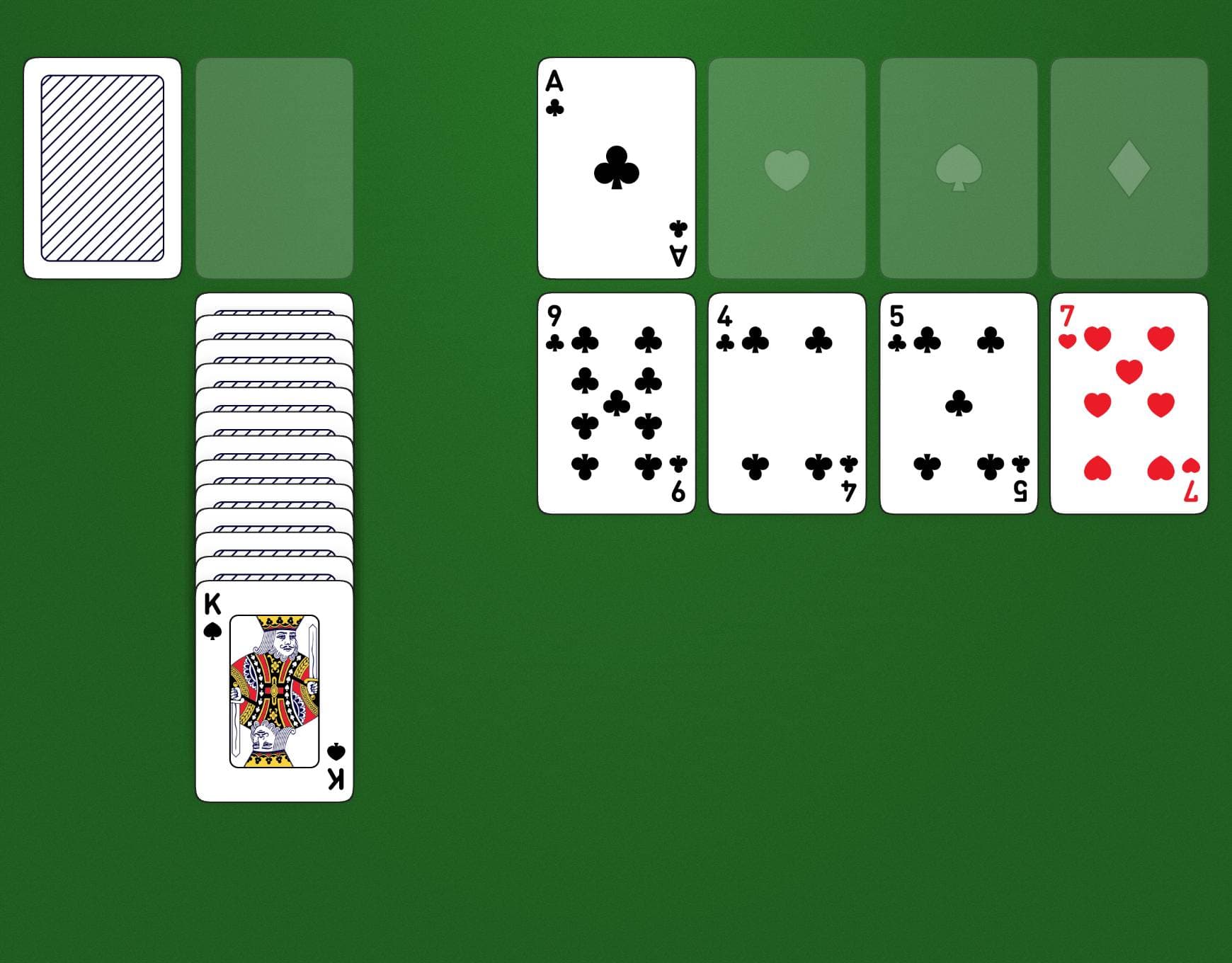
Canfield Rush Solitaire is a Canfield Solitaire variant that speeds up the stock: three cards a pass the first time through, two at a time on the second pass, one at a time on the third. That makes it a bit easier than standard Canfield, though it's still a hard game. It's played with a single deck, with about a 20% chance of winning, and skill matters more than luck.
Gold Rush Solitaire and Thieves Rush Solitaire use the same fewer-cards-each-pass trick on the stock.
Canfield Rush moves quickly, but if you want the fuller challenge, the standard Canfield game is still there too.
If you run into anything odd or have an idea that would make the game better, please contact me.
Have a good time playing!
How to play Canfield Rush Solitaire
Layout:
4 foundation piles: Build up in suit from whatever rank the first pile happens to start on, wrapping from King back to that rank, until each pile holds 13 cards.
4 tableau piles: Build down by alternating color. Alternating-color runs can be moved together as a group. Any card can fill an empty pile. Each pile starts with one card.
Stock: Deals three cards at a time on the first pass, two at a time on the second pass, and one at a time on the third. You get three passes total.
Waste: Top card is always available for play on the tableau or foundations.
Reserve: The top card is always available for the tableau or foundations. It starts with 13 cards, only the top one face up.
Foundation:
There are four foundation piles.
The first foundation pile is dealt a random starting card, and every other foundation pile must also start on that same rank.
A card can be added to a foundation pile only if it's one rank higher and the same suit as the pile's current top card, wrapping from King back to that starting rank, so the only card that fits on a 3 of diamonds is a 4 of diamonds.
The top card of each foundation can be moved back into play if another pile will accept it.
Reserve:
The reserve starts with thirteen cards: the top card face-up, the rest face-down beneath it. Nothing can be moved back into the reserve once play begins. Its top card can be played to the tableau or the foundation.
Tableau:
Four tableau piles of one card each, all dealt face-up.
A card can be added to a tableau pile only if it's one rank lower and the opposite color of the pile's current top card, so the only cards that fit on the 8 of hearts are the 7 of spades and 7 of clubs.
Cards on the tableau that are not covered by another card are free to be played onto the foundation or any other tableau pile.
Any card can fill an empty tableau spot, though in practice you'll usually drop in the reserve's top card since it's always available.
Alternating-color runs of cards in order from high to low can be moved together from one tableau column to another.
Stock and waste:
There's one waste pile, and the remaining cards make up the stock.
Clicking the stock deals three cards to the waste on the first pass, two at a time on the second pass, and one at a time on the third and final pass. If too few cards remain to fill a full deal, you just get whatever's left. Between passes, the waste pile turns back into a fresh stock.
The top waste card can be played to the tableau or foundation.


