Play Tabbycat Solitaire Online for Free (No Signup Required)
Sort the deck into four wrap-around runs of thirteen, stash overflow in your one spare Tail pile, and chase 60% odds in this feline spin on Manx.
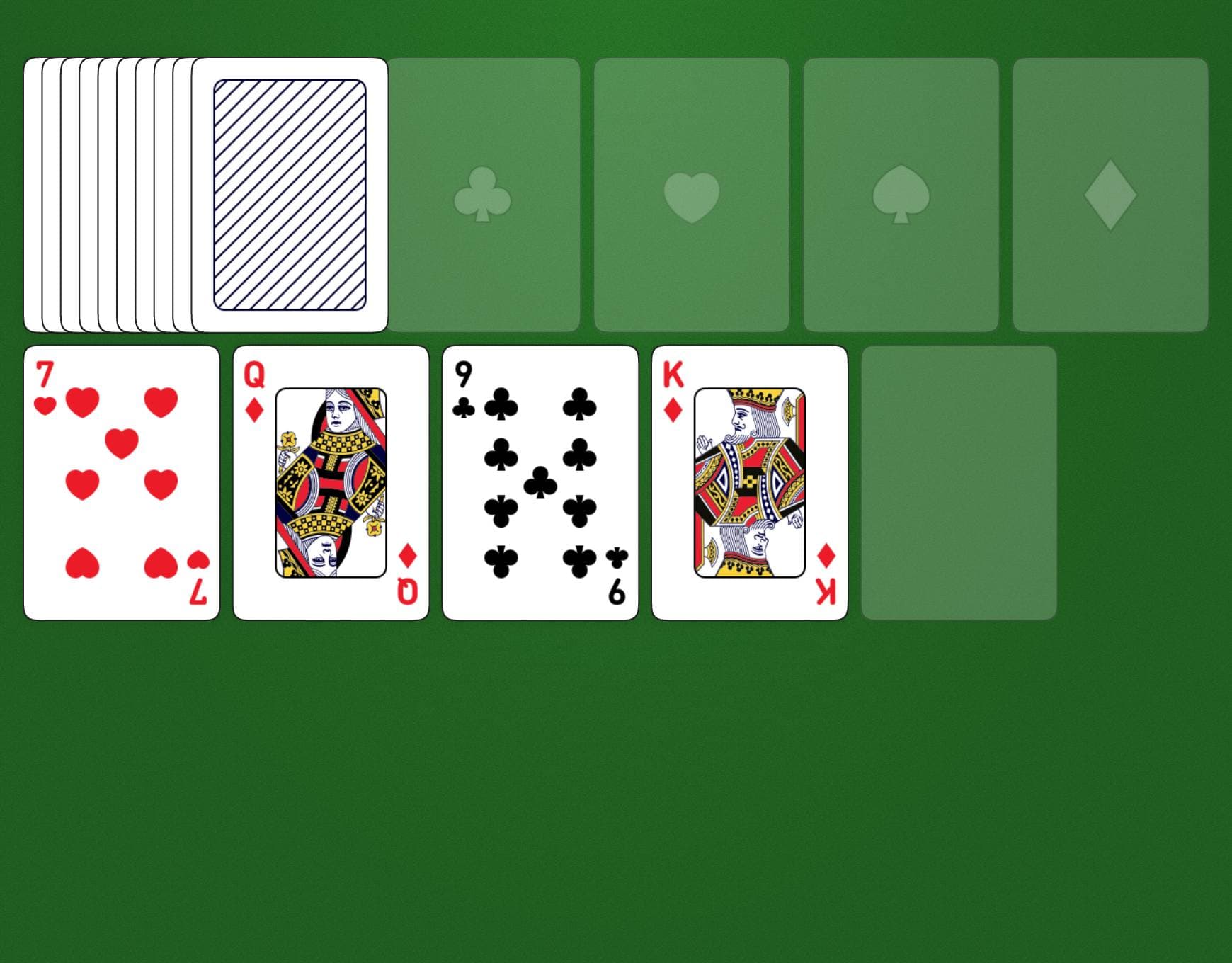
Tabbycat Solitaire was created by Rick Holzgrafe of Solitaire Til Dawn as a companion to his game Manx. Both games are named after cats, and the joke lives in the layout: the Manx is a famously tailless breed, so Manx makes do with a single one-card cell, while Tabbycat grows a proper Tail — an extra pile beside the four columns that can hold a whole run of cards.
The goal is to sort the entire deck into four complete sequences of thirteen cards, built down regardless of suit. Building wraps around the corner, so kings may be played on aces, and a finished sequence does not have to start with a king — any thirteen cards in unbroken descending order will do. Every click on the stock deals a fresh card onto each column and buries your work, so the Tail and a little foresight are what keep the game under control.
Play enough rounds and you'll win about 60% of them, a medium-difficulty result for a single deck where skill, not luck, decides the outcome.
If the wrap-around building appealed to you, give Manx Solitaire and Tarantula Solitaire a try next.
Tabbycat keeps every card in play at once; when you want something slower and quieter, original Solitaire is right there.
If you run into anything odd or have an idea that would make the game better, please contact me.
Enjoy playing!
How to play Tabbycat Solitaire
Layout:
4 foundation piles: Each accepts only a complete sequence of thirteen cards in unbroken descending order, regardless of suit.
4 tableau piles: Build down regardless of suit, wrapping from ace to king. Each pile is dealt one card at the start of the game. Descending runs may be moved as a group. Any card can fill a space.
Tail: A single pile that starts empty. Park any card or movable run here, but only while the Tail is empty.
Stock: Click to deal one card onto each tableau pile. There are no redeals.
Foundation:
There are four foundation piles.
Single cards are never allowed to be moved to the foundation. Only once you've built a complete sequence of thirteen cards on the tableau, in unbroken descending order and regardless of suit, can you transfer it to a foundation. Because building wraps around the corner, the sequence need not run from king to ace — a run from the 7 around to the 8 counts just the same.
The top card of each foundation can be moved back into play if another pile will accept it.
Tableau:
Four tableau piles, each dealt one card in a row. Every card is dealt face-up.
A card can be added to a tableau pile only if it's one rank lower than the pile's current top card, whatever its suit, so any 7 fits on any 8. In the tableau, you may also play kings on aces.
Regardless of their suits, groups of cards in descending sequence may be moved from one pile to another. Any card or movable group can fill an empty space.
Tail:
There is one Tail pile, and it begins the game empty.
Any single card or movable run may be parked on the Tail, but only while it is empty — nothing may ever be built on cards already lying there. Cards on the Tail may be moved back to the tableau at any time, singly or in groups, and once the Tail has been emptied it may be used again.
Stock:
The remaining forty-eight cards make up the stock.
When you click on the stock, one card is dealt to the top of each tableau pile — never to the Tail. There is only one pass through the stock, and there is no waste pile.


