Play Stonewall Solitaire Online for Free (No Signup Required)
Half this six-row wall deals face down, your sixteen reserve cards are a one-shot resource, and only about 10% of games end in a win.
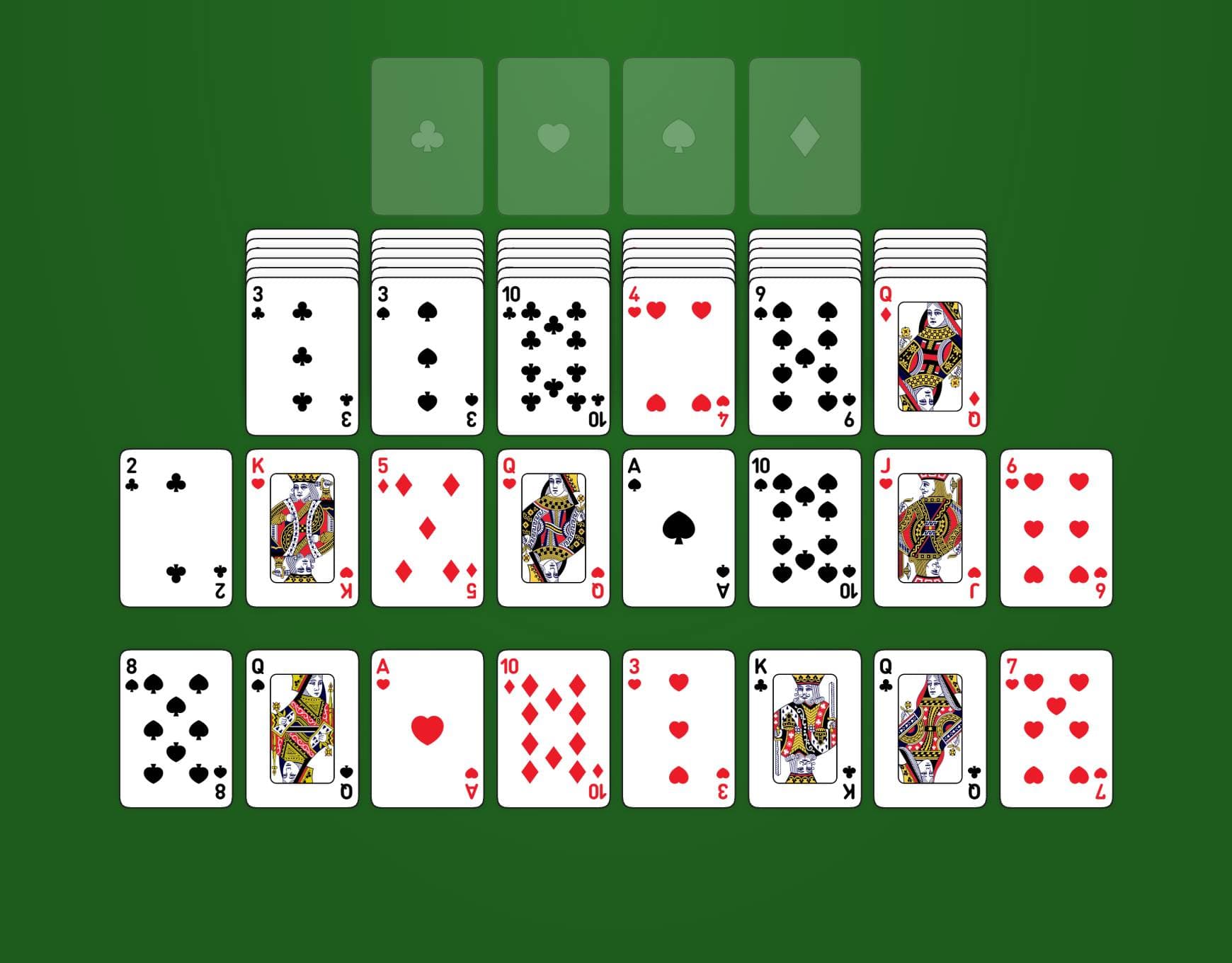
Stonewall Solitaire is an old patience that has been turning up in card game collections for well over a century. It takes its name from the deal: six rows of six cards with every other row dealt face down, so the finished tableau looks like a wall of bricks with half of them mortared out of sight.
The sixteen cards left over are spread face-up beneath the wall as a reserve, and every one of them may be played at any moment — the same open hand that gives Flower Garden its bouquet. The reserve is never replenished, so each of those cards is a one-shot resource, best spent prying loose the face-down bricks that matter most.
Working half the wall blind takes patience, and it shows in the numbers: this one is difficult, with a win rate of roughly 10%, so spend that one-shot reserve wisely. It is played with a single deck, and because half of the wall begins face down, your odds of victory depend heavily on the luck of the deal.
For that same open-reserve feeling elsewhere, go on to Flower Garden Solitaire or Wildflower Solitaire next.
If the face-down wall wears you down, original Solitaire trades it for a deal where nothing hides from you twice.
If you run into anything odd or have an idea that would make the game better, please contact me.
Enjoy playing!
How to play Stonewall Solitaire
Layout:
4 foundation piles: Build up in suit from Ace to King.
6 tableau piles: Build down in alternating colors. Six cards are dealt to each pile, with the first, third, and fifth cards face down. Any card may fill an empty space.
Reserve: 16 cards spread face-up in two rows below the tableau. Every reserve card is available for play at any time.
There is no stock and no waste; the whole deck is on the table from the very first move.
Foundation:
There are four foundation piles, and they begin the game empty.
Each foundation starts with an Ace. A card can be added to a foundation pile only if it's one rank higher and the same suit as the pile's current top card, so the only card that fits on an 8 of spades is the 9 of spades. There can be no more than 13 cards in a pile.
The top card of each foundation can be moved back into play if another pile will accept it.
Reserve:
There are sixteen reserve cards, dealt face-up in two rows. Unlike most reserves, every card is available at all times — not just the one on top.
A reserve card may be played to the foundations, built onto a tableau pile, or moved into an empty tableau spot. No card may ever be moved into the reserve, and an emptied slot stays empty for the rest of the game.
Tableau:
Six tableau piles of six cards each make up the tableau. The first, third, and fifth card of every pile is dealt face down; a hidden card is turned over as soon as the cards covering it are cleared away.
A card can be added to a tableau pile only if it's one rank lower and the opposite color of the pile's current top card, so the only cards that fit on an 8 of spades are the 7 of hearts and 7 of diamonds.
Cards on the tableau that are not covered by another card are free to be played onto the foundation or any other tableau pile, and a face-up run in descending alternating colors may be moved as a group.
Any card or run — whether from the tableau or the reserve — may fill an empty tableau spot.


