Play Signora Solitaire Online for Free (No Signup Required)
Weave red and black together instead of matching suits, chase eight wrapping foundations across two full decks, and make your single pass through the stock count.
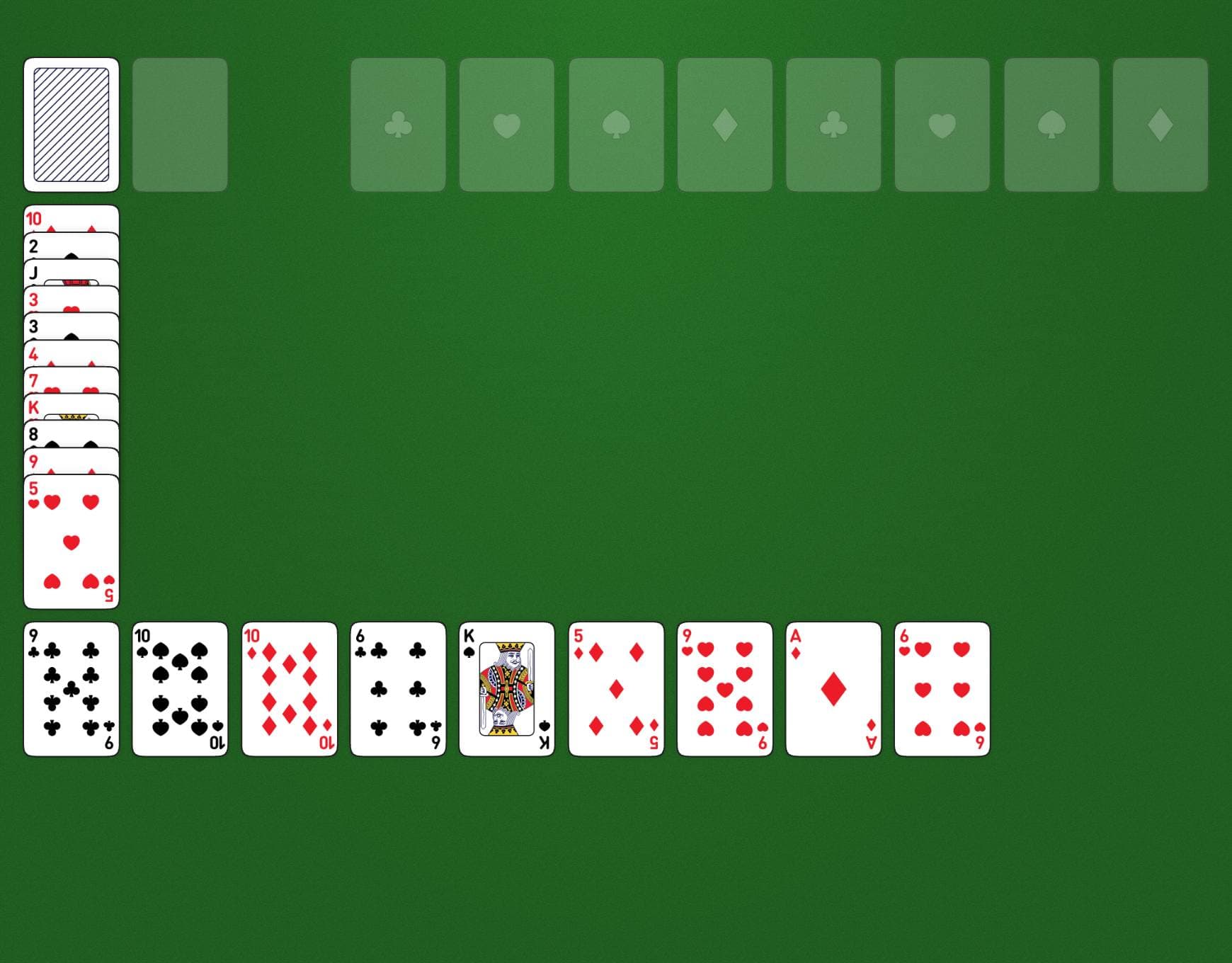
Signora Solitaire is a two-deck game from the Colonel family, and it plays as the alternating-color cousin of that older variant. Where Colonel builds everything by suit, Signora asks you to weave red and black together, which changes the whole feel of a deal. It shuffles two full decks into eight foundations, a generous eleven-card reserve, and nine slim tableau columns.
The starting foundation rank is chosen at random, and the piles wrap from King back to Ace as they climb, so you are never simply racing from Ace to King. Every one of the eight foundations begins on that same base rank, and matching it across the whole layout is the first puzzle each deal hands you. Because the reserve fans out eleven cards you can see from the start, a little forward planning goes a long way.
You get a single pass through the stock, one card at a time to the waste, so a card you miss stays buried for the rest of the deal. To soften that, an emptied tableau column refills itself automatically, first from the waste and then from the stock, keeping the board flowing while you concentrate on the alternating-color runs.
If you enjoy Signora, try Colonel Solitaire, its same-suit sibling, or Roman Solitaire, which keeps the same layout but builds regardless of suit instead of by color.
If you run into anything odd or have an idea that would make the game better, please contact me.
Have fun!
How to play Signora Solitaire
Layout:
8 foundation piles: Build up in alternating colors from a random base rank, wrapping from King to Ace as needed. Cards are dealt from two full decks.
11-card reserve: Eleven cards are dealt face-up here at the start. Only the top card is in play, and it may go to the tableau or a foundation.
9 tableau piles: Build down in alternating colors. Each column starts with a single face-up card.
Stock and waste: Flip cards one at a time to the waste. There is only one pass through the stock.
Foundation:
There are eight foundation piles, filled from two decks.
One foundation is seeded with a starting card at random, and every pile begins on that same rank. A card can be added to a foundation pile only if it's one rank higher and the opposite color of the pile's current top card, wrapping from King around to Ace, so the only card that fits on a black 8 is a red 9.
The top card of each foundation can be moved back into play if another pile will accept it.
Reserve:
There is one reserve, which is dealt eleven cards face-up at the start of the game. No cards may be moved into the reserve. The top card of the reserve can be played to any tableau pile or a foundation.
Tableau:
Nine tableau piles, dealt in a downward cascade, each starting with a single face-up card.
A card can be added to a tableau pile only if it's one rank lower and the opposite color of the pile's current top card, so the only card that fits on a black 8 is a red 7. Only one card may be moved at a time; sequences are not permitted.
When a tableau column is emptied, it is refilled automatically from the top of the waste, or from the stock when the waste is empty.
Stock and waste:
There is one waste pile and the remaining cards make up the stock.
When you click on the stock, one card is dealt to the waste. You get only one pass through the stock. The top card of the waste can be played to the tableau or a foundation.


