Play Colonel Solitaire Online for Free (No Signup Required)
The first card you play sets the rank for all eight foundations, then you build down ten wrapping columns and race to clear an eleven-card reserve.
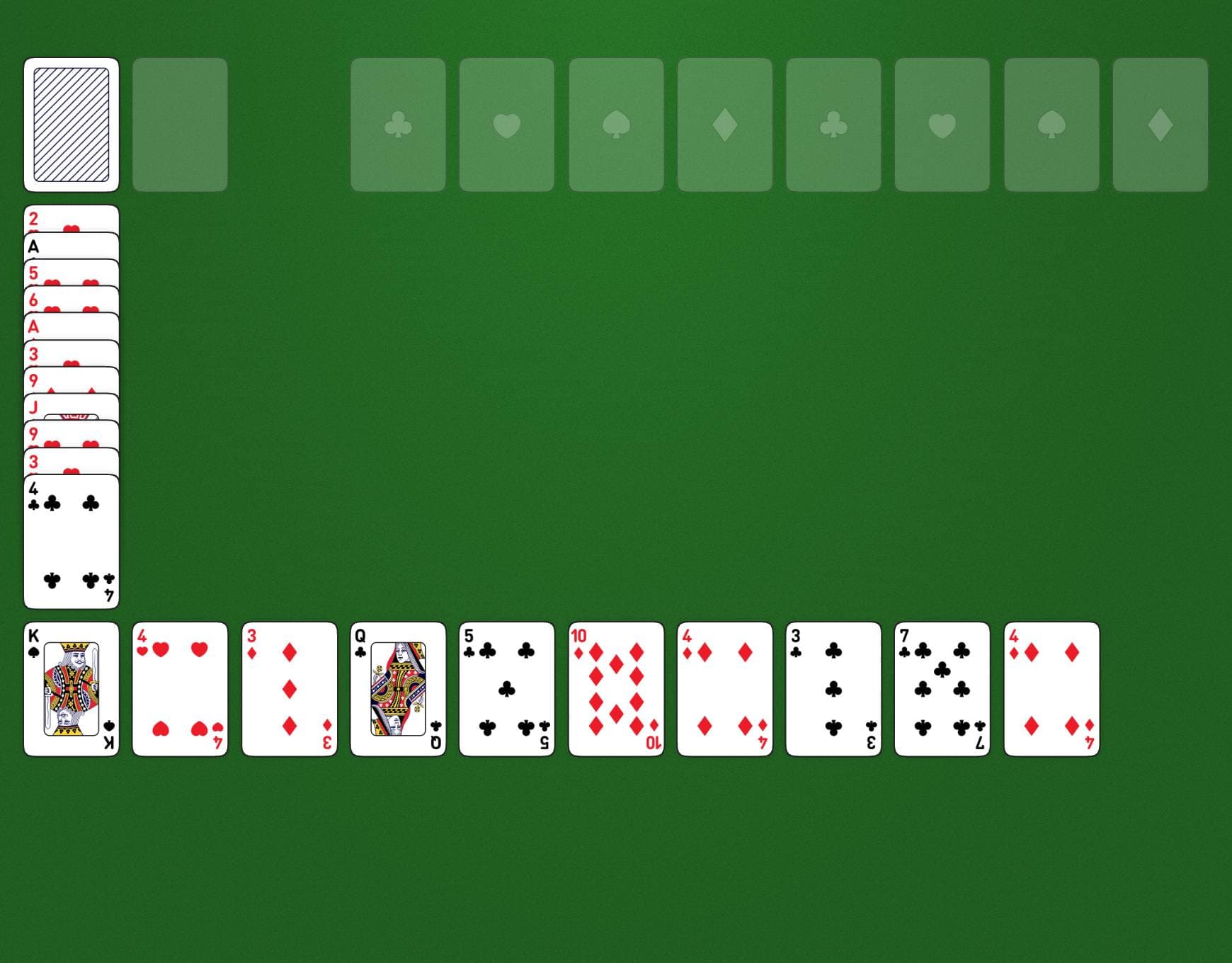
Colonel Solitaire is a two-deck relative of Forty Thieves that hands you an unusual amount of control from the first move. No foundation cards are dealt at the start: whatever card you send up first sets the base rank for all eight foundations, which then build up in suit and wrap from King back to Ace until each holds thirteen cards.
Ten one-card columns build down in suit — the ranking wraps here too, so a King may even be played on an Ace — and same-suit sequences move as a group. An eleven-card reserve sits in the middle of the table, and its cards may only ever march off to the foundations, never to the tableau. Empty columns do not stay empty either: the top card of the waste claims the space instantly, with the stock stepping in when the waste runs dry.
That single redeal is exactly why I rate the game difficult: two decks give you plenty to juggle, and getting through them cleanly takes skill as much as luck.
Forty Thieves Solitaire takes the same two-deck foundation-building idea one direction, and Signora Solitaire takes it another.
You already know original Solitaire; once Colonel's eight foundations wear you out, it's still there waiting.
If you run into anything odd or have an idea that would make the game better, please contact me.
Enjoy playing!
How to play Colonel Solitaire
Layout:
8 foundation piles: Build up in the same suit from a base rank of your choosing, wrapping from King to Ace, until each pile has 13 cards. The first card you play to a foundation sets the base rank for all eight piles.
10 tableau piles: Build down in the same suit, with the ranking wrapping from Ace round to King. Same-suit sequences may be moved as a group. Spaces are automatically filled from the waste, or from the stock if the waste is empty. At the start of the game, each pile is dealt one card.
Reserve: 11 cards are dealt here at the start of the game, all face up. The top card may only be played to the foundations.
Stock: Click to flip over 1 card at a time to the waste. There is one redeal.
Waste: Top card is available for play.
Foundation:
There are eight foundation piles. No cards are dealt to them at the start of the game: the first card played to a foundation sets the base rank, and every other pile must be started with a card of that same rank.
A card can then be added to a foundation pile only if it's one rank higher and the same suit as the pile's current top card, wrapping from King to Ace. If the base rank is 9, each pile runs 9, 10, J, Q, K, A, 2 and so on up to the 8. There can be no more than 13 cards in a pile.
The top card of a foundation may be moved back to the tableau if you need it.
Reserve:
There is one reserve, which initially contains eleven cards, all dealt face-up. No cards may be moved into the reserve. The top card of the reserve may only be played to the foundations — never to the tableau.
Tableau:
Ten tableau piles of one card each. Every card is dealt face-up.
A card can be added to a tableau pile only if it's one rank lower and the same suit as the pile's current top card. The ranking is continuous: on an Ace of hearts, the King of hearts may be played.
Cards on the tableau that are not covered by another card are free to be played onto the foundation or any other tableau pile. Cards in a descending same-suit sequence may be moved together as a group.
Empty tableau spots are instantly filled with the top card of the waste. If the waste is empty, a card from the stock is used instead.
Stock and waste:
There is one waste pile, and the remaining 83 cards make up the stock.
When you click on the stock, one card from the stock is dealt to the waste. When the stock runs out, the waste is turned over to form a new stock once — two passes in total.
The top card of the waste can be played to the tableau or foundation.


