Play Roman Solitaire Online for Free (No Signup Required)
Roman frees Signora's tableau from suit rules, so you can build down regardless of suit and string longer runs across two decks.
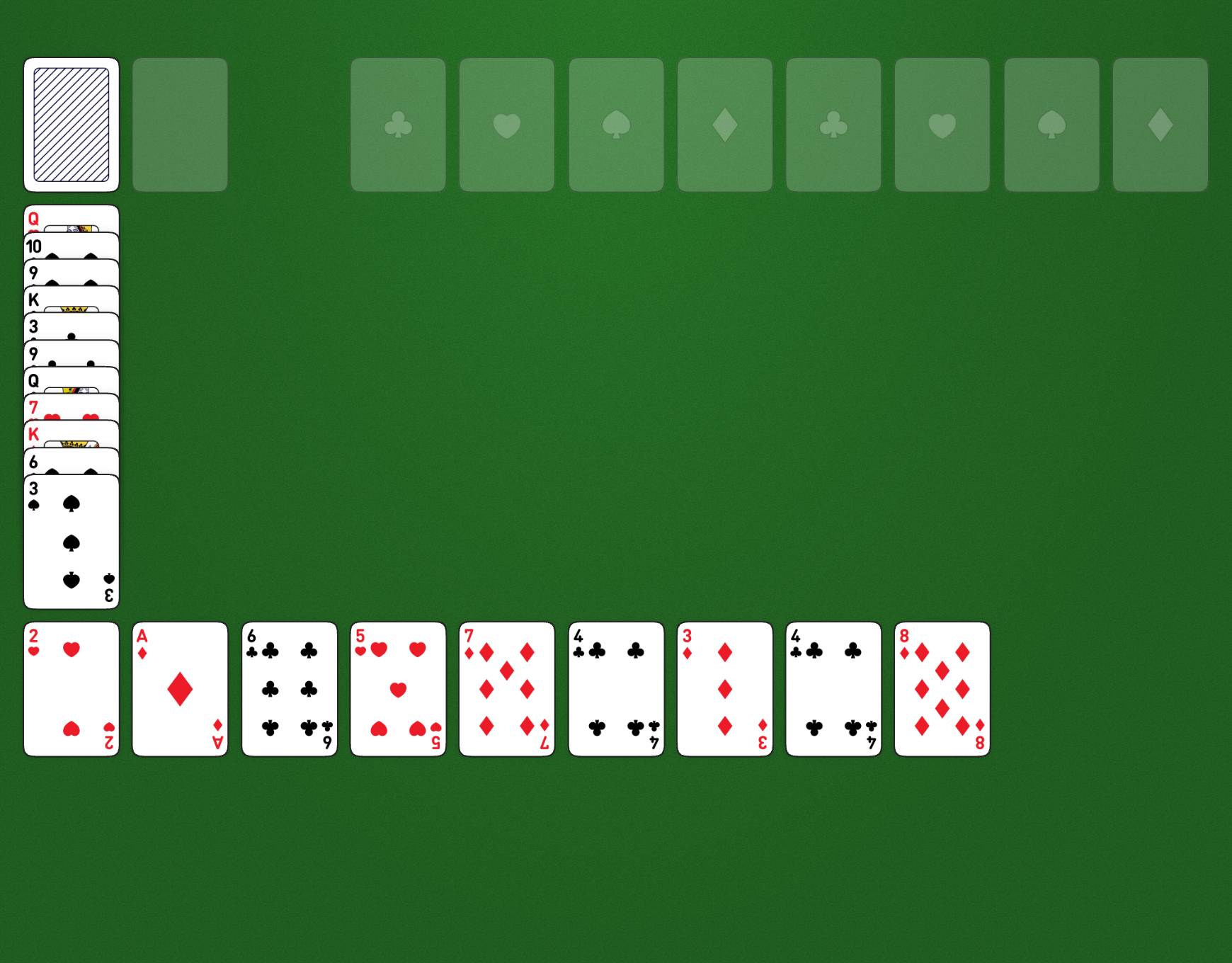
Roman Solitaire is Thomas Warfield's take on Signora, and the two games share almost the same shape: two decks, eight foundations, a nine-column tableau, a deep reserve, and a single pass through the stock. What makes Roman its own game is one rule. Where Signora builds the tableau down in alternating colors, Roman builds down regardless of suit, so any card that is one lower will land on the pile in front of it.
That small change loosens the game considerably. With suit no longer a constraint on the tableau, you can string longer descending runs together and shuffle cards between columns much more freely. The eight foundations still ask for careful play: no cards are dealt to them at the start, so whatever card you send up first sets the base rank for all eight, and each pile then builds up in suit, wrapping from King back to Ace, until it holds a full circuit of thirteen cards.
The eleven-card reserve is a one-time deal: its top card can only go to a foundation, never to the tableau, so it drains as the game goes on rather than refilling. Signora, Colonel, and Double Signora sit right alongside Roman in the same little family, and playing them back to back is the clearest way to feel how one build rule reshapes a game.
If you enjoy Roman, try Signora Solitaire, the game it is based on, along with Colonel Solitaire and Double Signora Solitaire.
If you run into anything odd or have an idea that would make the game better, please contact me.
Enjoy playing!
How to play Roman Solitaire
Layout:
8 foundation piles: No cards are dealt at the start; the first card you play to any foundation sets the base rank for all eight. Build up in suit, wrapping from King to Ace as needed, until each pile holds thirteen cards.
9 tableau piles: Each pile is dealt one face-up card. Build down regardless of suit. Only the top card of a pile may be moved.
Reserve: Eleven cards are dealt here face-up. The top card is available for play, but only to a foundation, never to the tableau.
Stock: Click to deal one card at a time to the waste. There is only one pass through the stock.
Waste: The top card of the waste is playable.
Foundation:
There are eight foundation piles. No cards are dealt to them at the start of the game: the first card played to a foundation sets the base rank, and every other pile must be started with a card of that same rank.
A card can be added to a foundation only if it's one rank higher than the pile's current top card and of the same suit, wrapping from King back to Ace when needed. Each pile is complete at thirteen cards.
The top card of each foundation can be moved back into play if another pile will accept it.
Tableau:
Nine tableau piles of one card each, dealt face-up.
A card can be added to a tableau pile only if it's one rank lower than the pile's current top card, regardless of suit, so a 7 of any suit fits on any 8. Only the top card of a pile may be moved, whether to a foundation or another tableau pile.
When a tableau pile is emptied, it is refilled automatically from the top of the waste, or from the stock when the waste is empty.
Only one card may be moved at a time; sequences are not permitted.
Stock and waste:
The remaining cards form the stock, and turned cards go to the waste.
When you click the stock, one card is dealt to the waste. There is only one pass through the stock.
The top card of the waste can be played to the tableau or foundation.


