Play Selective FreeCell Solitaire Online for Free (No Signup Required)
Same FreeCell you know, except foundations start empty and the first card you drop sets that suit's starting rank all the way around. Choose wisely, or bury your own cards.
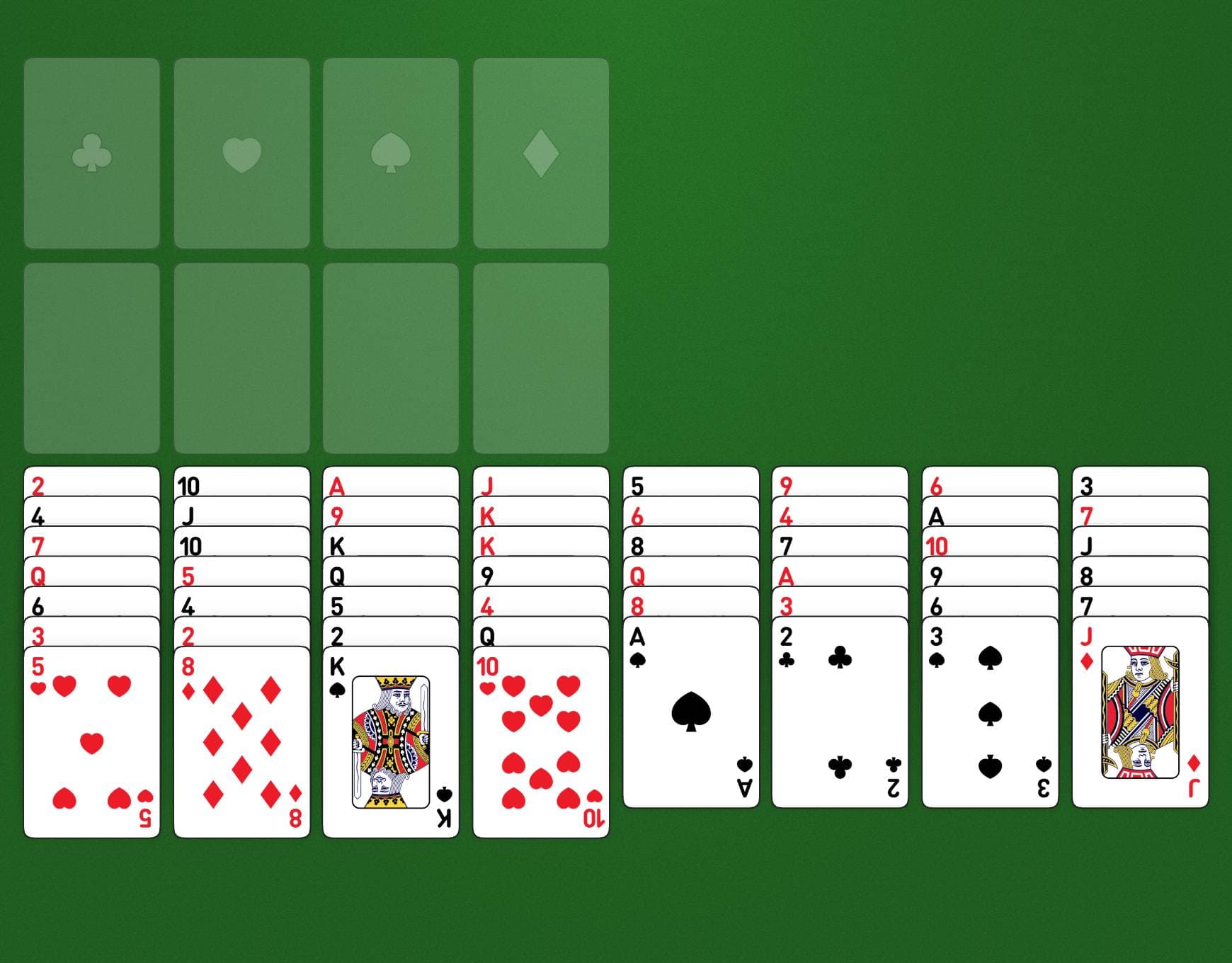
Selective FreeCell Solitaire keeps almost everything you know from FreeCell and changes a single rule that quietly reshapes the whole game. In ordinary FreeCell the foundations always start at the Ace, so you know from the first move exactly which cards will anchor each pile. Here the foundations start empty and open: the very first card you drop onto a foundation sets that pile's base rank, and every foundation then builds up in suit from there, wrapping from King around to Ace.
That freedom sounds generous, but it is a double-edged sword. Choosing to launch a foundation on, say, a 6 commits you to a full loop of thirteen ranks in that suit, and a poorly chosen base can leave awkward cards buried in the columns for far too long. Strong players read the whole board before deciding where each suit should begin.
Everything else is pure FreeCell. All fifty-two cards are dealt face-up, four free cells give you room to maneuver, and a smart player can win the great majority of deals with careful planning rather than luck.
If you enjoy Selective FreeCell, try FreeCell, the classic that started it all, or Big FreeCell Solitaire, a larger two-deck challenge.
If you run into anything odd or have an idea that would make the game better, please contact me.
Have fun!
How to play Selective FreeCell Solitaire
Layout:
4 foundation piles: Build up in suit, wrapping from King to Ace. The first card played to a pile sets its base rank.
4 free cells: Each cell holds a single card of any kind. Use them as temporary parking spots to unblock the columns.
8 tableau piles: Four piles of seven cards and four piles of six cards, all dealt face-up.
Foundation:
There are four foundation piles, and they begin empty with no fixed starting rank.
The first card placed on a foundation defines that pile's base rank. After that, a card can be added only if it is the same suit and one rank higher than the current top card, wrapping from King back to Ace as needed, until the pile holds all thirteen of its suit.
The top card of each foundation can be moved back into play if another pile will accept it.
Free cells:
There are four free cells, each empty at the start.
Any single card may be moved into an empty cell, and the card in a cell may later be played back to the tableau or a foundation. The number of free cells and empty columns you have determines how large a group of cards you can shift in one move.
Tableau:
Eight tableau piles hold the whole deck, every card face-up from the start.
A card can be added to a tableau pile only if it's one rank lower and the opposite color of the pile's current top card, so the only card that fits on a red 8 is a black 7. You may move a run of properly ordered cards together as long as enough free cells and empty columns are available to cover the move.
Any card may be placed into an empty tableau column.


