Play FreeCell Solitaire Online for Free (No Signup Required)
Take a break with this free FreeCell Solitaire. It is by far the easiest of all the Solitaire games. Or is it?
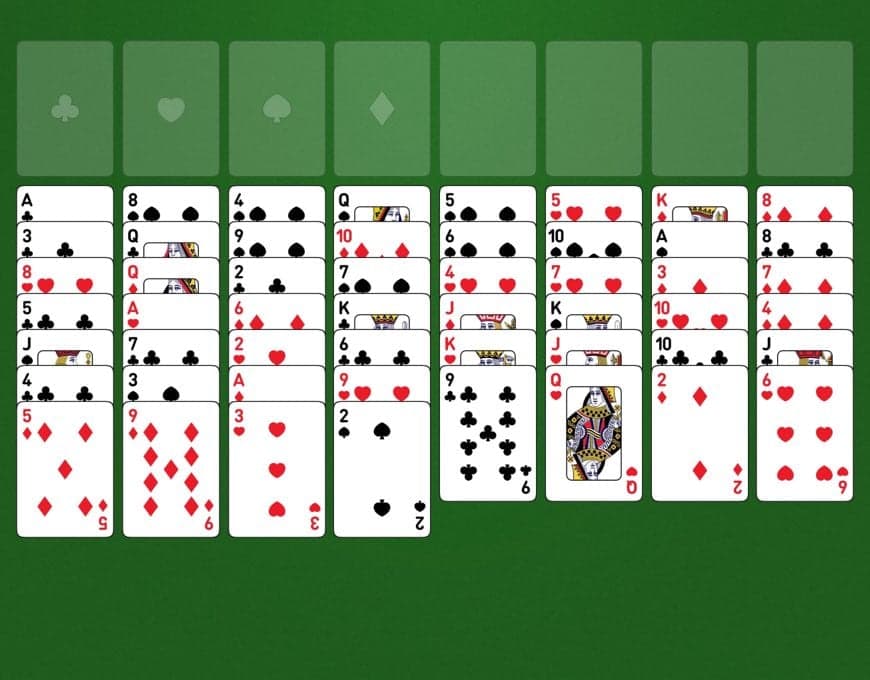
What makes FreeCell so special is that almost every deal is solvable. When you, from time to time, stumble upon that rare game that gives you trouble, you will wonder: Is this the unsolvable one?
It's been calculated that 99.999% of games are winnable, so not surprisingly, FreeCell is one of the more popular one-deck solitaire games. One in five players prefers playing this game, and more than half of the games played (54%) are won. But remember - 46% are lost. It's a strategy-based game, and luck has much less to do with it than it does in, for instance, Classic Solitaire and Spider Solitaire.
Have fun, and stay sharp!
Holger
4.8
5581 ratings

I can play FreeCell over and over - it never gets old. Always new variations and challenges.
Timothy Walsh
Sometimes I get really annoyed with this game. It starts out looking so easy, but all of a sudden, I find myself in a pickle. My brain gets no rest. I love it.
Emily Sanders
How to play FreeCell
FreeCell is a fairly easy game, though you have to be tactical to win it. Here, you'll find a brush-up for those of you who are already familiar with the rules. If you need more thorough instructions, take a look at our guide on how to play FreeCell Solitaire.

The goal is, as usual, to move all the cards onto the foundation piles, where they are ordered by suit and rank. The first card being the ace, then the two, and so on and so forth. The way you get them up there is to free them one by one from the tableau. You do that by putting the cards in running order on the tableau, alternating black and red cards. When a card is freed that is the next in the running order on the foundation, it can be moved there - either manually or automatically (you choose that in settings).
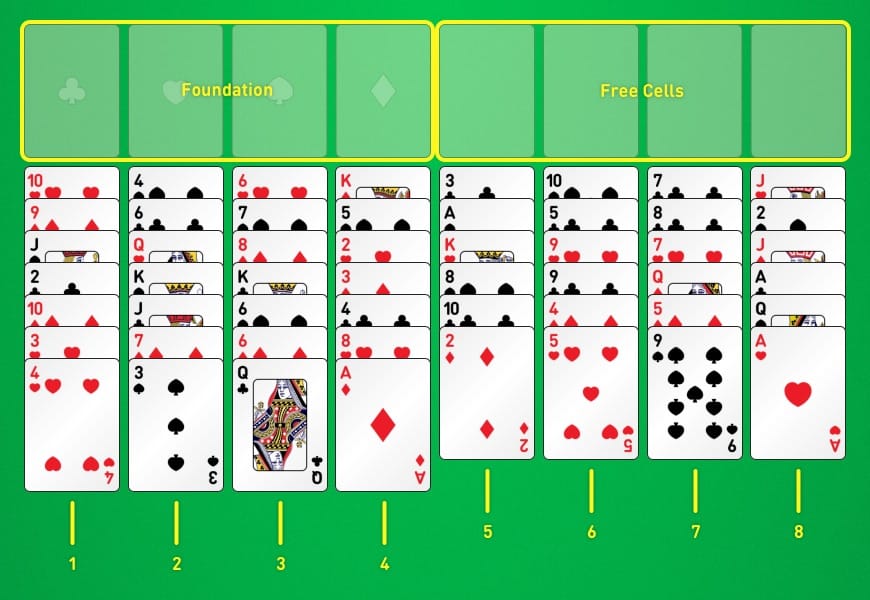
The free cells that the game takes its name from are the places at the top right, where you can "park" cards temporarily. You do that to free the card underneath so you can make your move.
You can move one or several cards from one tableau to another, if the first card you're moving is one rank lower than the card you're moving it onto, and the color is opposite. The more free cells and empty columns you have, the more cards you can move in one go.
When all the cards are neatly piled on the foundation - you won. Congratulations!
I love to start my day off with the daily challenge that Online Solitaire prepares for me and keep track of my progress in the daily challenge calendar. It makes me feel ship-shaped and sharp.
Bettany Bristol
Even on an off day, I get great pleasure from the games here. There's a hint at hand for the next move, and I can always choose a winnable deal to be sure that success is possible.
Tod Sorensen
FreeCell Strategy
Every card is dealt face-up from the start, so your habits decide the game. These are the checks worth running before every move.
Free your aces and low cards first
It's the buried aces and twos that stall a game. Scan all eight columns for them and plan how to dig them out first. Say the A♠ sits under the 9♥, 4♣ and J♦ - clearing those three cards does you more good than tidying up a neat sequence somewhere else.
Keep a free cell empty whenever you can
The four free cells are the tightest resource you've got. Each one holds a single card, and the more you fill up, the less room you have to move. So treat them as short-term parking, not storage. The moment a red 7 turns up, unload that 6♣ you parked earlier so the cell is free again.
An empty column beats a free cell
An empty column can take any card, hold a whole ordered run in one drop, and you can build on it afterwards. So when you can clear a short column, you usually should. Park the Q♠ on an empty column and you can build the J♥ and 10♣ on top of it, where a free cell would just hold the Q♠ and nothing more.
Learn the "supermove" math
The site lets you drag several cards at once, but that's really just shorthand for shuffling them through your free cells and empty columns. The limit is simple - empty free cells plus empty columns, plus one. With all four cells free and no empty column you can drag five cards, and every extra cell or column you clear adds one more. So if a stack won't budge, free up a cell or a column first.
Plan the whole sequence before you move a card
Trace the whole chain first - which card parks where, where it lands, and what that frees next. Before you park the 8♦, check there's a black 9 waiting for it, or you'll strand it with nowhere to go.
Keep builders out of the foundations
Sending cards up feels like progress, but once the 6♥ goes up, bringing it back down for the 5♠ you parked in a cell costs an extra move you'll rarely want to spend, so a mid-rank card often earns its keep down on the tableau. Try to keep the foundations roughly even, and hold a card back whenever something in play still needs a place to land.
Build long alternating-color runs
Descending runs of alternating colors move as a single unit and keep your options open. Collect the 5♥-4♠-3♦ onto a black 6 instead of leaving them spread across three columns, and you free up space as you go.
How hard is FreeCell?
Friendlier than it looks, and mostly down to skill. Here's how it goes on this site:
- Players win 54% of the time across 113 million games here
- Almost every deal can be solved with the right moves
- Skill decides these games far more than the shuffle does
- Lose one and there was usually a better line to spot
Frequently Asked Questions (FAQ)
If your questions aren't answered by our FAQ below, feel free to reach out at contact@online-solitaire.com, and we'll do our best to help you.
Do you have a downloadable version?
We sure do! You can download this classic card game for free on Windows™, Mac™, Linux™, or Android. There is no iOS app right now, but you can play the web version on iPhone and iPad. We even have a version for Amazon Kindle and for Google Chrome as well.
Are all games winnable?
It's almost true that all games are winnable. In fact, 99.999% of games are winnable. In the classic Microsoft version that had 32,000 games, only one game, the infamous game #11982, was unwinnable.
How many cards can I move at once?
Officially, FreeCell moves one card at a time. When you drag a stack, the game quietly uses your free cells and empty columns as stepping stones, then puts the pile back together on the other side. The supermove section above has the exact math. So if a drag won't complete, you just don't have the spare cells and columns to carry it.
What's the difference between a free cell and a foundation?
A free cell is a parking spot - you can pull the card back out whenever you like. A foundation is the goal - you can still take the top card back if you truly need it, but in practice it's home for good.
Can I undo moves and get hints?
Yes. Undo works like a takeback in chess - rewind as far as you need and steer down a different branch. Hint suggests a next move when you're stuck.
Is FreeCell a game of luck or skill?
Skill, almost entirely. The shuffle barely matters, and once the moves click you'll win far more than you lose.


