Play Four by Ten Solitaire Online for Free (No Signup Required)
Only four long columns but ten free cells to work with: the whole deck is face-up from the start, and most deals can be solved with patience.
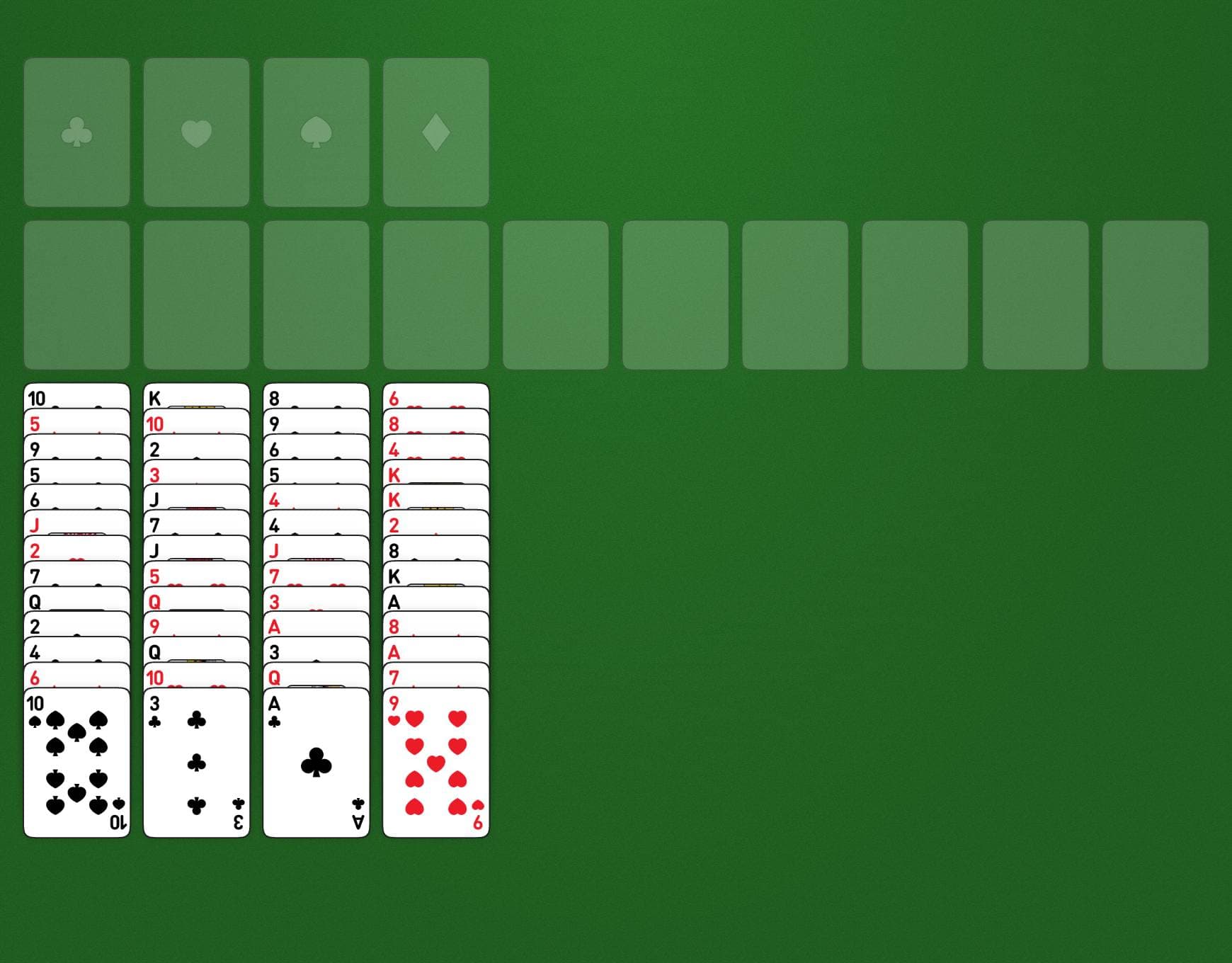
Four by Ten Solitaire flips the usual FreeCell balance on its head: instead of many columns and a handful of cells, it gives you just four long tableau piles and a generous ten free cells. The whole deck is dealt face-up into those four columns of thirteen cards each, with nothing hidden and no stock to draw from — everything you need is already on the table.
With ten cells to park cards in, Four by Ten is one of the gentler members of the FreeCell family, and a very high share of deals can be solved with patience. The catch is the shape of the tableau: only four columns means less room to build long alternating-color sequences, so those cells fill up faster than you might expect. The art is treating them as temporary storage rather than a dumping ground.
Because moves are made a single card at a time, a run you want to relocate has to be shuffled through the cells and empty columns piece by piece. Emptying a whole column early gives you the breathing room to reorganize, so clearing one of the four is usually worth the effort.
If you enjoy Four by Ten, try FreeCell, Eight Off Solitaire, or Big FreeCell Solitaire, three open-tableau games in the same spirit.
If you run into anything odd or have an idea that would make the game better, please contact me.
Enjoy playing!
How to play Four by Ten Solitaire
Layout:
4 foundation piles: Build up by suit from Ace to King. Completed cards are moved to the foundations automatically when a move is available.
4 tableau piles: Each pile is dealt thirteen face-up cards at the start — the entire deck. Build down in alternating colors.
10 free cells: Each cell holds one card. Any card may be moved into an empty cell, and the card there can be played back out at any time.
Foundation:
There are four foundation piles, all empty at the start.
A card can be added to a foundation pile only if it's one rank higher and the same suit as the pile's current top card, so the only card that fits on the 5 of clubs is the 6 of clubs. Each pile runs from Ace up to King.
The top card of each foundation can be moved back into play if another pile will accept it.
Cells:
There are ten free cells. Each holds a single card, and all begin empty.
Any available card may be moved into an empty cell for safekeeping. The card resting in a cell is always available to be played onto the tableau or foundations, which frees the cell for reuse.
Tableau:
Four tableau piles of thirteen cards each, every card dealt face-up from the start.
A card can be added to a tableau pile only if it's one rank lower and the opposite color of the pile's current top card, so the only card that fits on the 8 of spades is the 7 of hearts or the 7 of diamonds.
Cards on the tableau that are not covered by another card can be played onto the foundations, a free cell, or another tableau pile. Any card may be placed on an empty tableau pile.
Only one card may be moved at a time; sequences are moved by relaying single cards through the cells and empty columns.


