Play Baker's Two-Deck Solitaire Online for Free (No Signup Required)
Double the deck, double the cells: 104 cards across ten suit-built columns, moderately tough, and skill wins the large majority of deals.
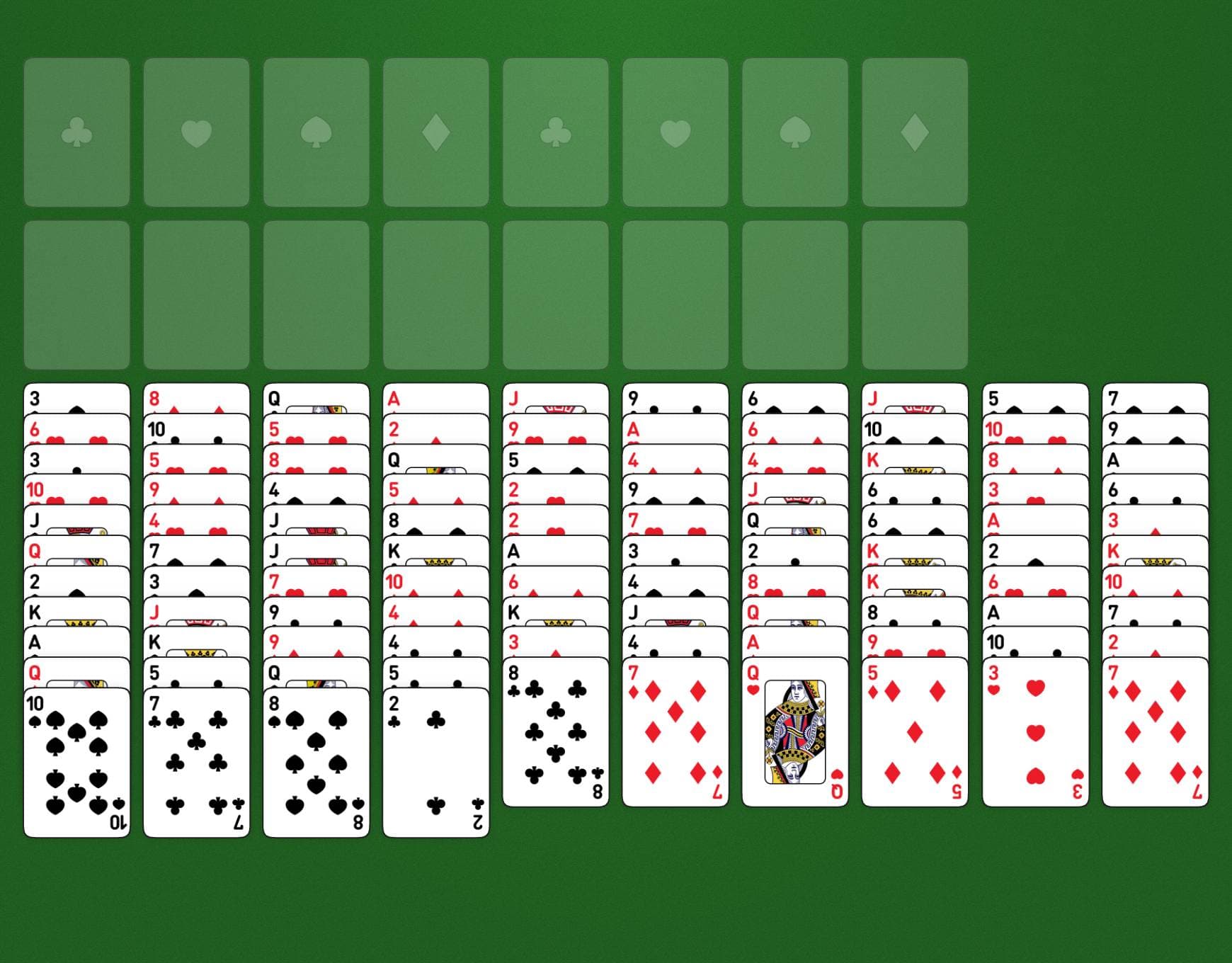
Baker's Two-Deck Solitaire doubles the classic Baker's Game, the same-suit forerunner of FreeCell that mathematician C. L. Baker made famous through Martin Gardner's Scientific American column. Two full packs are shuffled together and dealt entirely face-up, so nothing is hidden — every move is a matter of planning rather than luck.
With 104 cards, eight free cells, and ten tableau columns, the table looks crowded at first, but the extra cells give you far more maneuvering room than the one-deck game. Because the tableau builds down in suit rather than in alternating colors, sequences come together slowly, and one carelessly buried Ace can cost you the whole deal. The game is moderately difficult, and the large majority of deals can be won with careful play. It is played with two decks, and your odds of victory are almost entirely determined by your skill.
This game keeps company with Baker's Solitaire and Double FreeCell Solitaire.
Circle back to the classic Solitaire for the one-deck original.
If you run into anything odd or have an idea that would make the game better, please contact me.
Enjoy playing!
How to play Baker's Two-Deck Solitaire
Layout:
8 foundation piles: Build up from Ace to King in the same suit.
8 free cells: Each cell holds one card of any rank.
10 tableau piles: Build down in the same suit. The whole two-deck pack is dealt here face-up at the start of the game — 11 cards to each of the first four piles and 10 cards to each of the remaining six. Any card may fill an empty pile.
Foundation:
There are eight foundation piles.
Any Ace may be moved to an empty foundation pile.
A card can be added to a foundation pile only if it's one rank higher and the same suit as the pile's current top card, so the only card that fits on a 9 of spades is a 10 of spades. There can be no more than 13 cards in a pile.
The top card of each foundation can be moved back into play if another pile will accept it.
Cells:
Eight originally empty cells.
Each cell holds one card. Any available card can be played into any available cell. Cell cards can be played back to the tableau or the foundation.
Tableau:
Ten tableau piles — the first four hold eleven cards each and the last six hold ten. Every card is dealt face-up.
A card can be added to a tableau pile only if it's one rank lower and the same suit as the pile's current top card, so the only card that fits on a 9 of spades is an 8 of spades.
Cards on the tableau that are not covered by another card can be played onto the foundation, an empty cell, or any other tableau pile.
Any card can fill an empty slot in the tableau.
Technically, only one card may be moved at a time, but because supermoves are allowed, you can move a sequence whenever there are enough free cells or empty columns to achieve the same result with a series of single-card moves.


