Play Three Demons Solitaire Online for Free (No Signup Required)
Three decks fill a 48-card reserve behind nine tableau columns, all feeding twelve foundations that wrap King to Ace. Redeal forever and chase a friendly 90% win rate.
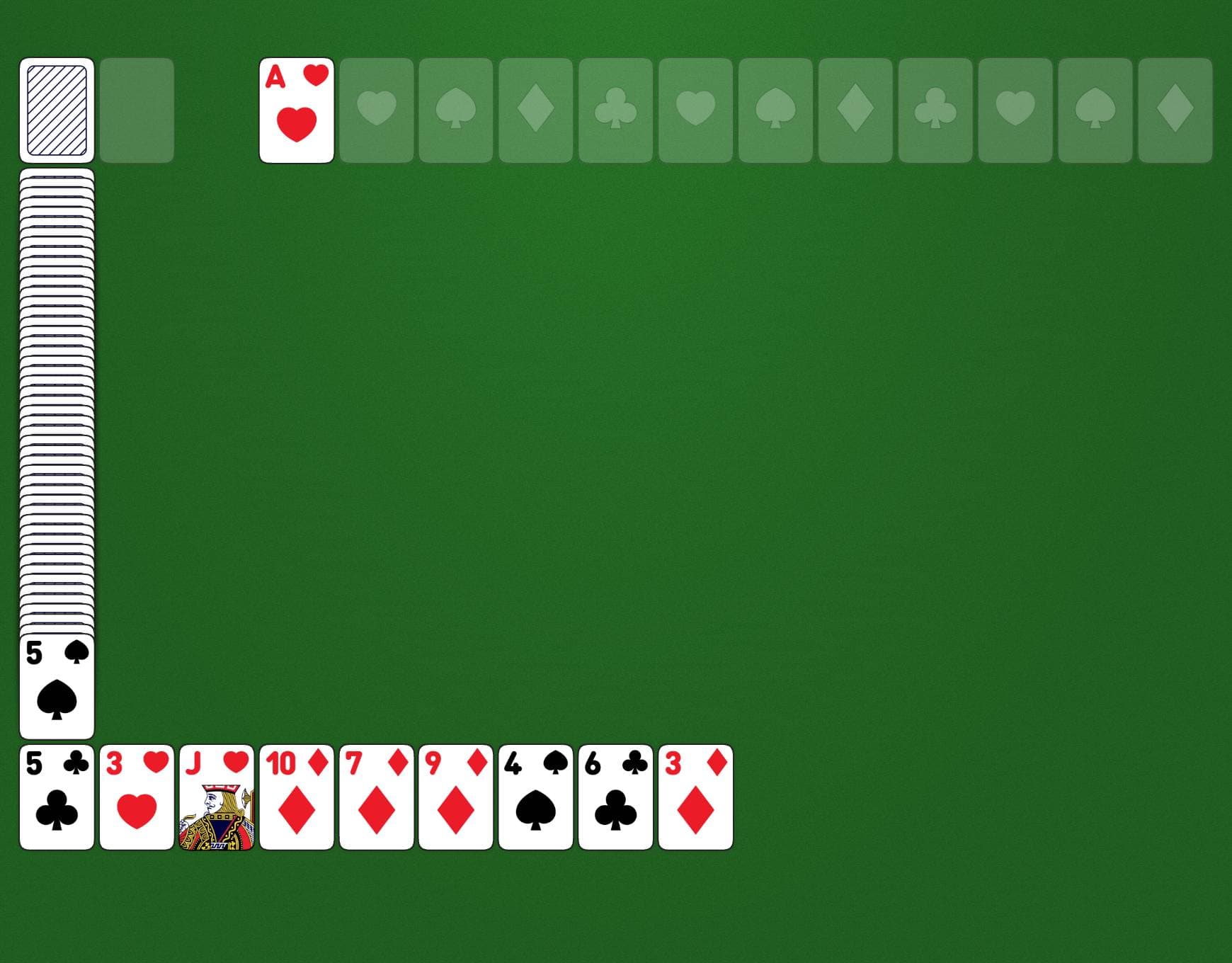
Three Demons Solitaire is a three-deck Canfield invented by Thomas Warfield, and the name is well earned: three full decks mean a hefty forty-eight-card reserve and nine tableau columns to keep in order all at once. It plays like Triple Canfield Solitaire with the reins loosened — more piles to work with, but a much deeper reserve leaning on your shoulder the whole way through.
As in every Canfield relative, a single card turned up on the first foundation sets the target rank for all twelve foundations, each climbing thirteen cards in suit and wrapping past the King to the Ace. The reserve does more than wait to be played: whenever a tableau column empties, the next reserve card slides in automatically to fill it, so the demon at your side is also the thing that keeps the board alive.
The game is generous with its deals, with a win rate of roughly 90%. It is played with three decks, and because the stock recycles without limit, your odds of victory rest far more on careful planning than on luck.
Canfield Solitaire is the classic this game descends from, played with a single deck instead of three.
For a change of pace, original Solitaire strips away the reserve and the extra decks and gets you back to the basics.
If you run into anything odd or have an idea that would make the game better, please contact me.
Enjoy playing!
How to play Three Demons Solitaire
Layout:
12 foundation piles: Build up in suit from the rank of the first card dealt to the first pile, wrapping from King to Ace as needed, until each pile has 13 cards.
9 tableau piles: Alternate color build down. Only the top card of each pile is playable. An emptied column is filled automatically from the reserve. At the start of the game, each pile is dealt one card.
Reserve: The top card is always ready for use on the foundations or the tableau. At the start of the game, there are 48 cards dealt here.
Stock: Click to flip over three cards to the waste at a time. Redeals are unlimited.
Waste: Top card is always accessible for play on the foundations or tableau.
Foundation:
There are twelve foundation piles.
One foundation pile is dealt a starting card at random. The other eleven piles must begin with a card of that same rank as it becomes available.
A card can be added to a foundation pile only if it's one rank higher and the same suit as the pile's current top card, wrapping from King to Ace, so the only card that fits on a 6 of clubs is a 7 of clubs. There can be no more than 13 cards in a pile.
The top card of each foundation can be moved back into play if another pile will accept it.
Reserve:
There is just one reserve, which originally contains forty-eight cards. Only the top card is dealt face-up; the rest are face-down. No cards may be moved into the reserve. The reserve's top card may be played to the tableau or the foundations, and it automatically fills any tableau column that becomes empty.
Tableau:
Nine tableau piles hold one card each, all dealt face-up.
A card can be added to a tableau pile only if it's one rank lower and the opposite color of the pile's current top card, so the only cards that fit on a 4 of spades are the 3 of hearts and 3 of diamonds.
Cards on the tableau that are not covered by another card are free to be played onto the foundation or any other tableau pile.
Empty tableau spots are instantly filled with a card from the reserve. Once the reserve runs out, an emptied column simply stays empty.
Stock and waste:
There is one waste pile, and the remaining cards comprise the stock.
When you click on the stock, three cards are dealt to the waste. The stock may be passed through an unlimited number of times; if fewer than three cards remain at the end of a pass, only those are dealt. Before the following pass, the waste is turned back into fresh stock.
The top card of the waste can be played to the tableau or foundation.


