Play Sixes and Sevens Solitaire Online for Free (No Signup Required)
Pull every Six and Seven to start sixteen foundations, then juggle two decks through nine single-card slots. Easy to learn, but luck rules the day.
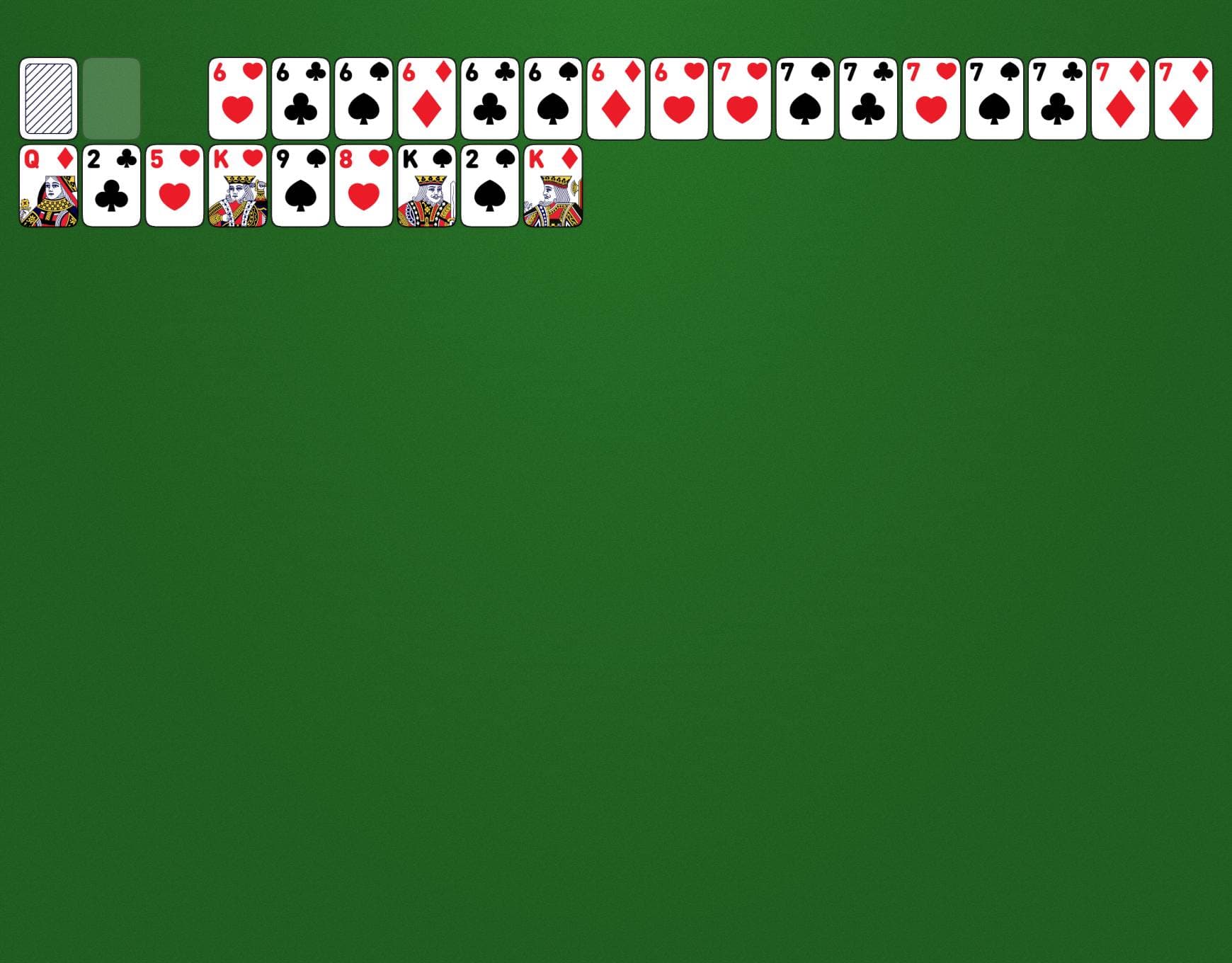
Sixes and Sevens Solitaire takes its name from the old English saying "to be at sixes and sevens," which describes a state of hopeless confusion — a fair warning for a game that asks you to sort two full decks onto sixteen foundations at once. Before play begins, every Six and every Seven is pulled from the shuffle and laid out as a base card. The Sixes build down in suit to the Ace, while the Sevens climb up in suit to the King.
There is no building on the tableau at all. The nine spots each hold exactly one card, so they behave like a bank of storage cells rather than a classic tableau. With only a single pass through the stock, the whole game comes down to how you spend those nine spaces: set aside the cards you will need soon and let the hopeless ones slide past.
The game is easy to learn, with a low chance of winning. It is played with two decks, and your odds of victory are primarily determined by luck, although disciplined use of the spaces will save many deals.
Captive Queens Solitaire — better known by its old French name, Quadrille — and Odd and Even Solitaire are two solitaire games worth trying if you enjoy this one.
If you run into anything odd or have an idea that would make the game better, please contact me.
Enjoy playing!
How to play Sixes and Sevens Solitaire
Layout:
16 foundation piles: Two rows of eight. The Six piles build down in suit to the Ace; the Seven piles build up in suit to the King. All sixteen base cards are dealt here at the start of the game.
9 tableau piles: One card each, dealt face-up. No building is allowed — every spot holds a single card. Empty spots may be refilled with any available card.
Stock: Click to flip over cards one at a time to the waste. There are no redeals.
Waste: Top card is playable.
Foundation:
There are sixteen foundation piles, arranged in two sets of eight.
When the game is dealt, all eight Sixes and all eight Sevens are taken out of the two decks and placed as base cards, one per pile. A Six pile accepts the next lower card of the same suit, so the only card that may be played on the 6 of spades is the 5 of spades; the pile is complete at the Ace, six cards in all. A Seven pile accepts the next higher card of the same suit, so the only card that may be played on the 7 of hearts is the 8 of hearts; the pile is complete at the King, seven cards in all.
Cards that fit are moved to the foundations automatically. The top card of each foundation can be moved back into play if another pile will accept it.
Tableau:
Nine tableau piles of one card each. Every card is dealt face-up.
Nothing may ever be built on a tableau card: each spot holds a single card, and that card can only leave by going to a foundation.
An empty spot may be refilled with any available card — usually the top card of the waste. Since the stock allows just one pass, use the spots to hold cards that would otherwise be buried in the waste.
Stock and waste:
The seventy-nine cards left after the deal make up the stock, and there is one waste pile.
When you click on the stock, one card from the stock is dealt to the waste. There is only one pass through the stock.
The top card of the waste can be played to a foundation or to an empty tableau spot.


