Play Simon Jester Solitaire Online for Free (No Signup Required)
Untangle two decks dealt face-up across a fourteen-column triangle, with no stock to save you, and sort the mess into eight single-suit runs from King to Ace.
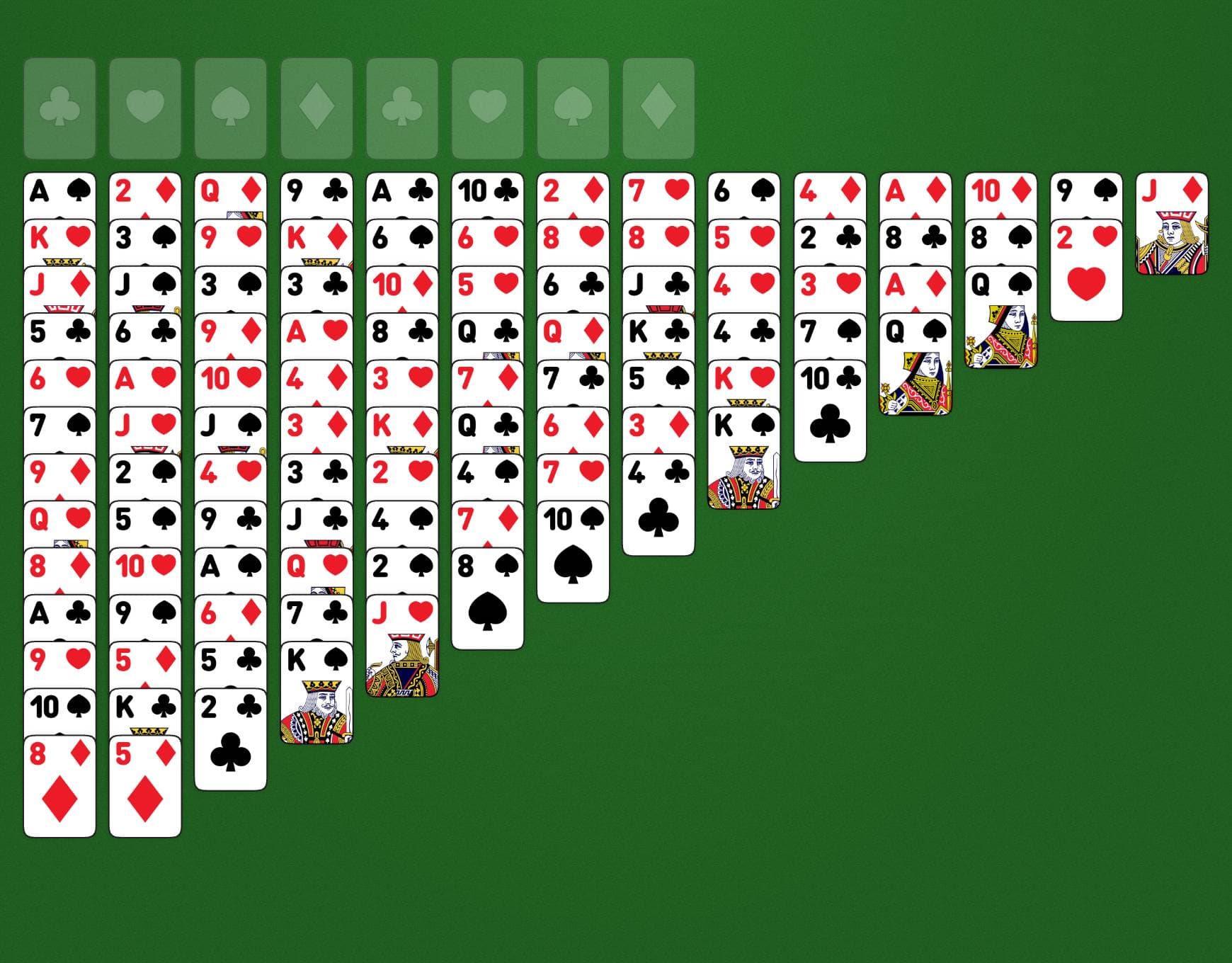
Simon Jester Solitaire is the two-deck version of Simple Simon, and it belongs squarely to the Spider family. Both decks are dealt face-up into a wide triangular tableau of fourteen columns, from a full row of thirteen cards down to a lone single card at the far end. Nothing is hidden and there is no stock waiting in the wings, so every card you will ever see is already on the table when the deal begins.
That open layout is what makes Simon Jester such a pure test of planning. Because there is no stock to bail you out, an early tangle of mixed suits can quietly seal off a column you needed. Skilled players learn to keep long descending chains flexible and to clear one full suit at a time rather than chasing quick moves.
The goal is to assemble eight complete King-to-Ace runs of a single suit. As soon as a run is finished it is lifted off the tableau for good, so the board slowly empties as you win. Building can cross suits freely, but only a group of cards already in the same suit can be dragged together, which is the tension at the heart of every Spider-style game.
If you enjoy Simon Jester, try Simple Simon Solitaire, its single-deck original, or the classic Spider Solitaire. Scorpion Solitaire is another all-face-up cousin worth a look.
If you run into anything odd or have an idea that would make the game better, please contact me.
Have fun!
How to play Simon Jester Solitaire
Layout:
8 foundation piles: Each foundation holds one completed King-to-Ace run of a single suit. Runs are sent here to finish the game and cannot be taken back.
14 tableau piles: Both full decks are dealt face-up in a triangle: two columns of thirteen, then one card fewer in each column after that, down to a single card in the last. There is no stock and no waste.
Foundation:
There are eight foundation piles, one for each suit across the two decks.
You do not place cards on the foundation one at a time. Instead, when a full King-to-Ace sequence of a single suit is assembled on the tableau, that whole run is moved to a foundation at once. Once there, its cards leave play and can never return to the tableau.
Completing all eight single-suit runs wins the game.
Tableau:
The two decks are dealt in a downward cascade across fourteen columns, arranged in a triangle of thirteen, thirteen, twelve, eleven, and so on down to a single card. Every card is dealt face-up.
A card or run can be added to a tableau pile only if it's one rank lower than the pile's current top card, regardless of suit, so any 7 fits on any 8. This lets you build long descending sequences of mixed suits while you organize the board.
Only a group of cards that are already in the same suit and in descending order may be moved together. A single card can always be moved on its own, but mixed-suit sequences must be taken apart one card at a time.
Empty tableau columns may be filled with any card or any movable run, giving you valuable room to untangle the suits.


