Play Pyramid Dozen Solitaire Online for Free (No Signup Required)
Pairs must add to twelve here, not thirteen, and every card lies face-up around the pyramid, so there's no stock, no waste, and nowhere to hide.
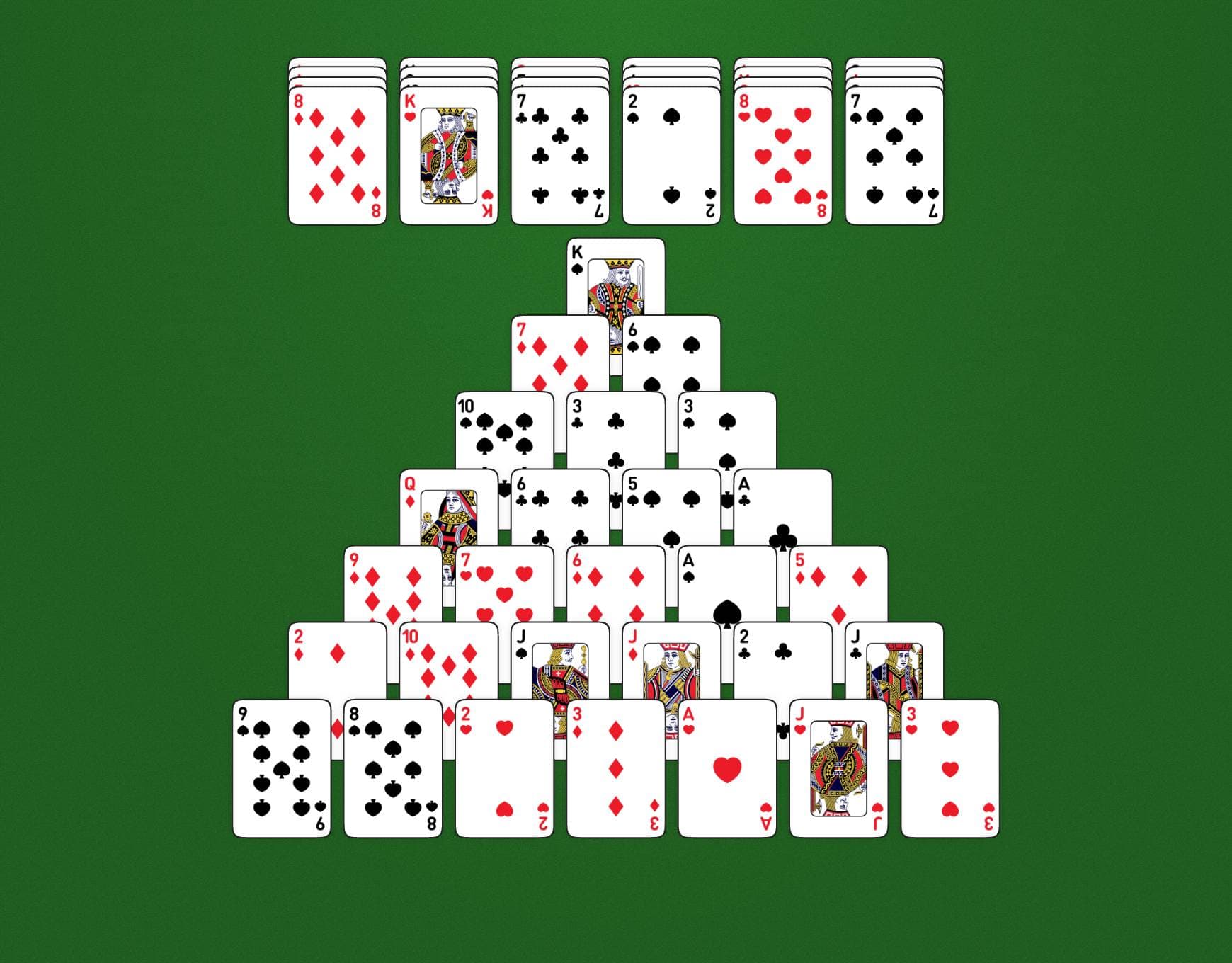
Pyramid Dozen Solitaire is an open-handed cousin of Pyramid in which the target total is twelve rather than the usual thirteen. The familiar 28-card pyramid is dealt at the top of the screen, and the rest of the deck is spread face-up into six columns of four beneath it, so there is no stock to flip and no waste pile to watch - every card is in view from the very first move.
Play follows the pairing idea of the whole Pyramid family. Remove any two available cards whose ranks add up to twelve: Ace with Jack, Two with Ten, Three with Nine, Four with Eight, Five with Seven, or a pair of Sixes. A card is "available" whenever nothing overlaps it, so the base row of the pyramid and the top card of each tableau column are always in play. The goal is narrow and pure: clear every card out of the pyramid. The columns need not be emptied - they exist only to feed partners into the triangle.
Because the entire layout is open before you touch a card, Pyramid Dozen rewards planning over luck. There are no surprise flips to rescue a stuck position, so a loss can almost always be traced to a pairing made a move too early. Reading the pyramid from the base upward, and holding back a useful column card until the match it unlocks is the one you need, is the whole of the strategy.
It plays a lot like Giza Solitaire and Pyramid Solitaire.
The original Solitaire is still here too, if you want cards dealt one at a time instead of all at once.
If you run into anything odd or have an idea that would make the game better, please contact me.
Enjoy playing!
How to play Pyramid Dozen Solitaire
Layout:
1 pyramid: 28 cards dealt into seven overlapping rows, all face-up. Remove pairs of uncovered cards whose ranks total twelve; the game is won when the pyramid is empty.
6 tableau piles: Four face-up cards each. No building is allowed - the top card of each pile is simply available for pairing. Empty spaces may not be filled.
Foundation: Kept off the table. Every matched pair is moved here automatically and leaves the game for good.
Foundation:
There is one foundation pile, and it stays hidden from view.
Removed cards are sent to it automatically: you never place cards on the foundation yourself, and no card can ever be brought back into play.
Pyramid:
There are twenty-eight cards in the pyramid. The first card is dealt, then two overlapping cards in a second row, three in the third, and so on down to seven cards in the seventh row. Every card is dealt face-up.
No building is allowed on the pyramid.
Cards on the pyramid that are not overlapped by another card are playable. Two uncovered cards may be removed together whenever their ranks total twelve: Ace and Jack, Two and Ten, Three and Nine, Four and Eight, Five and Seven, or two Sixes.
The pyramid's empty slots may not be filled.
Tableau:
Six tableau piles of four cards each, all dealt face-up.
No building is allowed on the tableau.
Cards on the tableau that are not covered by another card are playable and may be paired with any other available card, including the top card of another tableau pile. Clearing the columns is never required to win, but it is usually the only way to dig the pyramid free.
The tableau's empty spaces may not be filled.


