Play Eternal Triangle Solitaire Online for Free (No Signup Required)
Watch every stock click bury all ten staircase piles at once, Spider-style, and see if you can out-plan the deal for a tough 20% win rate.
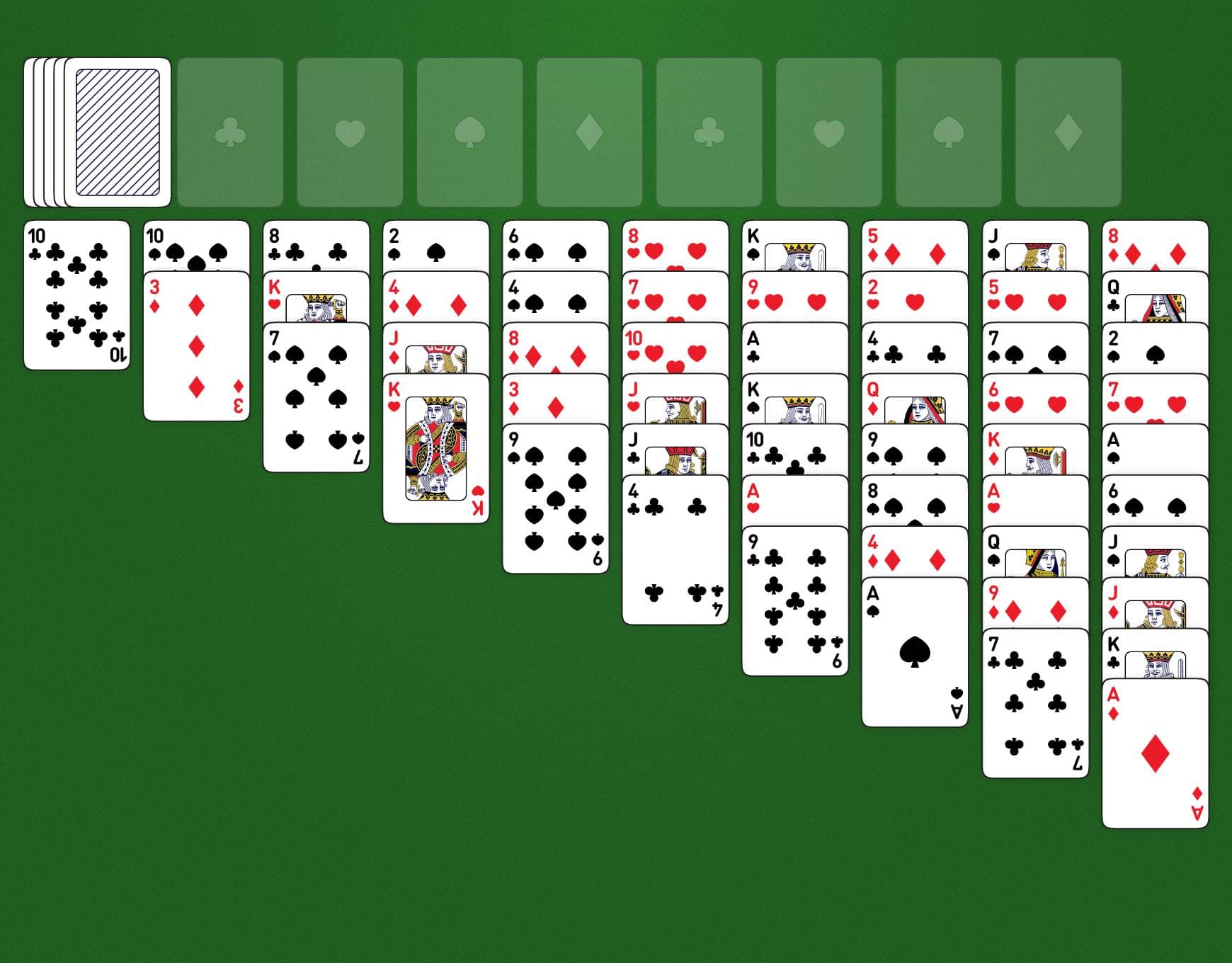
Eternal Triangle Solitaire takes its name from the shape of its deal: ten piles that grow from a single card to ten, forming a long triangular staircase across the table. The name is also a wink at the old phrase for a three-way romance — fitting for a game that has spawned a small family of geometric relatives, including Hypotenuse and the three-deck Triple Triangle.
At heart it is a two-deck Klondike. You build the tableau down in alternating colors, move packed runs as a unit, and climb eight foundations from Ace to King in suit. What changes everything is the stock: there is no waste pile. Each click deals one card onto every tableau pile, Spider-style, burying whatever you had arranged under a fresh layer of trouble.
That dealing rule is the whole strategy. Because all 55 tableau cards start face-up, you can plan deeply — but every deal entombs your sequences, so squeeze out each safe move and send cards to the foundations before touching the stock. With about a 20% win rate baked into that deal, the game plays difficult from the first click. It is played with two decks, and skill matters here more than luck.
This triangular staircase deal is the hook; Hypotenuse Solitaire and Triple Triangle Solitaire build on the same idea.
Since the alternating-color building here comes straight from classic Solitaire, that's worth returning to for the same rules without the staircase twist.
If you run into anything odd or have an idea that would make the game better, please contact me.
Enjoy playing!
How to play Eternal Triangle Solitaire
Layout:
8 foundation piles: Build up from Ace to King in the same suit.
10 tableau piles: Alternate color build down. Groups of cards in an alternating-color sequence can be moved together. Only Kings can fill empty spaces. At the start of the game, one card is dealt to the first pile, two to the second, and so on up to ten in the last pile; every card is face-up.
Stock: Click to deal one card onto each tableau pile. There are no redeals.
Foundation:
There are eight foundation piles.
Any ace may be moved to any vacant foundation pile.
A card can be added to a foundation pile only if it's one rank higher and the same suit as the pile's current top card, so the only card that fits on an 8 of spades is a 9 of spades. There can be no more than 13 cards in a pile.
The top card of each foundation can be moved back into play if another pile will accept it.
Tableau:
Ten tableau piles form a staircase, growing from one card to ten — 55 cards in all. Every card is dealt face-up.
A card can be added to a tableau pile only if it's one rank lower and the opposite color of the pile's current top card, so the only cards that fit on an 8 of spades are the 7 of hearts and the 7 of diamonds.
Cards on the tableau that are not covered by another card are free to be played onto the foundation or any other tableau pile.
If the cards form a downward sequence of alternating red and black, groups of cards can be shifted from one tableau pile to another as a unit.
Only Kings, alone or leading a sequence, may fill empty spots in the tableau.
Stock:
There is no waste pile; the remaining 49 cards make up the stock.
When you click on the stock, one card is dealt face-up onto every tableau pile — even the empty ones. Four full deals of ten are followed by a final deal of nine, and there are no redeals.


