Play Eclipse Solitaire Online for Free (No Signup Required)
Two decks fan across thirteen columns, and one stock click buries all of them at once, Spider style. Expect a tough climb: about a 15% win rate, decided by skill.
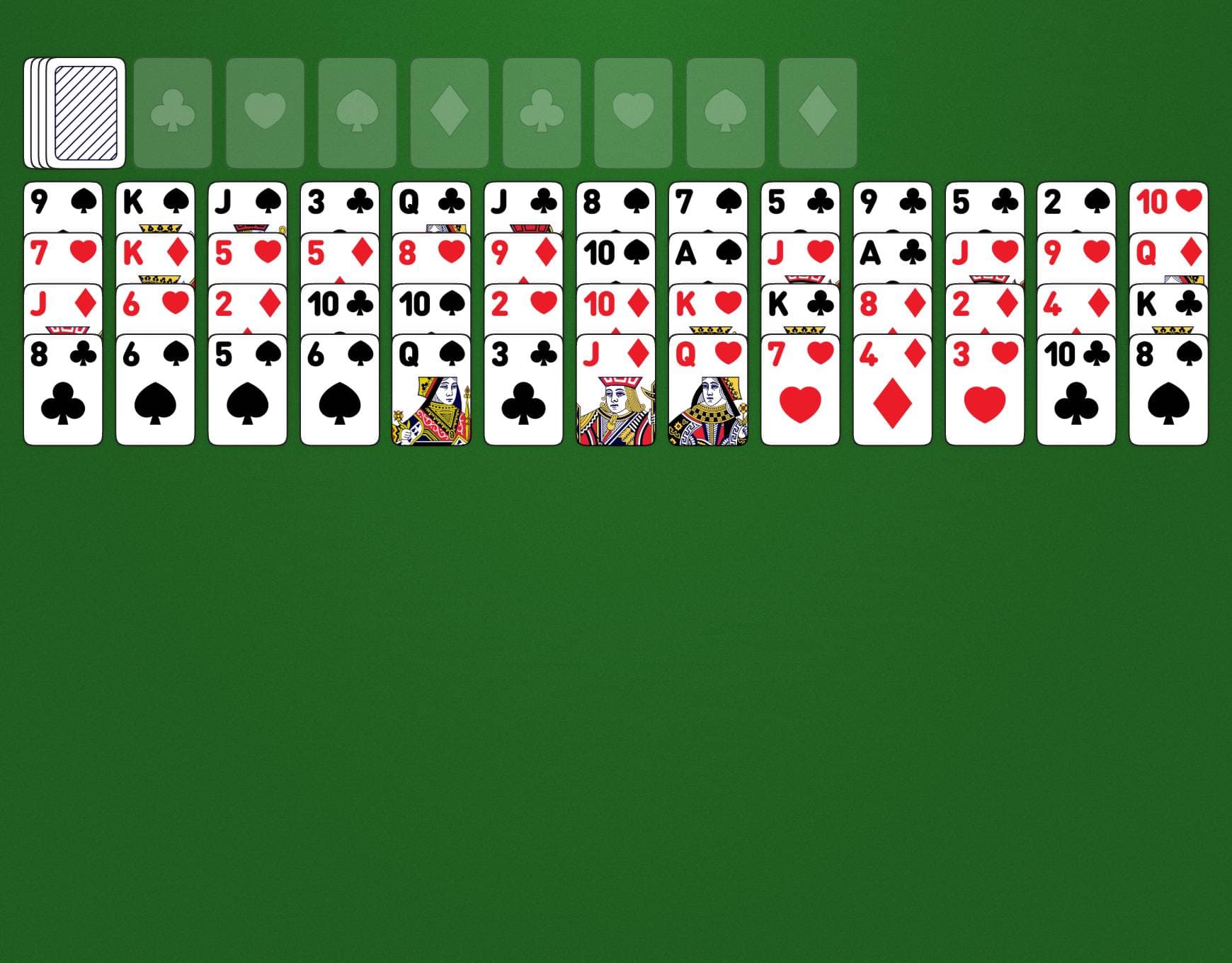
Eclipse Solitaire spreads two full decks across thirteen tableau columns of four face-up cards each, just like Waning Moon — but with two twists: same-suit sequences may be moved as a group, and instead of flipping to a waste pile, each click on the stock deals a fresh card onto every column. Foundations are built up in suit, and the tableau is built down in suit. It's a difficult game, with about a 15% chance of winning, played with two decks, and success depends mostly on skill.
The name completes a small astronomical family within the Forty Thieves line: where Waning Moon thins its long row of piles card by card, Eclipse periodically darkens the whole tableau at once, as the fifty-two stock cards rain down one per column over four deals. Both games descend from the two-deck classics of the nineteenth century, though Eclipse's deal borrows its drama from Spider.
Every stock deal buries all thirteen top cards, so treat each click like a countdown. Clear what you can first, line up same-suit runs so they can be shifted out of danger in one piece, and try to keep an empty column open before you deal — it is the safest place to park a card that would otherwise entomb a run you spent half the game assembling.
Next up: Waning Moon Solitaire, Lucas Solitaire, and Forty Thieves Solitaire.
If you run into anything odd or have an idea that would make the game better, please contact me.
Enjoy playing!
How to play Eclipse Solitaire
Layout:
8 foundation piles: Build up from Ace to King in the same suit.
13 tableau piles: Build down in the same suit. Same-suit sequences may be moved as a group. Any card can fill an empty space. At the start of the game, each pile is dealt four cards face-up.
Stock: By clicking on the stock, you deal one card to each tableau pile. There are no redeals.
Foundation:
There are eight foundation piles.
Any ace may be moved to any vacant foundation pile.
A card can be added to a foundation pile only if it's one rank higher and the same suit as the pile's current top card, so the only card that fits on a 5 of diamonds is a 6 of diamonds. There can be no more than 13 cards in a pile.
The top card of each foundation can be moved back into play if another pile will accept it.
Tableau:
Thirteen tableau piles fan out downward, four cards dealt to each, all face-up from the start.
A card can be added to a tableau pile only if it's one rank lower and the same suit as the pile's current top card, so the only card that fits on an 8 of spades is a 7 of spades.
Cards on the tableau that are not covered by another card are free to be played onto the foundation or any other tableau pile.
Groups of cards in sequence from high to low may be moved together from one tableau pile to another if they are all of the same suit.
Any card can fill an empty slot in the tableau.
Stock:
The stock is made up of leftover cards.
When you click on the stock, a card is dealt to the top of each tableau pile. There is only one pass through the stock — four deals in all.


