Play Corners Solitaire Online for Free (No Signup Required)
Five piles hold cards with no building at all, so you send everything straight to the foundations with only three passes through the stock to help.
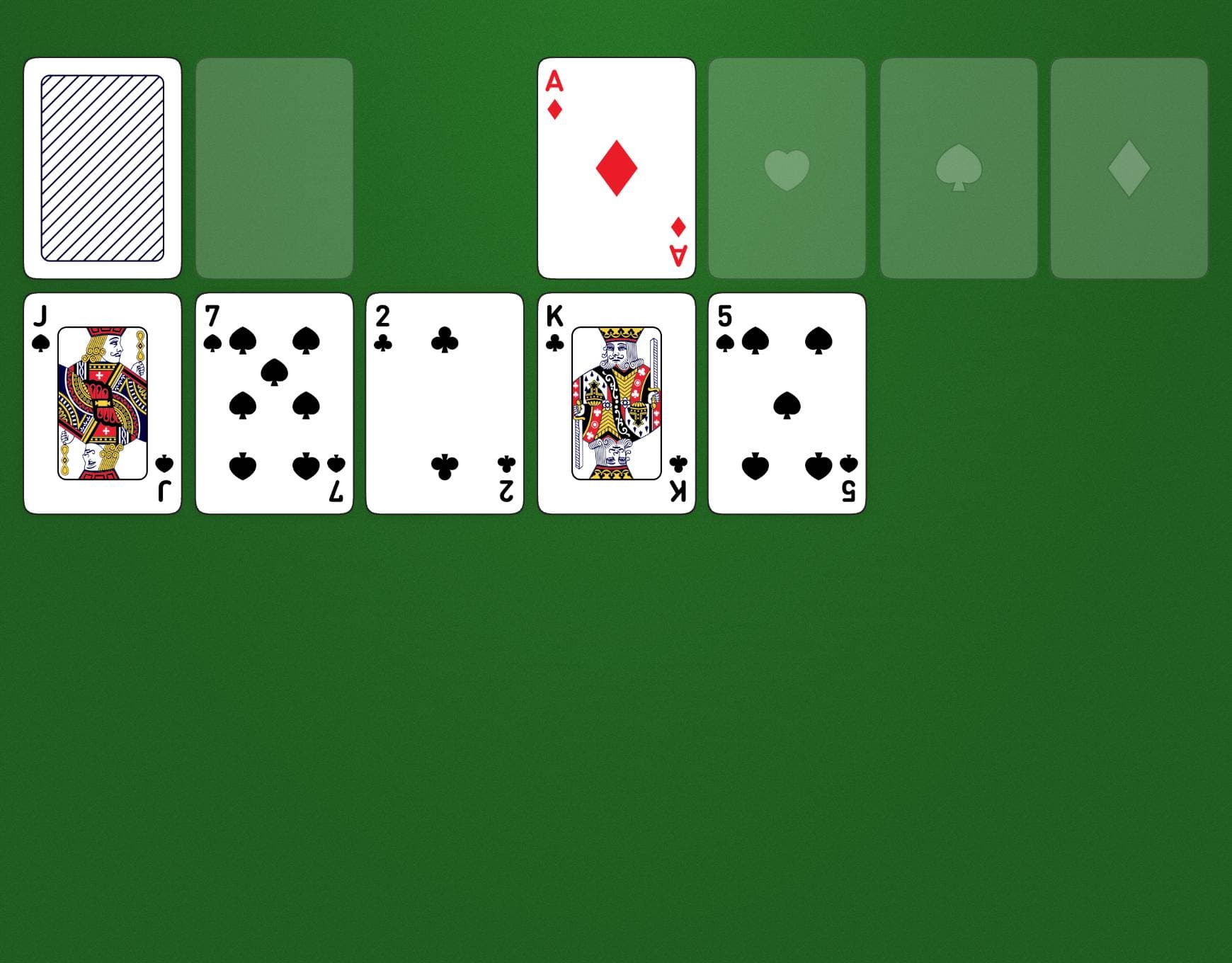
Corners Solitaire belongs to the Four Seasons family, a group of compact one-deck games that has been around since the nineteenth century. The name comes from the traditional table layout, in which the four foundations sit in the corners around a cross of five tableau piles — the same arrangement that earned Four Seasons its "Vanishing Cross" and "Corner Card" nicknames.
What makes Corners stand out is its ruthless tableau: no building is allowed at all. The five piles are nothing more than a holding area, and every card you dig out of them must go straight to a foundation. In exchange, you get three passes through the stock instead of one, and whenever a tableau pile empties, a fresh card is flipped from the stock to fill the space automatically.
The foundations start from a randomly dealt base card rather than the aces, and they wrap from King to Ace as needed, so every deal feels a little different. The game is tough, and with so few decisions to make along the way, luck plays a bigger part than skill.
Corners' hook is a tableau that never builds; Four Seasons Solitaire and Czarina Solitaire give you more of that same restraint.
Corners rewards patience over cleverness; when you'd rather build sequences with your own hands, original Solitaire hands that control back to you.
If you run into anything odd or have an idea that would make the game better, please contact me.
Enjoy playing!
How to play Corners Solitaire
Layout:
4 foundation piles: Build up in suit from the rank of the first card dealt to the first pile, wrapping from King to Ace as needed, until each pile holds 13 cards.
5 tableau piles: No building is allowed — cards may only leave for the foundations. Spaces are automatically filled from the stock. At the start of the game, each pile is dealt one card.
Stock: Click to flip over 1 card at a time to the waste. There are two redeals, for three passes in total.
Waste: The top card can be played on the foundations.
Foundation:
There are four foundation piles.
A foundation pile will be given a card at random. This is the starting card. Begin the remainder of the piles with cards of the same rank.
A card can be added to a foundation pile only if it's one rank higher and the same suit as the pile's current top card, wrapping from King to Ace as needed, so the only card that fits on a J of spades is a Q of spades. There can be no more than 13 cards in a pile.
The top card of each foundation can be moved back into play if another pile will accept it.
Tableau:
Five tableau piles of one card each. Every card is dealt face-up.
No cards may be added to the tableau piles — building is not permitted. The only legal move for an uncovered tableau card is onto a foundation.
Empty tableau spots are immediately filled with a card from the stock, so the five piles never stay vacant for long.
Only one card may be moved at a time; sequences are not permitted.
Stock and waste:
There is one waste pile, and the remaining cards make up the stock.
Click the stock to deal one card to the waste. You get three passes through the stock in total.
The top card of the waste can be played to the foundation.


