Play Chequers Solitaire Online for Free (No Signup Required)
Chequers Solitaire spreads two decks almost bare: 25 tableau piles built up or down with wraparound, and eight foundations working from both ends at once.
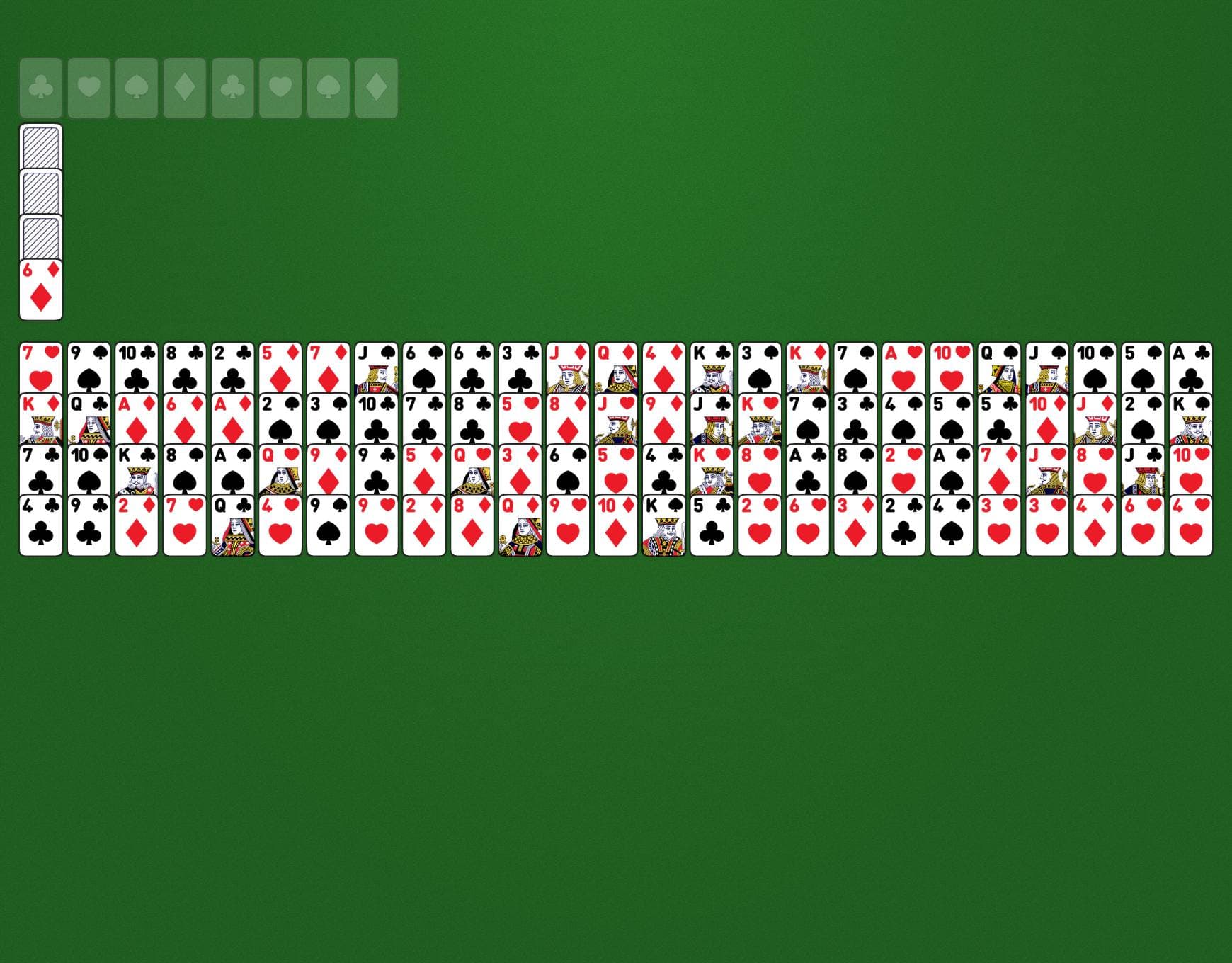
Chequers Solitaire is an old two-deck patience that spreads almost everything on the table at once. One hundred of its 104 cards are dealt face-up into twenty-five tableau piles of four, while the last four cards form a small reserve with only its top card showing. With so much of the game visible from the first move, it plays like a giant open puzzle.
The foundations work from both ends at the same time. Four piles build up in suit from the Aces while four more build down in suit from the Kings, so every card in both decks eventually has a home. On the tableau you may build up or down in the same suit, and the sequence wraps around, so a King may sit on an Ace and vice versa. Only one card moves at a time.
The reserve adds a twist of its own: whenever you clear a tableau column, the top card of the reserve is dealt into the gap automatically. Only after the reserve runs dry do empty columns stay open for whatever card you choose. The game is played with two decks, and how well you plan your moves matters more than any lucky draw.
It plays a lot like Caprice Solitaire.
If you'd rather play the classic version, you'll find it at Solitaire.
If you run into anything odd or have an idea that would make the game better, please contact me.
Enjoy playing!
How to play Chequers Solitaire
Layout:
8 foundation piles: Four piles build up in suit from Ace to King, and four piles build down in suit from King to Ace. All start empty.
25 tableau piles: Build up or down in the same suit, wrapping between King and Ace. Each pile is dealt four cards face-up at the start of the game.
Reserve: Four cards, with only the top card face-up. It automatically refills empty tableau columns.
Foundation:
There are eight foundation piles, split into two groups of four.
The first group starts with the Aces and builds up in suit: a card can be added only if it's one rank higher and the same suit as the pile's current top card. The second group starts with the Kings and builds down in suit: a card can be added only if it's one rank lower and the same suit as the pile's current top card. Each suit may start only one pile in each group, so with two decks in play, every suit gets exactly one Ace pile and one King pile.
The top card of each foundation can be moved back into play if another pile will accept it.
Tableau:
Twenty-five tableau piles of four cards each. Every card is dealt face-up.
A card can be added to a tableau pile only if it's one rank higher or lower and the same suit as the pile's current top card, so the only cards that fit on an 8 of spades are the 7 of spades and the 9 of spades. The ranking wraps around, so a King can be played on an Ace and an Ace on a King.
Cards on the tableau that are not covered by another card are free to be played onto the foundations or any other tableau pile.
When a tableau column is emptied, it is immediately refilled with the top card of the reserve. Once the reserve is empty, any card may fill an empty column.
Only one card may be moved at a time; sequences are not permitted.
Reserve:
There is one reserve pile, which originally contains four cards. Only its top card is face-up.
Whenever a tableau column becomes empty, the reserve's top card is dealt into it automatically. The face-up top card of the reserve may also be played by hand to the foundations or onto a tableau pile where it fits.


