Play Challenge FreeCell Solitaire Online for Free (No Signup Required)
Every ace and two is buried at the bottom of the columns, so you must dig out a full stack before any foundation opens: a puzzle-first spin on FreeCell.
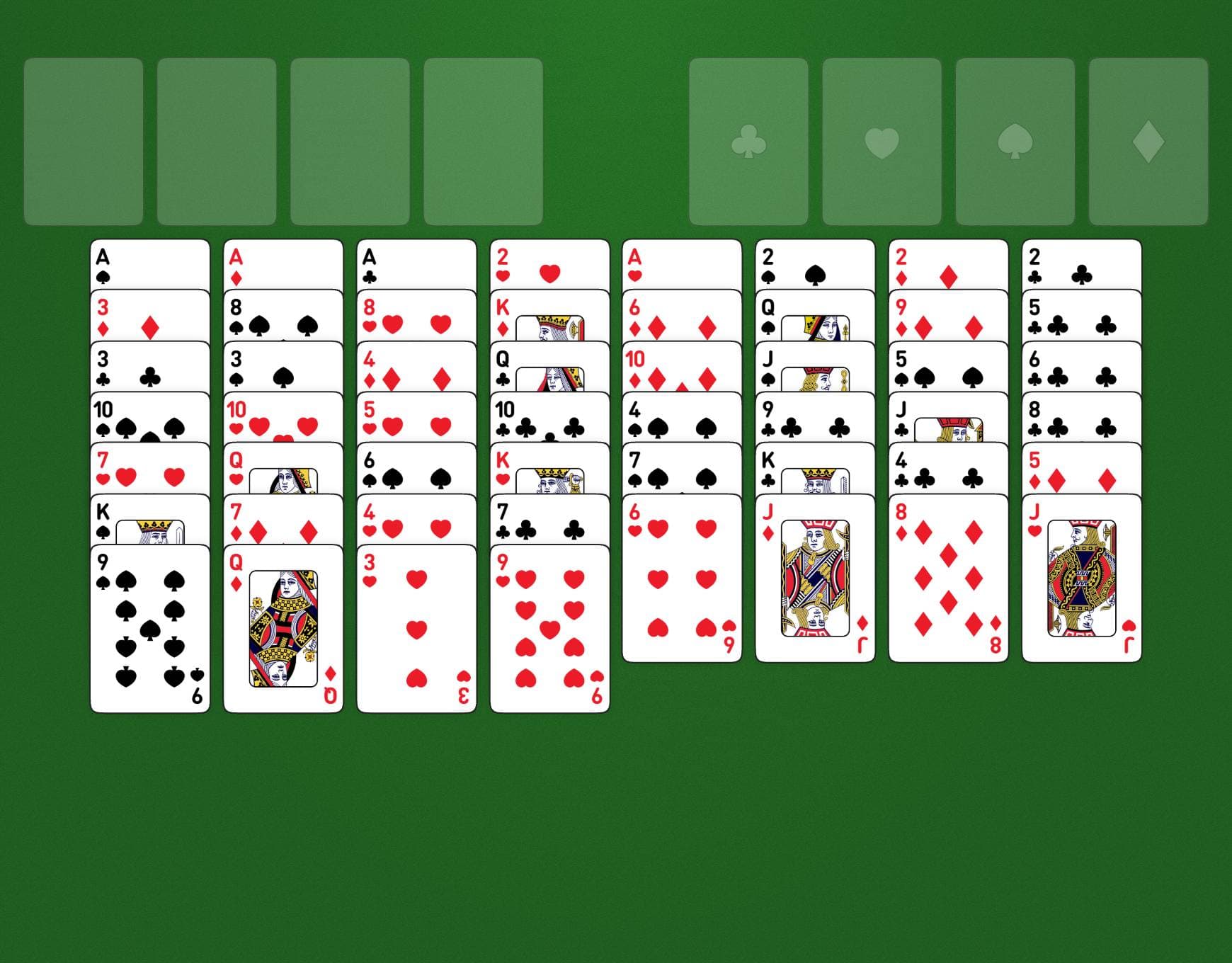
Challenge FreeCell Solitaire comes from Thomas Warfield, the prolific designer behind Pretty Good Solitaire and dozens of other FreeCell spin-offs. On the surface it plays exactly like the FreeCell you already know — all fifty-two cards dealt face up, four free cells for temporary storage, and four foundations built up by suit. What changes everything is the deal.
The defining trait of Challenge FreeCell is what players call ace depth. In an ordinary FreeCell game the aces and twos fall wherever the shuffle drops them, and they are often sitting near the tops of the columns where a couple of moves set them free. Here the deal is deliberately rigged so that every ace and every two is forced to the very bottom of the eight columns. You cannot begin a single foundation until you have excavated an entire stack, which makes the opening far more demanding than standard FreeCell and turns a routine deal into a genuine puzzle.
That one twist reshapes your whole strategy. Since the foundations stay bare until you dig the aces out, focus the early game on creating space rather than racing to build up. Keep a free cell open whenever you can, clear a full column early — remember that any card may drop into an empty column here — and send the low cards you unearth to the foundations the moment they become available.
New to the family? Start with plain FreeCell to learn the moves, then take on the meaner sibling Super Challenge FreeCell Solitaire, where only a King may fill an empty column. ForeCell Solitaire is another Warfield variation worth a try.
If you run into anything odd or have an idea that would make the game better, please contact me.
Enjoy playing!
How to play Challenge FreeCell Solitaire
Layout:
8 tableau columns: The entire 52-card deck is dealt face up into eight columns — the first four hold seven cards each and the last four hold six. Every card is visible, but all four aces and all four twos are buried at the very bottom.
4 free cells: Four open cells sit alongside the columns. Each is a temporary parking spot that can hold a single card.
4 foundation piles: One pile per suit, built up from the Ace to the King.
Foundation:
There are four foundation piles, one for each suit. Each is built up in order — Ace, 2, 3, and so on up to the King. Because the aces are pinned to the bottom of the columns, no foundation can start until you have cleared a column down to its base. Once a card reaches a foundation it stays there, and winning cards are sent up automatically.
Tableau:
Eight columns, every card face up. Build down in alternating colors, so the only card that may be played on a red 8 is a black 7. You may move a run of cards at once, but only as many as your open free cells and empty columns could shift one at a time. In Challenge FreeCell an empty column is a wild space — any card, or a legal sequence led by any card, may be placed there.
Free cells:
Four free cells, each holding exactly one card. Move any available card into an empty cell to get it out of the way, then play it back to a column or a foundation when the moment is right. The fewer cells you tie up, the larger the sequences you can move.


