Play Binary Star Solitaire Online for Free (No Signup Required)
Feed all 104 face-up cards into twin gravity wells that take a card one rank up or down in any suit, for an 85% win rate.
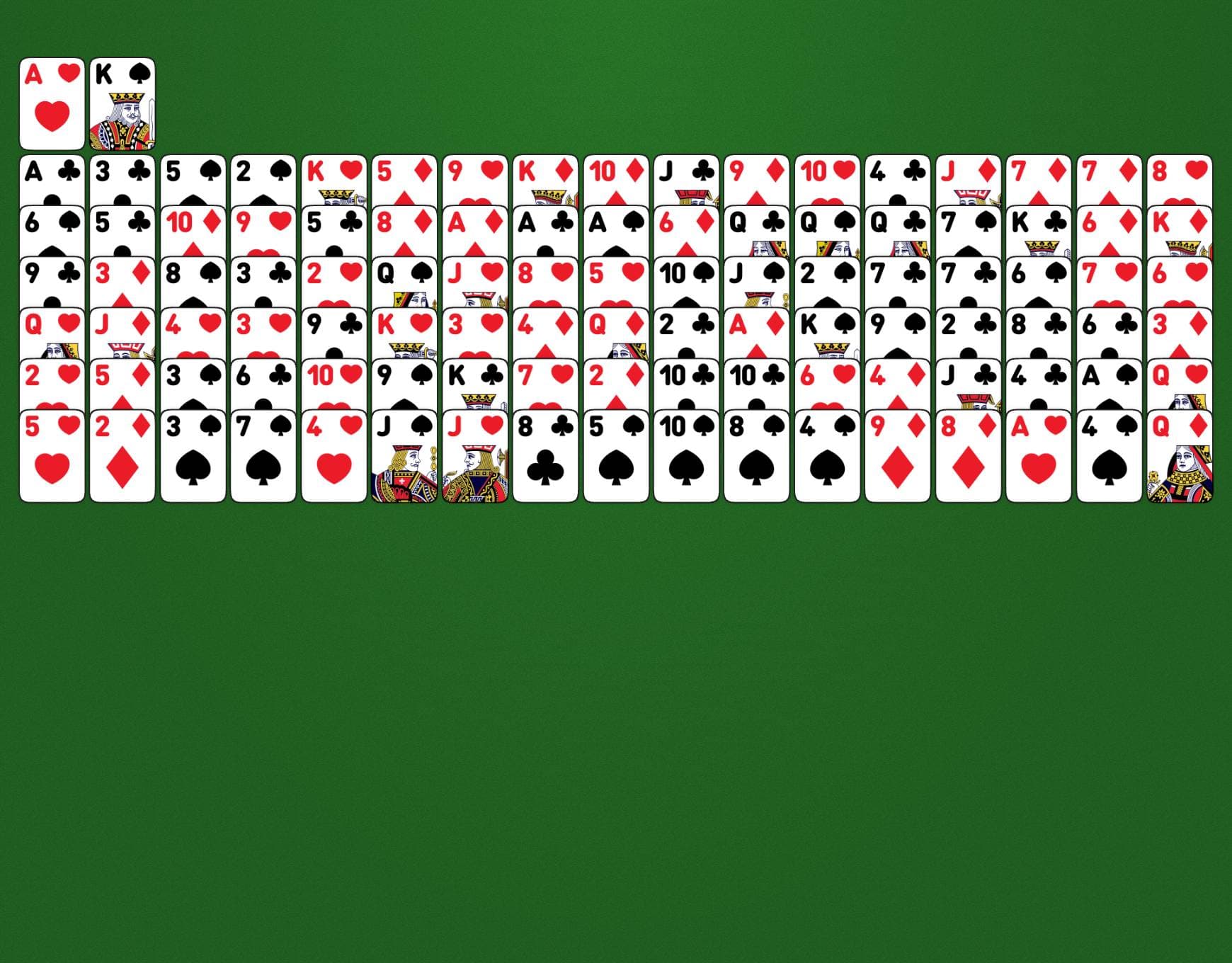
This is a two-deck version of Black Hole in which the single black hole has been split in two. Thomas Warfield invented it, and the name is a nod to astronomy: a binary star is a pair of stars circling one another, just as this game has you feeding cards into a pair of gravity wells. One hole starts with the Ace of Hearts and the other with the King of Spades, and both accept cards one rank higher or lower than their current top card, regardless of suit.
Because all 104 cards are dealt face-up from the very first move, nothing is hidden from you. The game is simple, with roughly an 85% chance of winning, and your odds of victory are primarily determined by skill. Having two holes instead of one gives you far more escape routes than the original game, but it also doubles the number of sequences you must keep in your head at once.
This game keeps company with Black Hole Solitaire, its single-hole ancestor, and with All in a Row Solitaire.
If you run into anything odd or have an idea that would make the game better, please contact me.
Enjoy playing!
How to play Binary Star Solitaire
Layout:
2 black holes: One begins with the Ace of Hearts, the other with the King of Spades. Build up or down regardless of suit, with the Ace and King deemed consecutive.
17 Fans: Only the top card of each fan is playable to either black hole. At the start of the game, each pile is given six cards.
Foundation:
There are two foundation piles, known as black holes.
One black hole is handed the Ace of Hearts at the start of the game, and the other is handed the King of Spades. Apart from their starting cards, the two holes follow identical rules.
A card can be added to either foundation pile only if it's one rank higher or one rank lower than the pile's current top card, regardless of suit, so any jack or king of any suit fits on a queen. Wrap on the foundation to play an ace on a king or a king on an ace.
The top card of each foundation can be moved back into play if another pile will accept it.
Tableau:
Seventeen tableau piles of six cards each. Every card is dealt face-up.
No building is allowed on the tableau.
Cards on the tableau that are not covered by another card can be played onto either foundation.
The tableau's empty spaces may not be filled.
Only one card may be moved at a time; sequences are not permitted.
You win once every fan has been emptied into the two black holes.


