Play All in a Row Solitaire Online for Free (No Signup Required)
Spread all 52 cards face-up, pick any card to start, and chain up or down in a circle from King to Ace: a friendlier cousin of Black Hole you can mostly out-think.
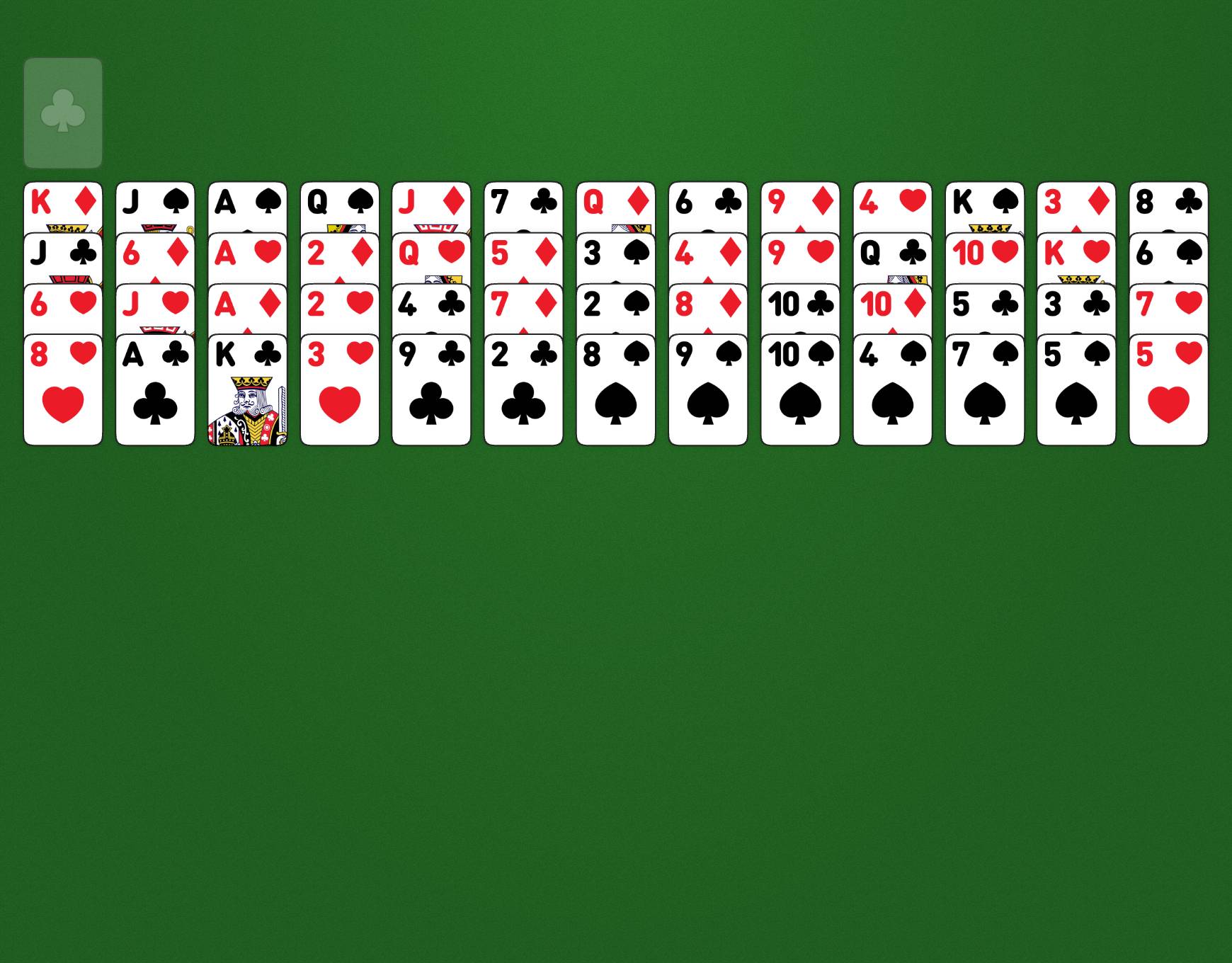
All in a Row Solitaire belongs to the same family as Black Hole, the one-pile adding game devised by the British card game authority David Parlett. The entire deck is spread face-up in a long row of thirteen piles, and the goal is to gather every last card onto a single foundation, one at a time, moving up or down in rank as you go.
Where Black Hole starts you off with a fixed Ace, All in a Row lets you choose any card on the table as your starting point, which gives the game a friendlier opening and a little more room for planning. Ranking is circular, so a King sits next to an Ace and the chain can loop around as many times as you need.
The game has a medium difficulty level, and most deals can be won with careful play. It is played with a single deck, and because every card is visible from the very first move, your odds of victory are determined almost entirely by skill.
Fans of Black Hole Solitaire will recognize the single foundation pile, and fans of Golf Solitaire will recognize the up-or-down rank chasing.
Want a change of pace instead? Standard Solitaire trades the circular chase for a slower, more familiar build.
If you run into anything odd or have an idea that would make the game better, please contact me.
Enjoy playing!
How to play All in a Row Solitaire
Layout:
1 foundation pile: Starts empty. Any card may be played first; after that, build up or down regardless of suit, wrapping between King and Ace, until all 52 cards are on the pile.
13 tableau piles: Four cards each, all dealt face-up. There is no building on the tableau; only the top card of each pile may be played. Empty spaces are never refilled.
Foundation:
There is one foundation pile, and it begins the game empty.
Any card from the tableau may be chosen as the starting card. After that, a card can be added to the foundation only if it's one rank higher or lower than the pile's current top card, regardless of suit. Ranking is circular, so an Ace can be played on a King and a King on an Ace, and the only cards that fit on an 8 of spades are any 7 or any 9.
The top card of each foundation can be moved back into play if another pile will accept it. The game is won when all 52 cards have been moved onto the foundation.
Tableau:
Laid out in a row, thirteen tableau piles of four cards each. Every card is dealt face-up.
No cards may ever be added to the tableau; the piles only shrink as cards leave for the foundation. Cards on the tableau that are not covered by another card are free to be played onto the foundation.
Empty tableau spots may not be filled, and only one card may be moved at a time; sequences are not permitted.


