Play Arabella Solitaire Online for Free (No Signup Required)
Deal thirteen columns face-up until ninety-one cards hit the table, juggle Spider's suit-runs with Klondike's one-pass stock, and outplan one hundred fifty-six cards with skill.
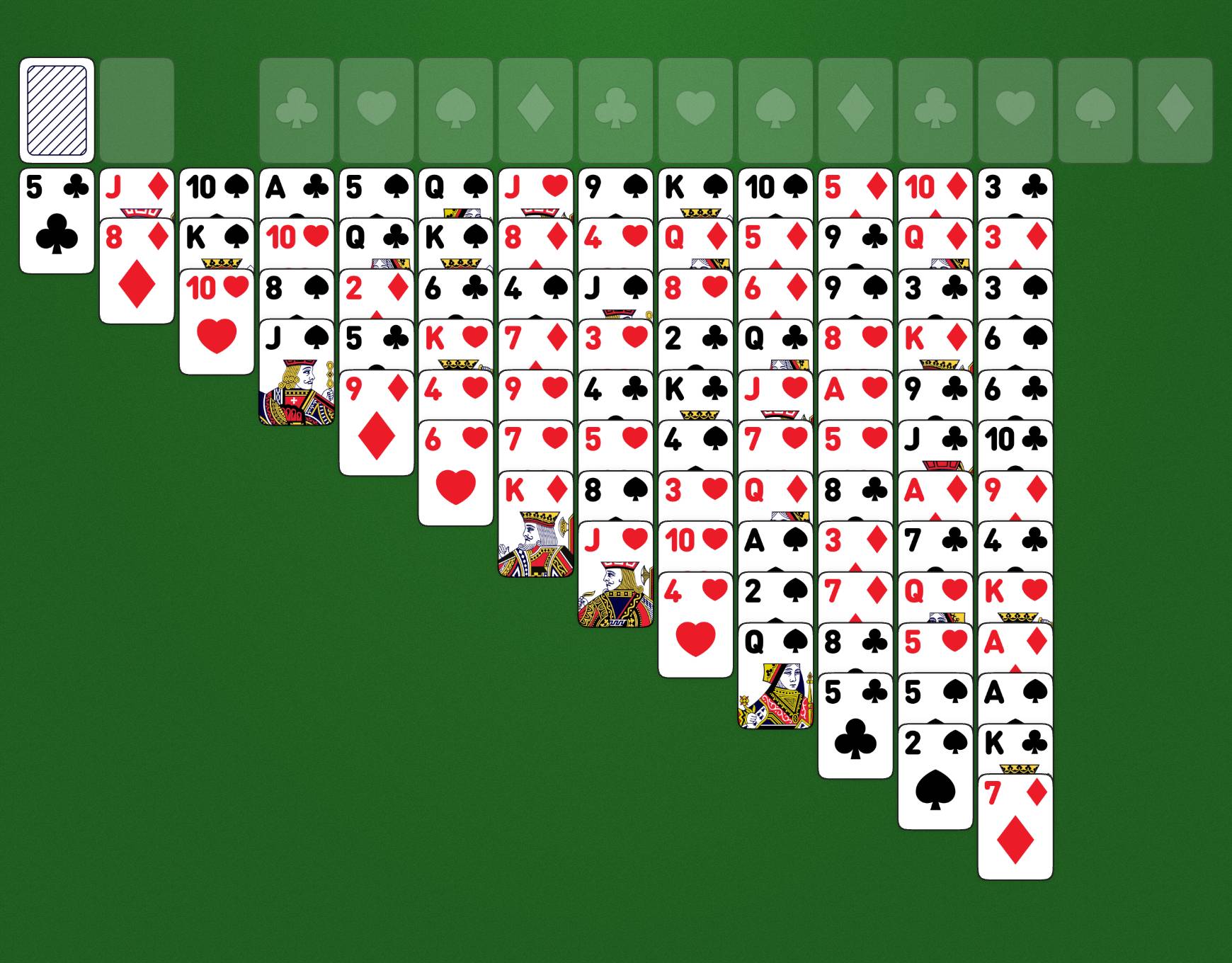
Arabella Solitaire is the three-deck member of the Lady Jane family, a blend of Spider and Klondike played on a truly grand scale. Thirteen tableau columns are dealt at the start — one card to the first, two to the second, and so on up to thirteen — which puts ninety-one cards on the table before you make a single move, every one of them face-up.
The building rules borrow from both parents. As in Spider, you may stack the tableau down regardless of suit, but only runs of the same suit move together as a group; and as in Klondike, a stock feeds a waste pile one card at a time. There is no second pass, and the twelve foundations must climb from Ace to King in suit. Empty columns are precious: only a King, or a same-suit run headed by a King, may occupy one.
With one hundred and fifty-six cards in play and all of them visible from the first deal, Arabella is a game of planning rather than guesswork. The single pass through the sixty-five-card stock is what punishes carelessness, so it pays to prepare landing spots before you flip. Your odds of victory are primarily determined by your skill.
Lady Jane Solitaire and Double Jane Solitaire share this same Spider-meets-Klondike blend, just at smaller scale.
After a spread this size, standard Solitaire makes a fitting next stop.
If you run into anything odd or have an idea that would make the game better, please contact me.
Enjoy playing!
How to play Arabella Solitaire
Layout:
12 foundation piles: Build up from Ace to King in the same suit.
13 tableau piles: Build down in any suit. Move groups of cards together if they are in sequence and of the same suit. Fill empty spots with a King or a same-suit group led by a King. To begin the game, one card is dealt face-up to the first pile, two cards to the second, and so on.
Stock: Click to turn over one card at a time to the waste. There are no redeals.
Waste: Top card is always accessible for play on the foundations or tableau.
Foundation:
There are twelve foundation piles.
Any ace may be moved to any vacant foundation pile.
A card can be added to a foundation pile only if it's one rank higher and the same suit as the pile's current top card, so the only card that fits on a 4 of spades is a 5 of spades. There can be no more than 13 cards in a pile.
The top card of each foundation can be moved back into play if another pile will accept it.
Tableau:
Thirteen tableau piles, with one card in the first, two cards in the second, three in the third, and so on up to thirteen. Every card is dealt face-up.
A card can be added to a tableau pile only if it's one rank lower than the pile's current top card, regardless of suit, so any jack of any suit fits on a queen.
Cards on the tableau that are not covered by another card are free to be played onto the foundation or any other tableau pile.
Only Kings, or same-suit sequences headed by a King, may fill empty spots in the tableau.
If all cards are of the same suit, groups of cards in sequence from high to low may be moved from one tableau column to another.
Stock and waste:
There is one waste pile, and the remaining sixty-five cards comprise the stock.
When you click on the stock, one card from the stock is dealt to the waste. There is only one pass through the stock.
The top card of the waste can be played to the tableau or foundation.


