Play Will o' the Wisp Solitaire Online for Free (No Signup Required)
Seven piles, three cards deep, one single deck of Spider where only same-suit runs move together: a tough climb with roughly a 10% win rate riding mostly on skill.
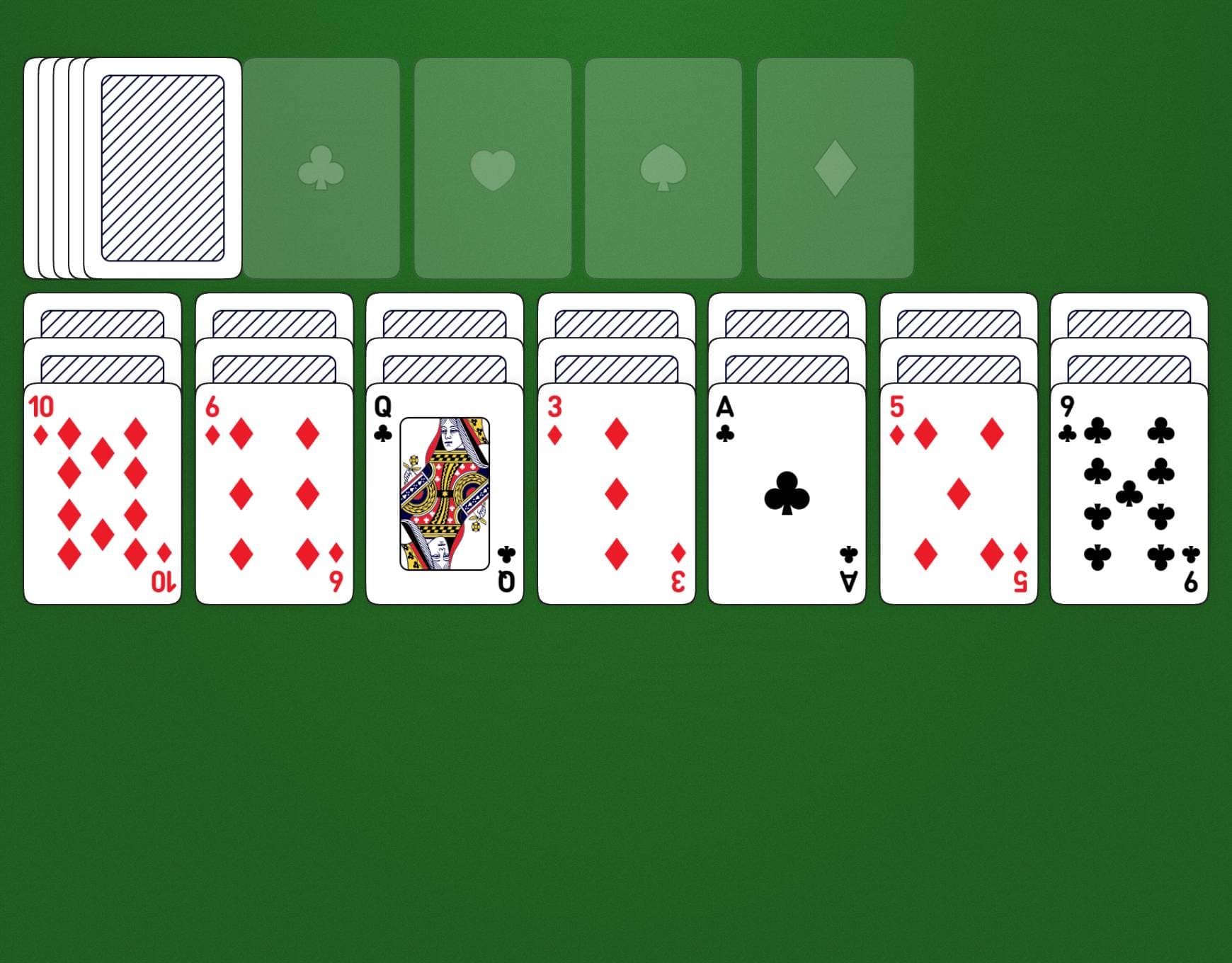
A will-o'-the-wisp is the pale marsh light of folklore that flickers ahead of night travellers and recedes as they approach — a fitting name for this compact Spider, where the win so often glows one deal away and then slips out of reach. Together with Spiderette it is the standard way to play Spider with a single deck: where Spiderette borrows Klondike's triangular deal, Will o' the Wisp Solitaire lays out a plain rectangle of seven piles, three cards deep, with only the top card of each showing.
The play is Spider through and through. Piles build down without regard to suit, but only descending cards of the same suit may travel together, so every off-suit landing buys time now at the price of a knot to untangle later. Clicking the stock throws a fresh card onto every pile — four full rounds and one final short one — and, as in every Spider, the deal is refused while any pile stands empty. A suit assembled in full, King down to Ace, is moved off to a foundation, and four finished suits win the game.
A single deck fills those seven piles, and getting them untangled is difficult work — you'll clear it roughly 10% of the time, and skill decides most of that outcome.
It plays much like Spiderette Solitaire and Spider Solitaire 4 Suits.
If you'd rather leave Spider behind for a while, Solitaire is the classic to return to.
If you run into anything odd or have an idea that would make the game better, please contact me.
Enjoy playing!
How to play Will o' the Wisp Solitaire
Layout:
4 foundation piles: Each receives one completed King-to-Ace sequence of a single suit. Fill all four to win.
7 tableau piles: Build down regardless of suit; only same-suit runs move as a group. Each pile is dealt three cards, the top one face-up.
Stock: Click to deal one card face-up onto every tableau pile. Dealing is not allowed while any pile is empty. There are no redeals.
Foundation:
There are four foundation piles.
Nothing is built on the foundations card by card. Instead, once you have assembled a complete descending run from King to Ace in a single suit on the tableau, you may move the whole thirteen-card sequence onto an empty foundation pile.
The top card of each foundation can be moved back into play if another pile will accept it. The game is won when all four suits have been completed and moved off.
Tableau:
Seven tableau piles of three cards each, laid out in a plain rectangle. In every pile the bottom two cards are dealt face-down and the top card face-up; a face-down card is turned over as soon as it is exposed.
A card can be added to a tableau pile only if it's one rank lower than the pile's current top card, regardless of suit, so any 7 fits on any 8.
Only a face-up descending run in a single suit may be moved as a group; mixed-suit sequences must be taken apart one card at a time.
Empty spaces may be filled with any card or any movable same-suit run.
Stock:
The remaining thirty-one cards comprise the stock, dealt face down.
When you click on the stock, one card is dealt face-up onto every tableau pile — four full deals of seven cards and a final deal of three to the first three piles. You may not deal while any tableau pile is empty. There are no redeals.


