Play Super Challenge FreeCell Solitaire Online for Free (No Signup Required)
Play ordinary FreeCell, but with every ace and two buried at the bottom and only Kings allowed into empty columns, a combo that crushes your win rate.
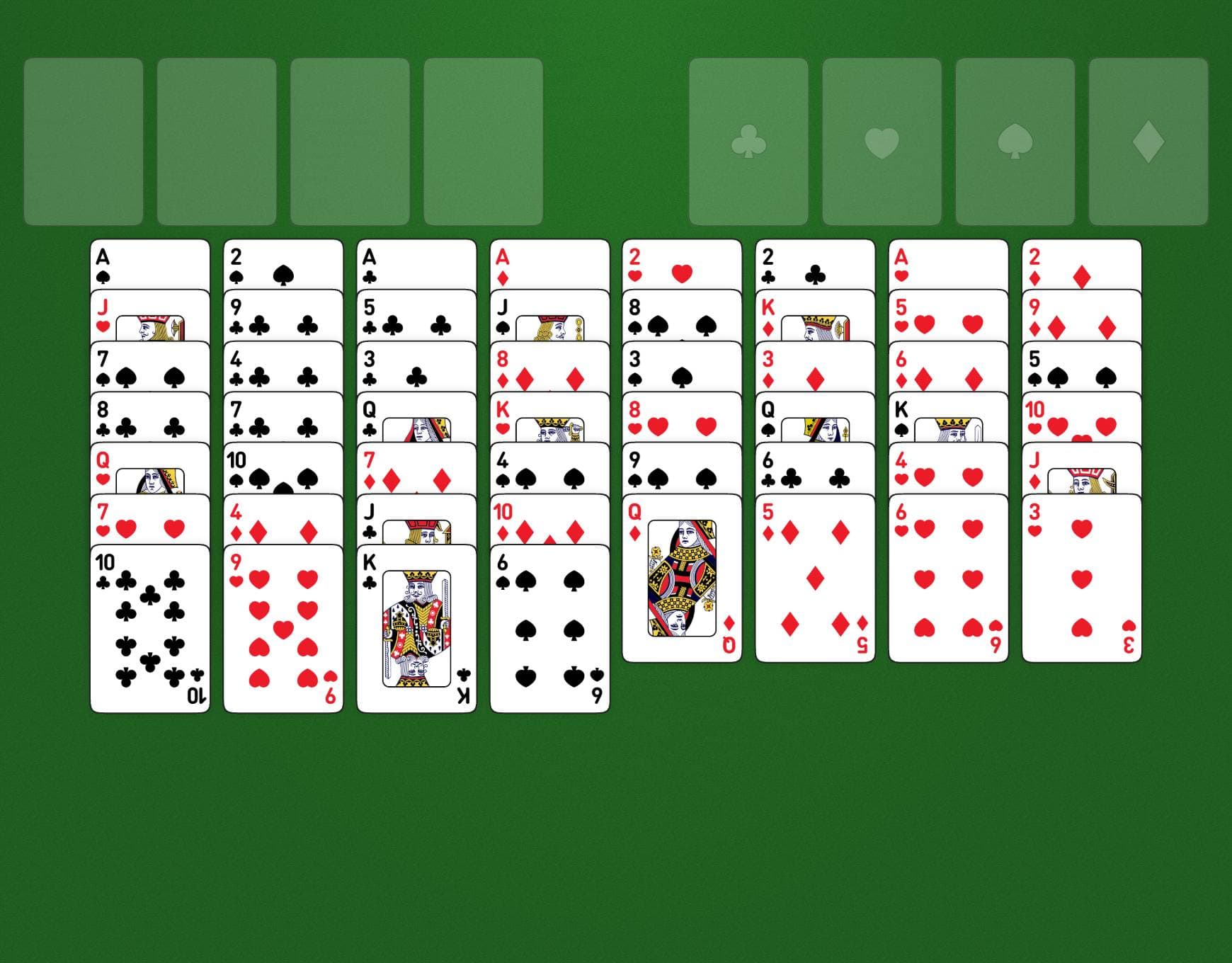
Super Challenge FreeCell Solitaire comes from Thomas Warfield, the designer behind Pretty Good Solitaire, who built a whole family of FreeCell spin-offs that keep the familiar open layout but crank up the difficulty. This is the toughest rung on that ladder. Everything looks like ordinary FreeCell — fifty-two cards face up across eight columns, four free cells, four foundations — yet two small changes turn a gentle solve into a genuine puzzle.
The first change is what players call "ace depth." Instead of a purely random shuffle, the deal forces every ace and every two down to the very bottom of the eight columns. Because the foundations start with the aces, you cannot make a single foundation move until you have excavated a card buried under five or six others. Long stretches of the game are spent digging rather than building, and a careless early move can seal an ace away for good.
The second change is the "super" part. In Challenge FreeCell any card may drop into an empty column, which gives you a valuable release valve. Super Challenge FreeCell slams that valve shut: only a King may occupy an empty column. With Kings the hardest cards to free and empty columns the most precious resource in any FreeCell, this single rule pushes the win rate far below plain FreeCell and rewards patient, several-moves-ahead planning.
The winning approach is to treat your free cells as short-term loans, not storage. Keep a cell open when you can, plan which King will refill an empty column before you empty it, and dig out the shallowest ace first to open a foundation early.
If you want to work up to it, start with plain FreeCell to learn the mechanics, then try its gentler twin Challenge FreeCell Solitaire, where empty columns accept any card. Eight Off Solitaire is another good stop for fans of open-layout FreeCell puzzles.
If you run into anything odd or have an idea that would make the game better, please contact me.
Enjoy playing!
How to play Super Challenge FreeCell Solitaire
Layout:
8 tableau columns: All 52 cards are dealt face up across eight columns, and every ace and two is forced to the bottom of a column.
4 free cells: Four single-card holding cells, all empty at the start.
4 foundation piles: Built up by suit from Ace to King. Empty at the start.
Foundation:
There are four foundation piles, one per suit.
A card can be added to a foundation pile only if it's one rank higher and the same suit as the pile's current top card, so the only card that fits on a 6 of clubs is a 7 of clubs. Each foundation begins with an Ace and finishes with a King. Because the aces sit at the very bottom of the tableau, freeing them is your first and hardest job. Cards, once placed on a foundation, stay there.
Tableau:
Eight columns, dealt face up, with the aces and twos buried at the bottoms.
A card can be added to a tableau pile only if it's one rank lower and the opposite color of the pile's current top card, so the only card that fits on the 8 of spades is a red 7. You can move a run of cards at once, but only as many as your open free cells and empty columns allow, since technically each card moves through a cell. An empty column can be filled only by a King (or a King-led sequence) — plan ahead, because you cannot simply drop any spare card into it.
Free cells:
Four free cells, each holding a single card of any suit or rank.
Move a card into an open cell to get it out of the way, then play it back onto the tableau or up to a foundation when the moment is right. Every occupied cell shrinks the size of the sequence you can shift in one go, so empty them as quickly as you fill them.


