Play SpiderCells Solitaire Online for Free (No Signup Required)
Four FreeCell cells, one Spider goal: sort all 52 cards into descending alternating-color runs with every cell empty, using nothing but the skill in your hands.
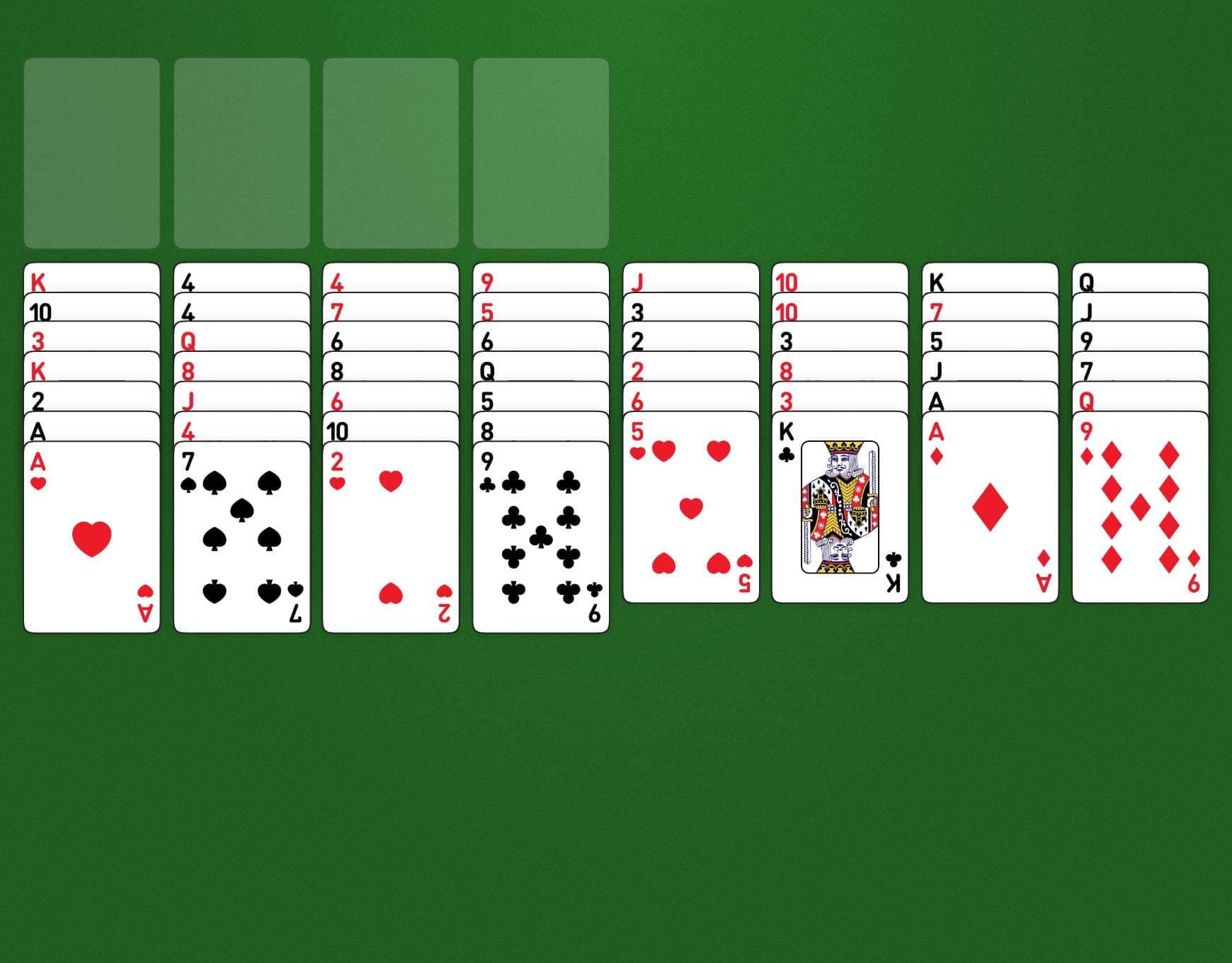
SpiderCells Solitaire crosses two of the most popular solitaire families into one open-information puzzle. From FreeCell it borrows the four storage cells and the fully face-up deal; from Spider it takes the idea of sorting the cards in place. There are no foundation piles at all — you win by arranging all 52 cards into descending, alternating-color order across the eight tableau columns while leaving every cell empty.
The absence of foundations changes how you think about the game. A cell is only a temporary parking spot, since any card you tuck away must eventually come back down to the tableau. On the other hand, descending alternating-color runs move as a single unit no matter how long they are, so the game is more forgiving than FreeCell once your sequences start to grow.
It's easy to learn but rewards careful planning. The game uses a single deck, and since every card is visible from the very first move, your odds of winning come down almost entirely to your skill.
If you like SpiderCells, you'll probably enjoy FreeCell and Spider Solitaire too, since this game borrows straight from both of them.
Or go back to basics with the original Solitaire.
If you run into anything odd or have an idea that would make the game better, please contact me.
Enjoy playing!
How to play SpiderCells Solitaire
Layout:
4 cells: Each cell holds one card, which can be played back to the tableau. All four cells start empty — and must be empty again to win.
8 tableau piles: Build down in alternating colors. Cards in descending alternating-color sequence can be moved as a group. Any card or valid group can fill an empty pile. At the start of the game, the first four piles receive seven cards each and the last four receive six, all face-up.
Cells:
There are four cells, and all four start out empty.
One card can be stored in each cell. Any available card can be played into any open cell, and cell cards can be played back onto the tableau at any time.
Because SpiderCells has no foundations, a card parked in a cell must eventually return to the tableau. The game cannot be won while any cell is occupied.
Tableau:
The eight tableau piles are dealt entirely face-up: seven cards in each of the first four piles and six cards in each of the last four.
A card can be added to a tableau pile only if it's one rank lower and the opposite color of the pile's current top card, so the only cards that fit on a 9 of hearts are the 8 of spades and 8 of clubs.
Cards on the tableau that are not covered by another card are free to be played onto a cell or any other tableau pile. Cards in descending alternating-color order move together as a single group, and unlike FreeCell, the size of the group is never limited by the number of empty cells.
Any card or valid sequence can fill an empty slot in the tableau.
There are no foundation piles. Instead, you win by sorting the whole deck where it lies: the game is over when every tableau pile is arranged in descending alternating-color order and all four cells are empty.


