Play Saratoga Solitaire Online for Free (No Signup Required)
Every Klondike card lands face-up, so you can plan the whole board instead of guessing where things hide. It's still real Klondike underneath: about 45% of deals win.
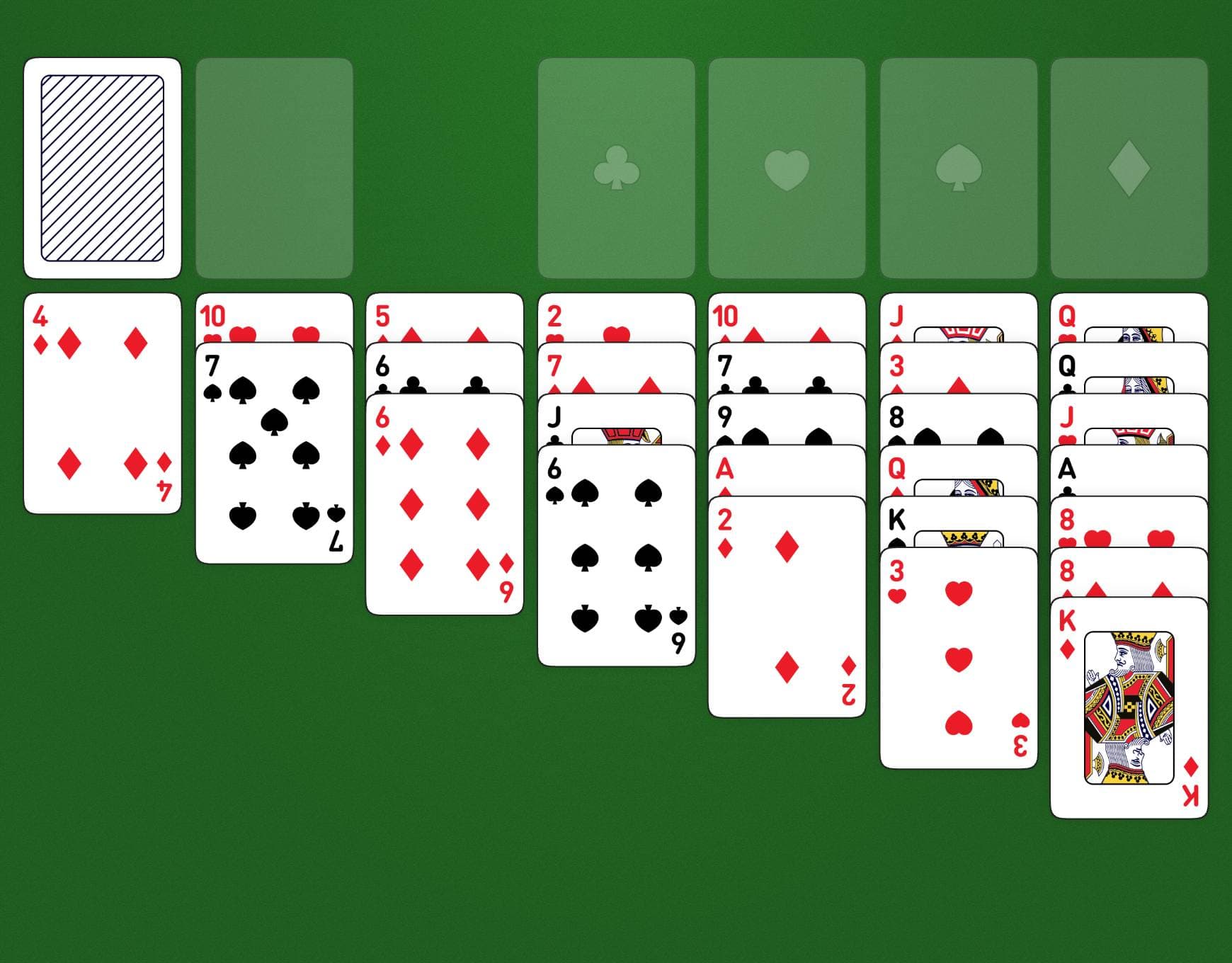
Saratoga Solitaire is Klondike with all its cards on the table: the tableau is dealt exactly as in the classic game, but every card lands face-up, so you can study the whole deal from the first move. The name fits the family tradition — Klondike was named after a gold rush, and Saratoga recalls Saratoga Springs, the New York resort town famous for its nineteenth-century racetrack and gaming rooms. Medium difficulty here means occasional punishing blocks, but about 45% of deals still come home. One deck is all it takes, and skill drives the outcome more than luck does.
Seeing every card changes the character of the game more than the small rule tweak suggests. In standard Klondike you often guess at which pile hides the card you need; in Saratoga you can count, plan, and choose the order of your digs with open eyes. The stock still turns three cards at a time, but redeals are unlimited, so patience is rewarded — the real skill lies in choosing which tableau moves to make now and which to hold in reserve.
Whitehead Solitaire is Saratoga's closest cousin, another Klondike variant dealt fully face-up. Thumb and Pouch Solitaire takes a different tack, keeping the usual hidden cards but loosening the building rule so any card of a different suit can go down, not just an opposite color.
Original Solitaire is the root this whole variant grew from, and it's worth returning to.
If you run into anything odd or have an idea that would make the game better, please contact me.
Enjoy playing!
How to play Saratoga Solitaire
Layout:
4 foundation piles: Build up from Ace to King in the same suit.
7 tableau piles: Build down in alternating colors. Sequences in alternating colors may be moved as a group. Only a King, or a sequence starting with a King, may fill an empty space. To begin the game, one card is dealt to the first pile, two cards to the second, and so on — every card face-up.
Stock: Click to turn over three cards at a time to the waste pile. Redeals are unlimited.
Waste: Top card is always accessible for play on the foundations or tableau.
Foundation:
There are four foundation piles.
A card can be added to a foundation pile only if it's one rank higher and the same suit as the pile's current top card, so the only card that fits on a 6 of diamonds is a 7 of diamonds. There can be no more than 13 cards in a pile.
The top card of each foundation can be moved back into play if another pile will accept it.
Tableau:
There are seven tableau piles, with one card in the first, two in the second, three in the third, and so on. Every card is dealt face-up.
A card can be added to a tableau pile only if it's one rank lower and the opposite color of the pile's current top card, so the only cards that fit on a 10 of clubs are the 9 of hearts and 9 of diamonds.
Cards on the tableau that are not covered by another card are free to be played onto the foundation or any other tableau pile.
Only a King, or a sequence headed by a King, can fill an empty slot in the tableau.
Groups of cards in succession from high to low, in alternating colors, may be moved from one tableau column to another.
Stock and waste:
There is one waste pile, and the remaining 24 cards make up the stock.
When you click on the stock, three cards from the stock are dealt to the waste pile. When the stock is empty, click it to turn the waste back into the stock; there is no limit to the number of passes.
The top card of the waste pile can be played to the tableau or foundation.


