Play Odd and Even Solitaire Online for Free (No Signup Required)
Race two decks onto eight foundations that climb by twos, odd ranks from the aces and even from the twos, while empty tableau spots refill themselves.
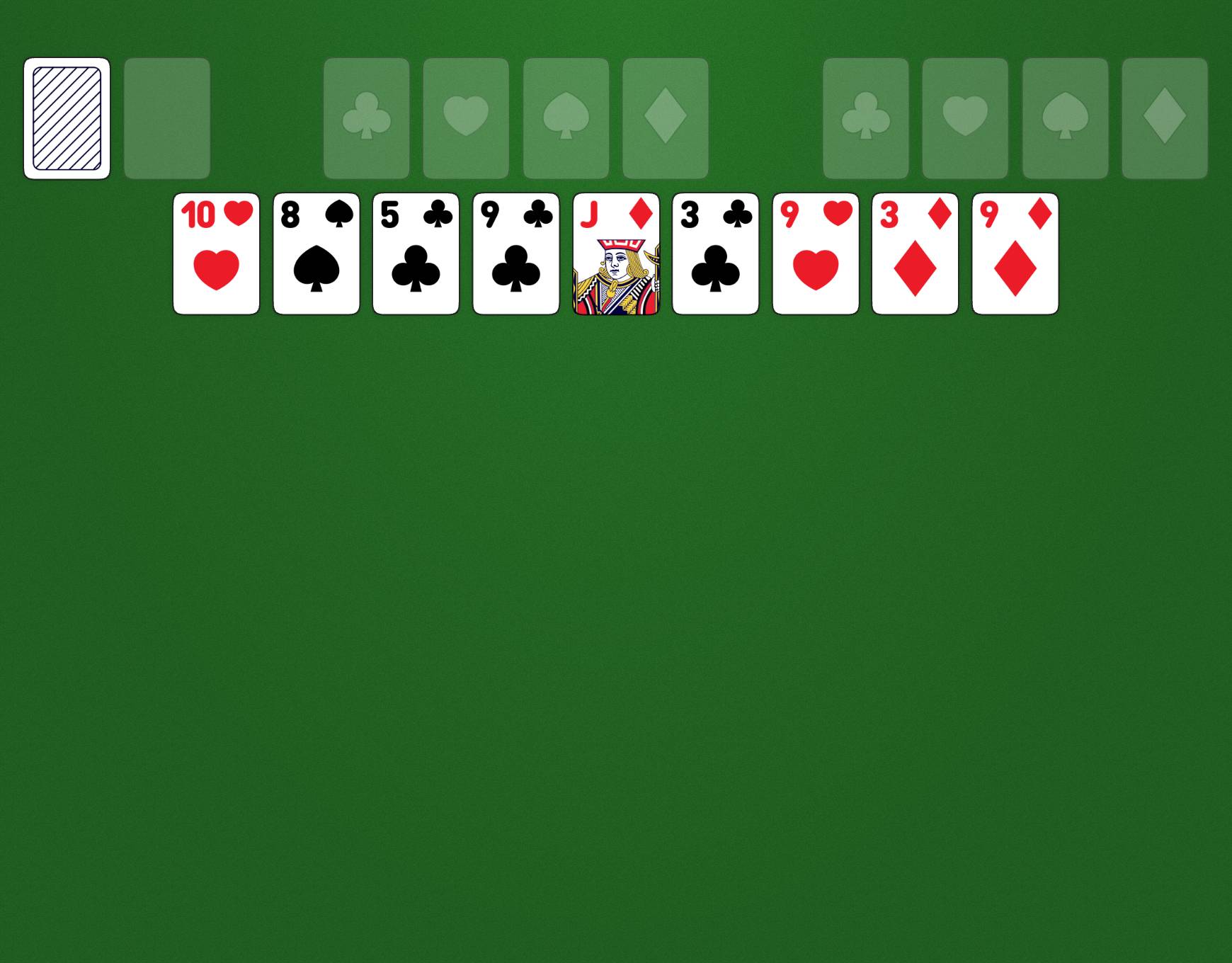
Odd and Even Solitaire is an old two-deck patience that appears in card game collections from the nineteenth century, when games of this kind were fashionable parlour entertainment. Its name comes from the two families of foundations: four piles climb through the odd ranks from the aces, while the other four climb through the even ranks from the twos, each pile skipping a rank with every card.
There is no building on the nine tableau piles, and every vacated spot is refilled for you automatically, so play consists of spotting which cards can go up and turning the stock at the right moment. The game is fast, with a low chance of winning. Two decks are in play, and luck does most of the deciding here.
Royal Cotillion Solitaire and Double Dot Solitaire are the nearest relatives to this one in the catalog.
Fancy the original instead? Head over to Solitaire.
If you run into anything odd or have an idea that would make the game better, please contact me.
Enjoy playing!
How to play Odd and Even Solitaire
Layout:
8 foundation piles: Four piles start with aces and build up by twos in suit (A, 3, 5, ...), and four start with twos and build up by twos in suit (2, 4, 6, ...), wrapping past the King until each pile holds 13 cards.
9 tableau piles: One face-up card each. No building is allowed. Empty spots are automatically refilled from the waste, or from the stock when the waste is empty.
Stock: Click to flip over cards one at a time to the waste. One redeal is allowed.
Waste: Top card is playable.
Foundation:
There are eight foundation piles, split into two groups of four.
The first group must be started with aces and the second group with twos, one of each suit per group. The starting cards are not dealt for you; play them up from the tableau, the waste, or the stock as they appear.
A card can be added to a foundation pile only if it's exactly two ranks higher and the same suit as the pile's current top card, so the only card that fits on a 5 of spades is a 7 of spades. Sequences wrap past the King, so the ace piles run A, 3, 5, 7, 9, J, K, 2, 4, 6, 8, 10, Q and the two piles run 2, 4, 6, 8, 10, Q, A, 3, 5, 7, 9, J, K. A pile is complete once it holds 13 cards.
In practice, cards stay on the foundations once played, since no other pile will accept them.
Tableau:
Nine tableau piles of one card each. Every card is dealt face-up.
No cards may be built on the tableau; each card's only destination is a foundation pile. This makes the tableau work like a bank of nine single-card reserves.
Whenever a tableau spot is emptied, it is immediately refilled with the top card of the waste. If the waste is empty, the refill comes from the stock instead. You may not fill spaces yourself.
Stock and waste:
There is one waste pile and the remaining 95 cards comprise the stock.
When you click on the stock, one card from the stock is dealt to the waste. When the stock runs out, click the empty slot to turn the waste over for a second and final pass; no further redeals are allowed.
The top card of the waste can be played to the foundations.


