Play Munger Solitaire Online for Free (No Signup Required)
Trim the reserve to seven cards, peel back Athena's checkerboard tableau, and make your single pass through the stock count in this tightened cousin of Minerva.
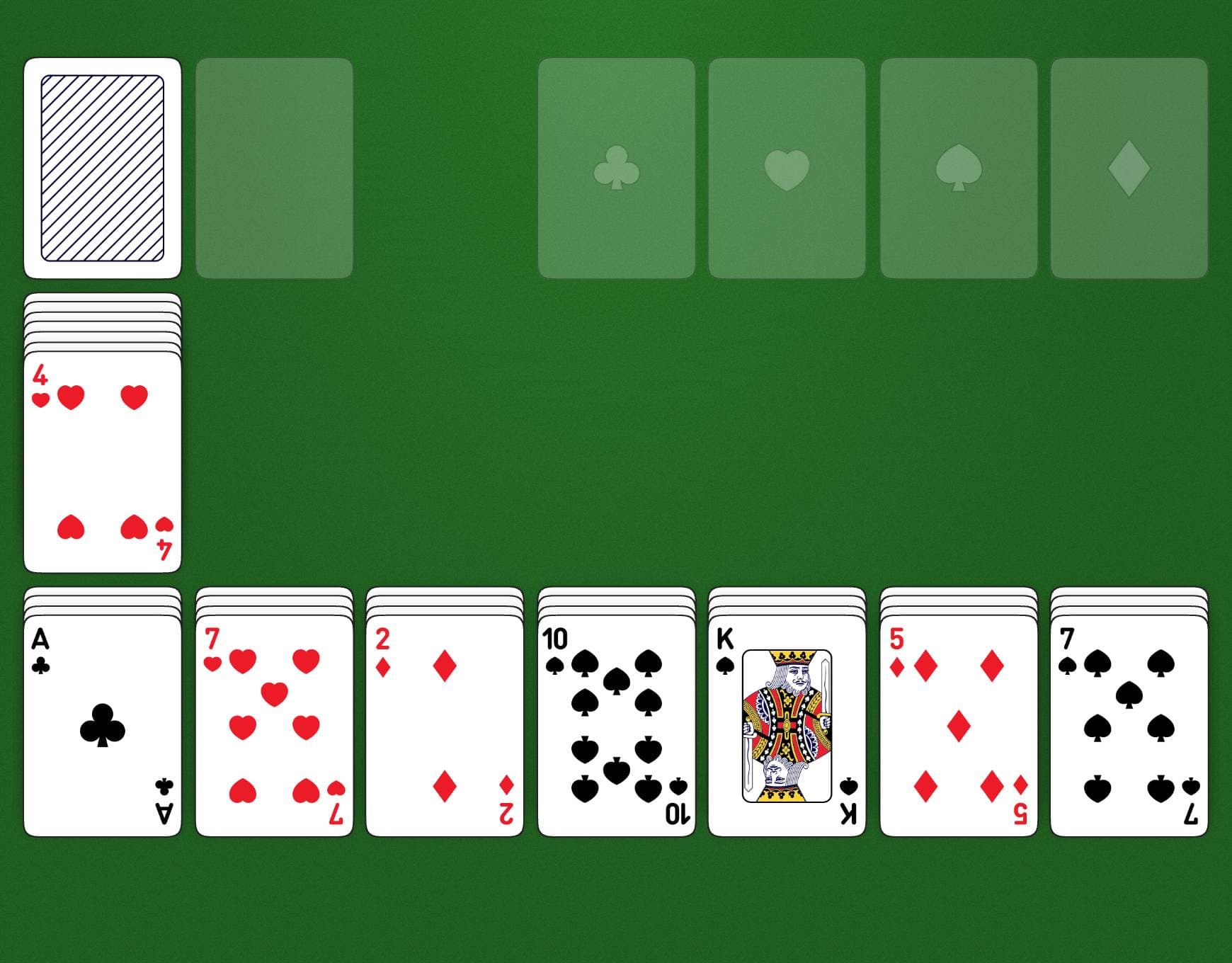
Munger Solitaire is a tightened cousin of Minerva, itself a member of the Athena family. It keeps Minerva's shape — four suit foundations, a Canfield-style reserve, and a tableau built down in alternating colors — but trims the reserve to seven cards and allows a single pass through the stock. Both changes push the game toward careful, front-loaded planning.
The tableau is dealt in the Athena pattern: seven columns of four cards, with the first and third rows face down and the second and fourth face up. That checkerboard means every column hides two cards you must expose through play, so the early game is a steady effort to peel back the board before the stock runs out.
Because the stock passes only once and hands out a single card at a time, there is no cycling back for a missed chance. When a column empties it takes only a King, which makes vacated spaces valuable and hard to reuse. Munger favors players who commit their reserve and stock cards deliberately, since a wasted turn here is one you rarely get back.
If you enjoy Munger, try Minerva Solitaire or Double Minerva Solitaire, two closely related solitaire card games.
If you run into anything odd or have an idea that would make the game better, please contact me.
Enjoy playing!
How to play Munger Solitaire
Layout:
4 foundation piles: Build up in suit from the Ace to the King.
7 tableau piles: Four cards each, dealt with the first and third rows face down and the second and fourth face up. Build down in alternating color. Empty columns may only be filled with a King.
Reserve: Seven cards are dealt here face up; the top card is available for play.
Stock: Click to deal one card at a time to the waste. There is a single pass with no redeals.
Waste: The top card is playable.
Foundation:
There are four foundation piles.
Each pile is built upward in a single suit, beginning with an Ace and ending with a King. A card can be added to a foundation pile only if it's one rank higher and the same suit as the pile's current top card, so the only card that fits on the 8 of spades is the 9 of spades.
The top card of each foundation can be moved back into play if another pile will accept it.
Reserve:
There is one reserve of seven cards, all dealt face up. No card may be moved into the reserve. The reserve's top card can be played onto a foundation or a legal tableau pile.
Tableau:
Seven tableau piles of four cards each, dealt in an overlapping cascade. The first and third cards of each column are face down, the second and fourth face up; uncovering a face-down card turns it up.
A card can be added to a tableau pile only if it's one rank lower and the opposite color of the pile's current top card, so the only card that fits on an 8 of spades is a 7 of hearts. Ordered runs may be moved together.
Cards on the tableau that are not covered may be played onto a foundation or another tableau pile.
An empty tableau column may be filled only with a King.
Stock and waste:
The undealt cards form the stock, and turned cards gather on the waste.
When you click the stock, one card is dealt to the waste. There is only one pass through the stock, with no redeals.
The top card of the waste can be played to the tableau or the foundation.


