Play Farmer's Wife Solitaire Online for Free (No Signup Required)
Ten columns of Three Blind Mice with one rule flipped: build down onto a different suit instead of the same one. Fairly easy, single deck, 60% win rate.
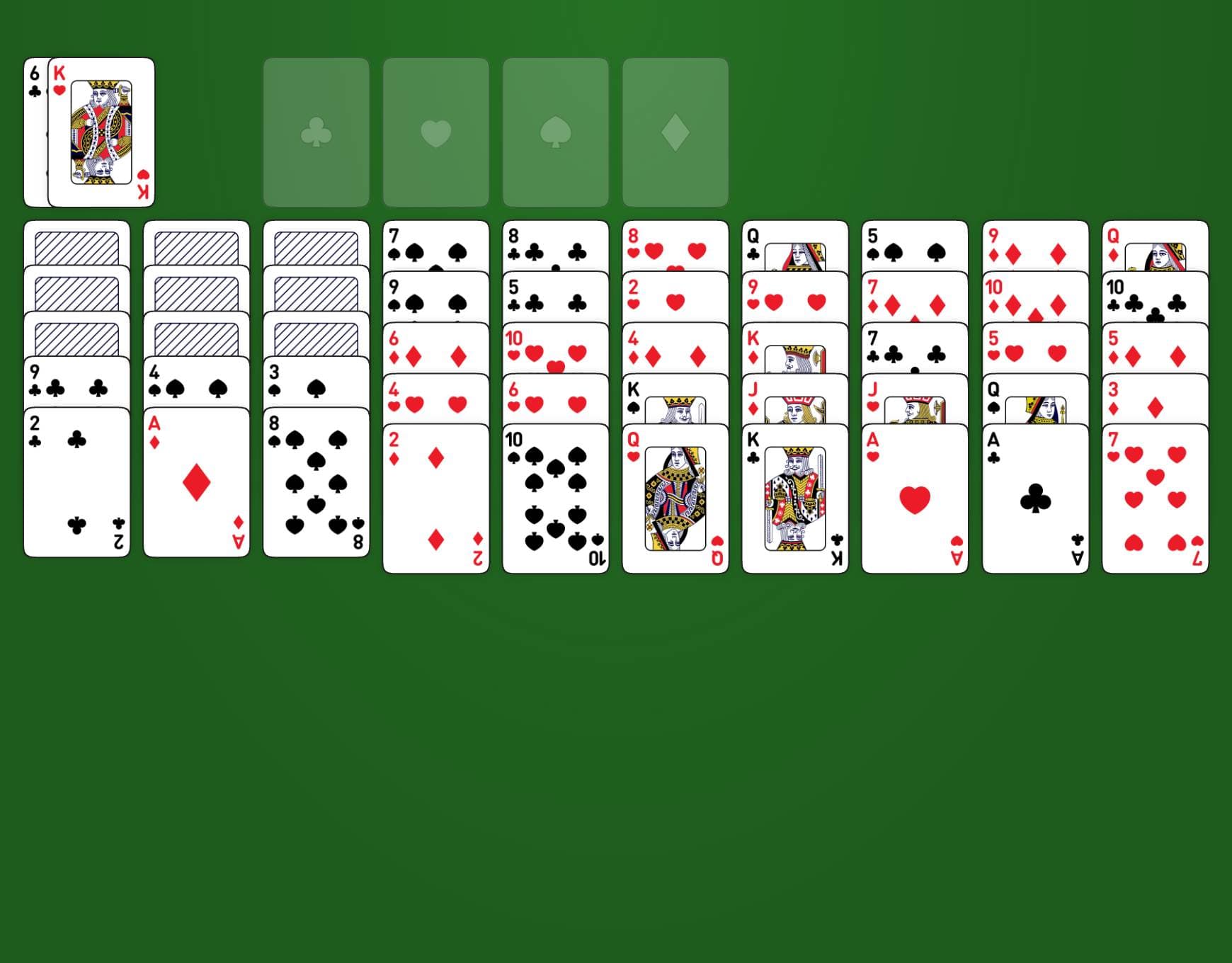
Farmer's Wife Solitaire takes its name from the same nursery rhyme as Three Blind Mice: she is the knife-wielding character of the verse, and the game is that layout with a single rule reversed. Ten columns of five cards are dealt from one deck, the first three hiding three face-down cards at their base, and the two leftovers rest beside the tableau as a small reserve.
The reversal lies in the building. Where Three Blind Mice insists that every card land on the next-higher card of its own suit, Farmer's Wife demands the opposite: each card must go on a next-higher card of a different suit, so an 8 of spades accepts the 7 of hearts, diamonds, or clubs — anything but the 7 of spades. Even the finished King-to-Ace runs you deliver to the foundations obey the rule, with no two neighboring cards sharing a suit.
As in Scorpion, any face-up card may be picked up with everything stacked on top of it, and only Kings may claim empty columns. With three suits to aim for on every build, this is the gentler sibling of the pair. The game is fairly easy, with about a 60% chance of winning. Played with a single deck, this one rewards good choices more than good luck: with three suits open on every build, skill is what wins games.
Three Blind Mice Solitaire and Scorpion Solitaire are the two games this one borrows its rules from.
Farmer's Wife fans should also try Spider Solitaire, the classic game this whole family builds on.
If you run into anything odd or have an idea that would make the game better, please contact me.
Enjoy playing!
How to play Farmer's Wife Solitaire
Layout:
4 foundation piles: Each one receives a complete sequence of thirteen cards from King down to Ace, with every card in a different suit from the one before it.
10 tableau piles: Build down, each card in a different suit from the card it lands on. Any face-up card can be moved along with all the cards on top of it. Only Kings may fill empty spaces. Each pile is dealt 5 cards; in the first three piles, three cards are face-down and two are face-up, while the other seven piles are entirely face-up.
Reserve: The two cards left over after the deal lie here face-up. The top card is available for play.
Foundation:
There are four foundation piles.
Single cards are never allowed to be moved to the foundation. Only once you've built a complete sequence on the tableau, thirteen cards in order from King down to Ace with each card in a different suit from its neighbor, can you transfer it to a foundation pile.
The top card of each foundation can be moved back into play if another pile will accept it.
Reserve:
The reserve holds the two cards left over after the deal, both face-up.
There is no stock to deal from, and no cards may be moved into the reserve. The top card of the reserve may be played to any tableau pile where it fits.
Tableau:
Ten tableau piles of five cards each. In the first three piles the bottom three cards are dealt face-down; every other card is dealt face-up.
A card can be added to a tableau pile only if it's one rank lower and a different suit than the pile's current top card, so the cards that fit on an 8 of spades are the 7 of hearts, the 7 of diamonds, or the 7 of clubs — never the 7 of spades.
Any face-up card in the tableau may be moved to another pile where it fits, bringing all cards on top of it along with it, regardless of their order. Face-down cards turn over as soon as they are uncovered.
Only Kings, or groups of cards led by a King, may fill empty spots in the tableau.


