Play Cheops Solitaire Online for Free (No Signup Required)
Named for the pharaoh, Cheops pairs same or neighboring ranks instead of summing to thirteen, with just one pass through the stock instead of Pyramid's three.
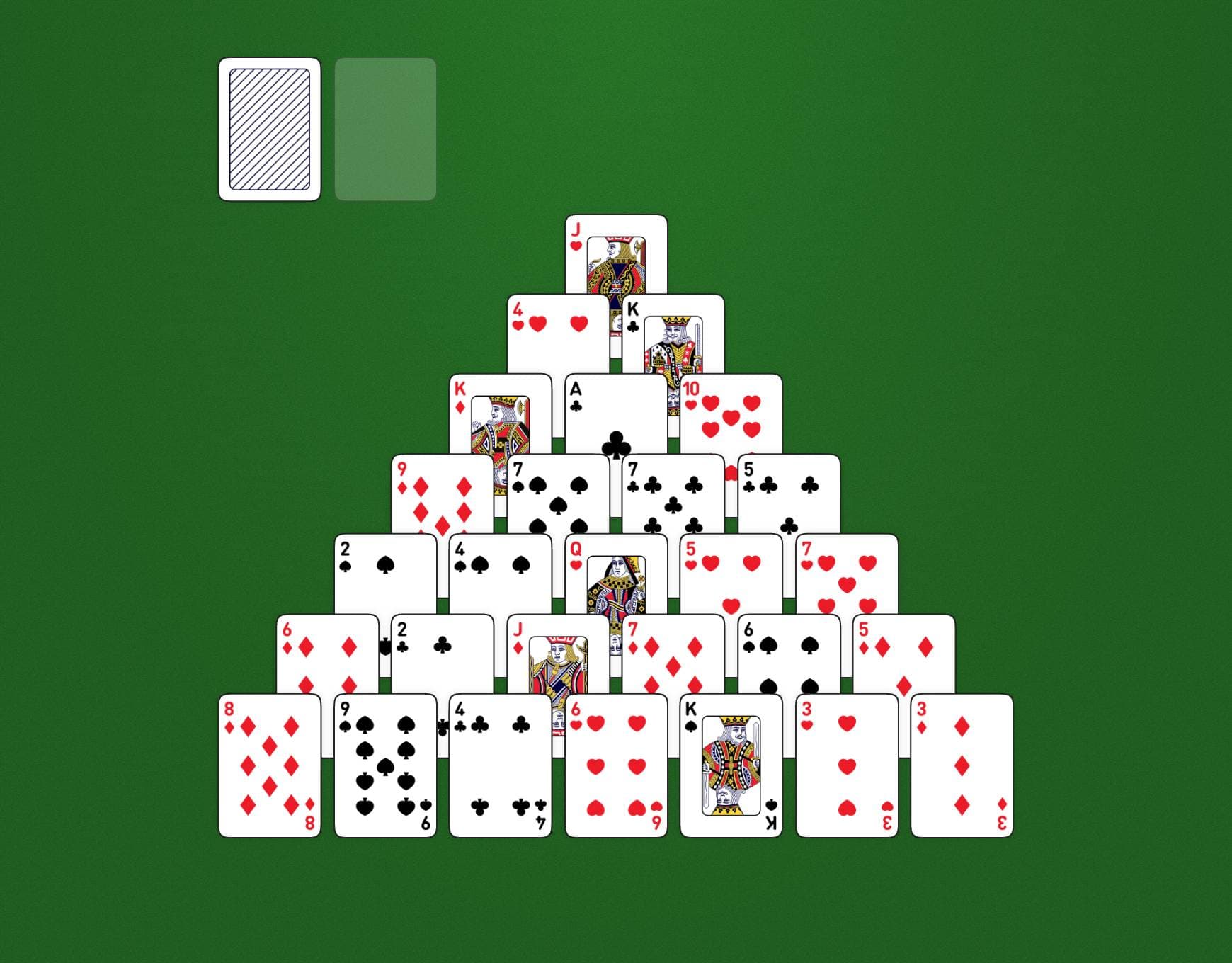
Cheops Solitaire is named after the pharaoh who built the Great Pyramid of Giza, and the tribute is fitting: the game is a close relative of Pyramid Solitaire, played on the same triangle of twenty-eight cards. The pairing rule, however, is completely different. Instead of hunting for pairs that add up to thirteen, you remove two exposed cards of the same rank or of neighboring ranks. A 9 can be paired with another 9, with an 8, or with a 10, and suits never matter.
That small change gives the game a very different rhythm. Ranks form a single ladder from Ace to King that does not wrap around, so an Ace only pairs with an Ace or a 2, and a King only with a King or a Queen. You also get just one pass through the stock — Pyramid allows three — so every card you flip to the waste deserves a moment of thought. The game is played with a single deck, and because you can usually choose between several legal pairs, your odds of victory are determined by both skill and luck.
The nearest relatives to Cheops in the catalog are Pyramid Solitaire, Giza Solitaire, and King Tut Solitaire.
If you run into anything odd or have an idea that would make the game better, please contact me.
Enjoy playing!
How to play Cheops Solitaire
Layout:
1 pyramid: Twenty-eight cards dealt face-up in seven overlapping rows. Only cards that are not covered by another card are playable.
Stock: Click to flip over cards one at a time to the waste. There is only one pass through the stock and no redeals.
Waste: The top card is available for pairing.
Pyramid:
There are twenty-eight cards in the pyramid. The first row receives one card, the second row two cards, and so on down to the seventh row, which receives seven cards. Each row overlaps the one above it, and every card is dealt face-up.
No building is permitted on the pyramid, and its empty slots may not be filled.
Cards that are not covered by another card are playable. Remove two exposed cards at a time if they are of the same rank or of consecutive ranks. A 7 may therefore be paired with another 7, a 6, or an 8. Suits are ignored. The rank sequence does not wrap around, so an Ace and a King cannot be paired together.
Removed pairs leave the game for good. You win when the pyramid is empty; cards left in the stock or waste do not matter.
Stock and waste:
There is one waste pile, and the remaining twenty-four cards comprise the stock.
When you click on the stock, one card from the stock is dealt to the waste. The top card of the stock is face-up and may be paired with the top card of the waste or with an exposed pyramid card. There is only one pass through the stock.
The top waste card is always available for pairing.


