Play Brigade Solitaire Online for Free (No Signup Required)
Brigade hands Flower Garden's foundations a head start with all four Aces placed, but its 13-card reserve is spent one card at a time, never refilled. Easy, 85% win rate.
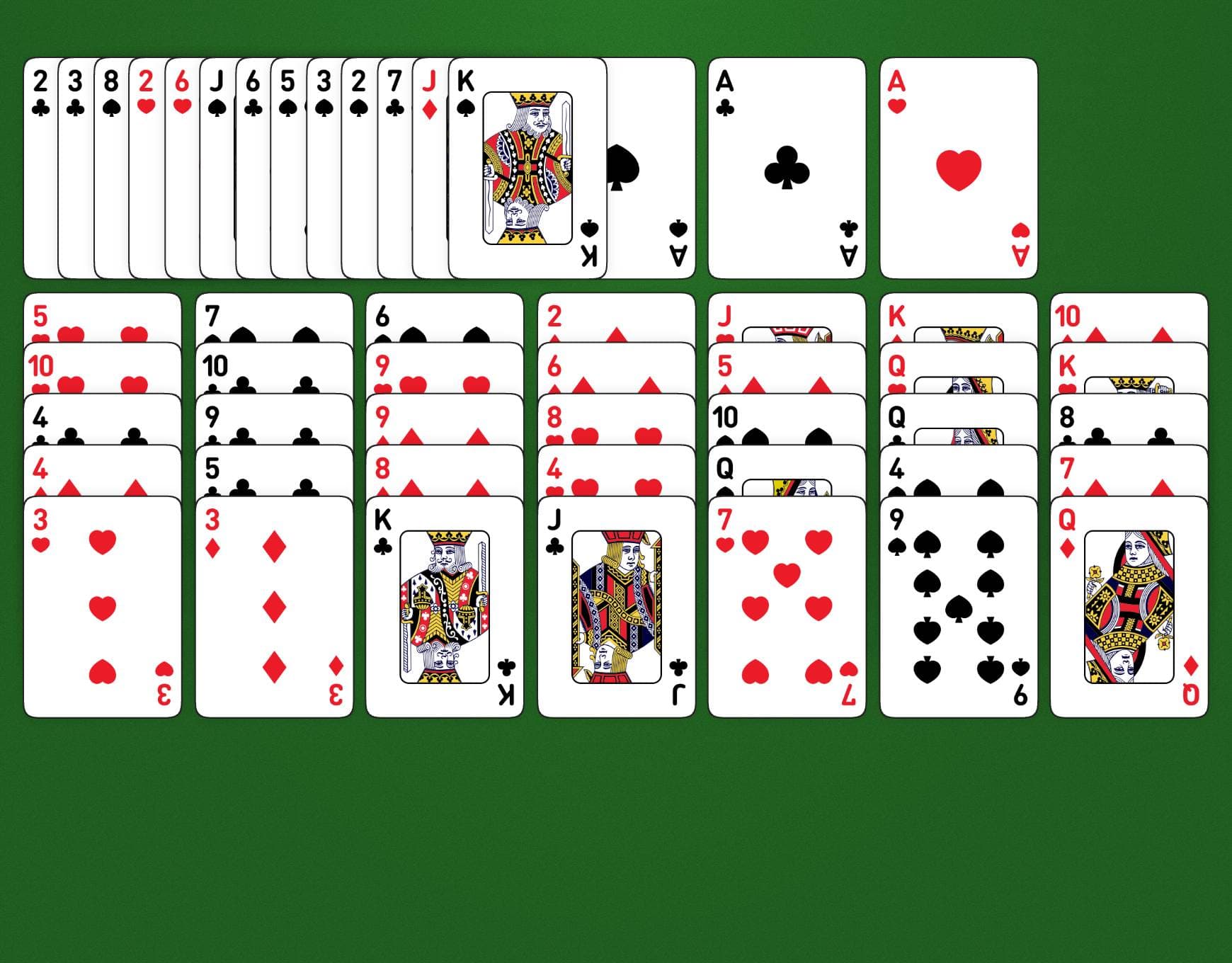
Brigade Solitaire is the parade-ground cousin of Flower Garden, an old patience in which a fan of loose cards must rescue a crowded tableau. Here the flower beds are drilled into seven tidy ranks of five soldiers each, and the leftover thirteen cards are fanned out beside them as the reserve — the brigade's supply column.
Two kindnesses make Brigade far friendlier than its parent. The four Aces are pulled from the deck before the deal and posted straight to the foundations, so building can begin with the very first move. And because the tableau builds down regardless of suit, almost any exposed card has somewhere useful to go. The discipline comes from the reserve: only its exposed card is available at any moment, it is never replenished, and nothing may ever be sent back into it — so each of those thirteen cards is a one-shot resource to be spent at exactly the right time.
Easy, at roughly 85%. Deal from a single deck, and skill carries most of that success rate.
This game keeps company with Flower Garden Solitaire and Wildflower Solitaire, both built from the same flower-bed idea.
Settle in with the classic Solitaire next.
If you run into anything odd or have an idea that would make the game better, please contact me.
Enjoy playing!
How to play Brigade Solitaire
Layout:
4 foundation piles: Build up in suit from Ace to King. The four Aces are dealt here at the start of the game.
7 tableau piles: Build down regardless of suit, one card at a time. Five face-up cards are dealt to each pile. Any card may fill an empty space.
Reserve: The 13 remaining cards, fanned face-up beside the tableau. Only the exposed card is available for play.
There is no stock and no waste; every card is in view from the very first move.
Foundation:
There are four foundation piles, and each begins the game with its Ace already in place.
A card can be added to a foundation pile only if it's one rank higher and the same suit as the pile's current top card, so the only card that fits on an 8 of spades is the 9 of spades. There can be no more than 13 cards in a pile.
The top card of each foundation can be moved back into play if another pile will accept it.
Reserve:
There is one reserve, which originally contains thirteen cards fanned face-up. Only the exposed card at the end of the fan may be played, either to the foundations or onto a tableau pile — including an empty one.
No card may ever be moved into the reserve, and it is never replenished. Once the fan runs out, it is gone for the rest of the game.
Tableau:
There are seven tableau piles of five cards each. Every card is dealt face-up.
A card can be added to a tableau pile only if it's one rank lower than the pile's current top card, regardless of suit, so any 7 fits on any 8.
Cards on the tableau that are not covered by another card are free to be played onto the foundation or any other tableau pile.
Any single card — from the tableau or the reserve — may fill an empty tableau spot.
Only one card may be moved at a time; sequences are not permitted.


