Play Big Apple Solitaire Online for Free (No Signup Required)
Trade New York's three waste piles for three single-card free cells, then push 96 stock cards through one unforgiving pass: just a 15% win rate.
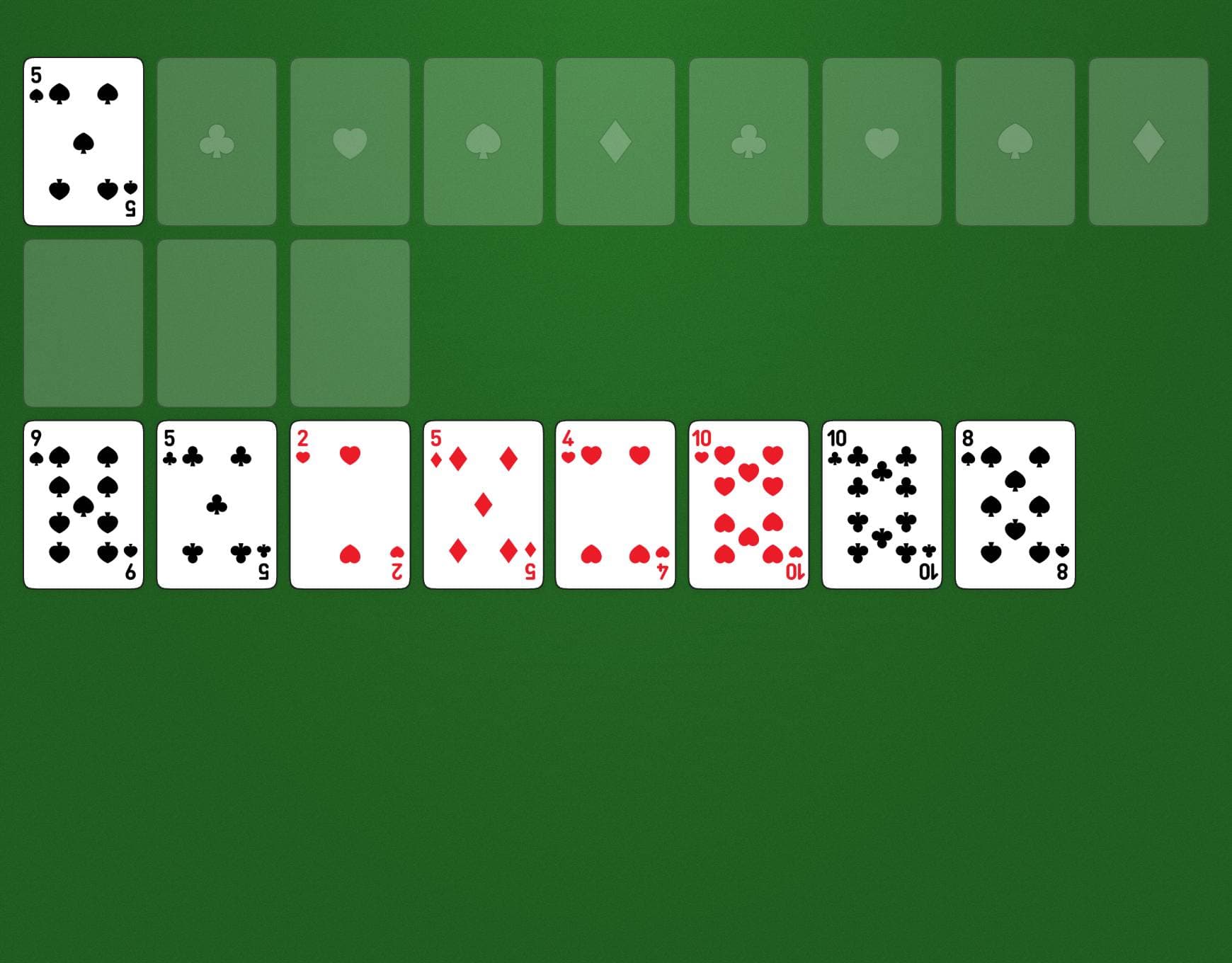
Big Apple Solitaire is the youngest member of a small family of two-deck patiences named after New York City. The family patriarch, New York, makes you manage three waste piles; its descendant Gotham loosened the tableau so that cards build down regardless of suit but move only in suit; and Big Apple completes the journey by trading the three waste piles for three free cells that hold a single card apiece.
The whole game flows through the stock. After one card is dealt to each of the eight tableau piles, the remaining 96 cards wait in the stock with the top card always face-up, and each one must be sent somewhere — a tableau pile, a cell, or a foundation — before the next can be seen. There is no waste pile and no second pass, so a card parked badly can clog the table for the rest of the deal.
One quirk deserves special attention: an emptied tableau pile may only be refilled from the stock or from a cell, never from another tableau pile. Free spaces are therefore best saved for the awkward cards the stock forces on you, rather than treated as a way to reorganize the table.
Two decks funnel every card through a single stock pass, and that's why only about 15% of these difficult games end in a win — skill decides most of it.
It plays like Colorado Solitaire or Sir Tommy Solitaire, if you want more in that same style.
Original Solitaire is the plain, no-frills version this family builds on.
If you run into anything odd or have an idea that would make the game better, please contact me.
Enjoy playing!
How to play Big Apple Solitaire
Layout:
8 foundation piles: Build up in suit from Ace to King. All piles start empty.
3 cells: Card storage places. Each cell can only have one card, which can be played back to the tableau or the foundations.
8 tableau piles: Build down regardless of suit. One card is dealt face-up to each pile. Empty spaces may only be filled from the stock or a cell.
Stock: The top card is always face-up and may be played directly to the tableau, a cell, or the foundations. There is only one pass through the stock.
Foundation:
There are eight foundation piles — two for each suit, since the game is played with two decks. All of them begin empty.
Any Ace may be moved to an empty foundation pile. A card can be added to a foundation pile only if it's one rank higher and the same suit as the pile's current top card, so the only card that fits on an 8 of spades is a 9 of spades. There can be no more than 13 cards in a pile.
The top card of each foundation can be moved back into play if another pile will accept it.
Cells:
Three cells, all of which are originally vacant.
One card can be stored in each cell. Any available card — from the tableau or the top of the stock — can be played into any empty cell. Cell cards can be played back to a tableau pile, an empty tableau spot, or the foundations.
Tableau:
Eight tableau piles of one card each. Every card is dealt face-up.
A card can be added to a tableau pile only if it's one rank lower than the pile's current top card, regardless of suit or color, so the cards that fit on an 8 of spades are any of the eight 7s.
Cards on the tableau that are not covered by another card can be played onto the foundations, an empty cell, or any other tableau pile. A descending run may be moved as a group only if all of its cards are of the same suit.
Empty tableau spots may only be filled from the stock or from a cell — cards may not be moved into them from other tableau piles.
Stock:
After the deal, the remaining 96 cards make up the stock.
The top card of the stock is always face-up and may be played directly to any tableau pile, an empty cell, or a foundation — there is no waste pile.
You only get one pass through the stock, so find a home for every card before you commit the next one.


