Play Anubis Solitaire Online for Free (No Signup Required)
Tear down a 45-card double-deck pyramid, pair ranks that sum to thirteen, and juggle three waste piles with just two passes through the stock.
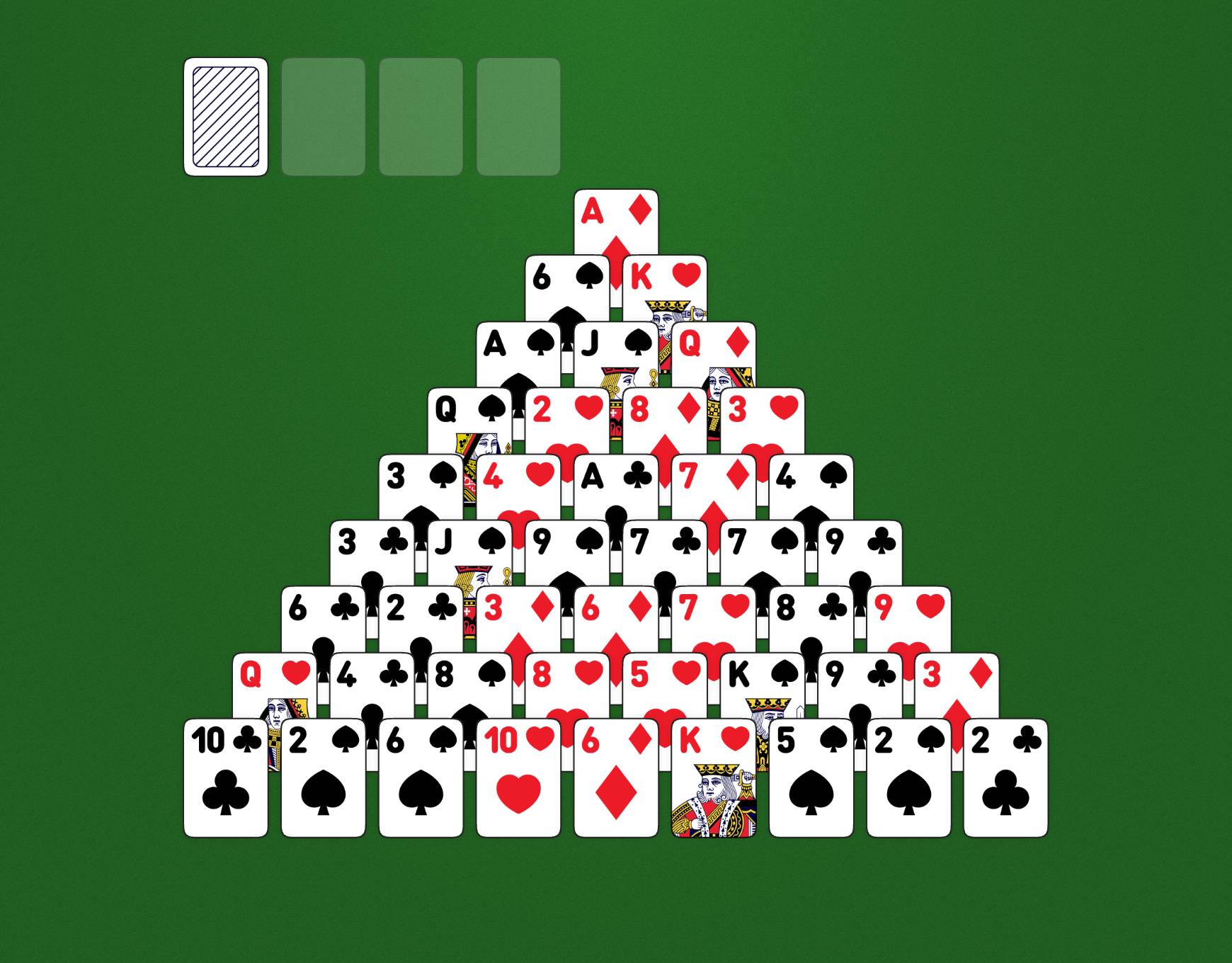
Anubis Solitaire is named after the jackal-headed god who watched over the tombs of ancient Egypt, and the game gives him a worthy monument to guard: a grand pyramid of forty-five cards, dealt from two decks into nine overlapping rows. As in classic Pyramid, your task is to tear that monument down. Remove exposed cards two at a time whenever their ranks add up to thirteen — a Queen with an Ace, a Jack with a 2, a 10 with a 3 — while Kings count thirteen all by themselves and are discarded singly.
What makes Anubis feel different from Double Pyramid is the deal. Every click on the stock turns one card onto each of three waste piles at once, so you are always choosing from three open cards rather than one. The extra information is generous, but the game asks for something in return: you only get two passes through the stock, where Double Pyramid allows three, and a card buried in the wrong waste pile can be hard to dig out again.
Because two decks are shuffled together, every pairing exists eight times over, yet the sheer size of the pyramid keeps the game challenging. You win the moment the pyramid is empty — cards left in the stock or waste piles do not count against you — and your odds of victory are determined by both skill and luck.
Anyone who likes the pairing-to-thirteen puzzle should also look at Double Pyramid Solitaire and Pyramid Solitaire.
Anubis punishes careless play; standard Solitaire is a slower, gentler build if you want the change of pace.
If you run into anything odd or have an idea that would make the game better, please contact me.
Enjoy playing!
How to play Anubis Solitaire
Layout:
1 pyramid: Forty-five cards from two decks, dealt face-up in nine overlapping rows. Only cards that are not covered by another card are playable.
Stock: Click to deal one card to each of the three waste piles. Two passes through the stock are allowed.
3 waste piles: The top card of each pile is available for pairing.
Pyramid:
There are forty-five cards in the pyramid. The first row receives one card, the second row two cards, and so on down to the ninth row, which receives nine cards. Each row overlaps the one above it, and every card is dealt face-up.
No building is permitted on the pyramid, and its empty slots may not be filled.
Cards that are not covered by another card are playable. Remove two exposed cards at a time if their ranks add up to thirteen. Kings count thirteen on their own and are discarded singly. Suits are ignored, and an Ace always counts as one.
Removed cards leave the game for good. You win when the pyramid is empty; cards left in the stock or waste piles do not matter.
Stock and waste:
There are three waste piles, and the remaining fifty-nine cards comprise the stock.
When you click on the stock, one card is dealt to each of the three waste piles. The top card of each waste pile may be paired with an exposed pyramid card or with the top card of another waste pile. When the stock runs out, the waste piles are gathered up to form a new stock; two passes in total are allowed.
The top card of each waste pile is always available for pairing.


