Play Spider Solitaire Online for Free (No Signup Required)
Afraid of spiders? No need to be afraid of this oldie but goodie. It can be a brain twister, all right. But you can do it.
This popular game got its name back in 1949 when it was created. Like the spider, it has eight "legs" - in the game's case, meaning the foundation piles, where all the cards end up if you win the game.
It has ten columns in the tableau, so there's a lot to keep track of. We recommend starting out with the one-suit version. This Itsy Bitsy Spider will make you feel invincible. Then, go on to the Spider Solitaire 2 Suits. You might find that spider puts up quite a bit of resistance. And if you feel like a true Spiderman from there, go on and tackle the Spider Solitaire 4 Suits. That's a real brain-buster!
You can always choose a winning deal, but remember there are no guarantees. A winning deal is a deal that can be won, a deal that is solvable. It might be called a winning deal, but my goodness, you have to be on your toes all the time to win the deal. The only thing guaranteed is that you will have a good time.
Have fun, and stay sharp!
Holger
4.8
3624 ratings

I love to start with the 1 suit version of this free Spider Solitaire game. That really boosts my confidence, and soon, I'm ready to take on the 2 suit version.
Peter Brooks
For this game of Patience, you really need patience. It is ever so hard, but that only tickles my brain.
Sarah Preston
How to play Spider Solitaire 1 Suit
This summary is for all of you who have played the game before but need a refresher on how to play. If you're a beginner, check out my guide on how to play Spider Solitaire complete with illustrations and a video tutorial.

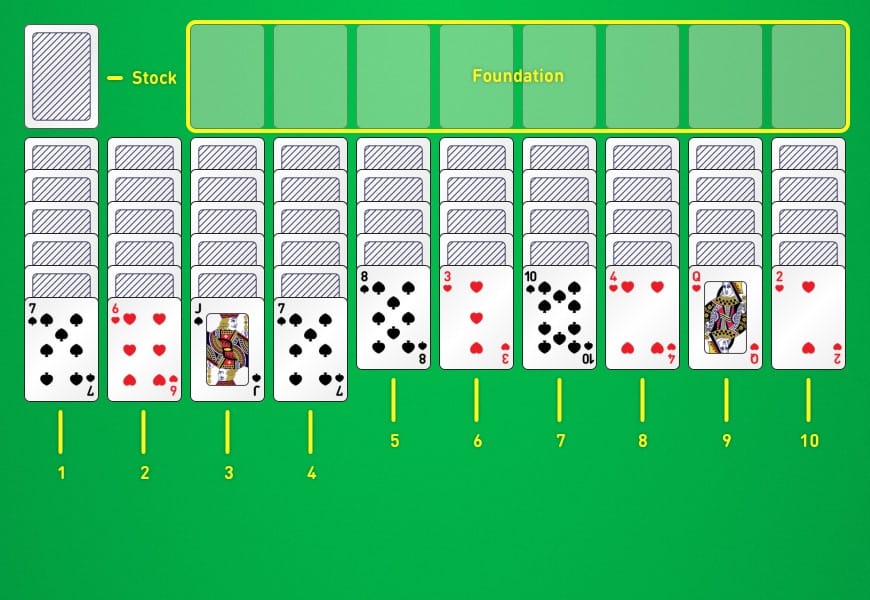
Unlike most solitaire games, this one is played with two decks of playing cards. The goal of the game is to move all cards from the tableau onto the foundation piles.
The layout of the game can be divided into three main areas:
- The tableau: This is where you'll make most of your moves.
- The stock: This is the pile of cards face down from which you draw.
- The foundation: This is where you want all your cards to end up ordered by suit and rank. It is the spider's eight legs.
To get cards from the tableau onto the foundation, you have to rank them from king to ace on the tableau. A card can always be moved onto the card one rank above it. In the one-suit game every card is a spade, so if you have a seven, you can put it on any eight.
The game's goal is to make runs of cards from king to ace in the same suit. Once you have a complete sequence of cards, they will be moved to the foundation. Only if the sequence of cards is of the same suit will this happen.
Since every card in the one-suit game is a spade, any cards that sit in perfect descending order can be moved together. For example, if you have the eight, seven, and six of spades in a row, you can click and drag all three onto any nine. Cards that are not in sequence still have to be moved one at a time.
You can move any card or partial run to an empty tableau spot if you have one.
When you have no more moves to make on the tableau, you can click on the stock in the top left corner. That will move ten cards from the stock down to the tableau, placing one card on each tableau. We don't recommend doing this before you're completely sure there are no moves left.
Good luck playing!
Must warn you all: These games are addictive. So fun and cozy they make time fly.
Hannah Smith
No fuss, no muss, no bells and whistles - just simple solitaire games. I love it!
Brittany Hudson
Spider Solitaire Strategy
One suit is the kind, gentle spider, but a few good habits will win you a lot more deals - and they carry straight over into the tougher two- and four-suit games.
Flip the face-down cards first
A Spider deal hides 44 of its 54 tableau cards, so most of the board starts out unknown. Prefer any move that digs a hidden card out over reshuffling ones you can already see. If sliding your 8♠ onto a 9♠ frees the face-down card underneath it, take that move rather than one that just shuffles visible cards around.
Build long runs down in order
In the one-suit game every card is a spade, so any run that goes down in rank, say 10♠-9♠-8♠-7♠, counts as a matching sequence you can pick up and move as a single block. Keep your columns neatly ordered and you can shift big stacks in one go, and that's the whole trick that makes one-suit so forgiving.
Keep a column empty, and save it for a King
An empty column is the most valuable spot on the board. A King is the one card with nothing to sit on, so an empty column is often the only way to move one and dig out whatever it's burying. When you clear a column, don't stuff it with a low card straight away. Hold it open for a stranded King, like a K♠ that's pinning down half a pile.
Never deal from the stock while a column is empty
Most Spider games, ours included, won't even let you deal a new row while a column sits empty, and even where it's allowed, you still shouldn't. Dealing drops one fresh card onto all ten columns at once, filling that hard-won empty space and burying your neat runs under new cards.
Race to complete a King-to-Ace run
Clearing a full K♠-down-to-A♠ run lifts thirteen cards off the board and onto a foundation, and it often frees a whole column too. That payoff is worth more than almost any other move, so when you're close, say the run is down to the 3♠ and 2♠, go get the A♠ that finishes it before you start anything new.
Look a few moves ahead before you commit
Spider punishes hasty moves that bury a card you'll want two turns later. Play the line out in your head first, and use Undo to try an idea before you're sure of it. If your 5♠ can go onto either of two 6♠s, pick the one that keeps a longer run together or turns over a face-down card, not just the first legal move your eye lands on.
How hard is Spider?
It all comes down to how many suits are in play. Here's how the win rates land on this site:
- One suit is the friendly one, won 56 of every 100 games across 23 million plays
- Two suits tighten it up, about 32 in 100 across 33 million games
- Four suits bite hard, only about 13 in 100 across 14 million games
- Skill counts for more here than in most solitaires
Frequently Asked Questions (FAQ)
If your questions aren't answered by our FAQ below, feel free to reach out at contact@online-solitaire.com, and we'll do our best to help you.
What is Spider Solitaire?
It's a Patience game, much like Solitaire or FreeCell. It was first popularized by Microsoft, which released it with the Microsoft Plus! 98 pack and later shipped it with Windows ME and XP, which is where most people know it from today. It is considered one of the more challenging types of Patience games, and a good deal of strategy and luck is needed to win the game.
How do you set up the game?
Two full decks are used in this game. So, there are a total of 104 cards. When a new game is started, 54 cards are divided into ten tableaus. Each of the first four tableaus has six cards, and each of the remaining six tableaus has five cards. Each tableau's top card is turned face up, while the others stay face down. The remaining 50 cards are placed in the stock at the upper left corner of the screen.
Why is it called Spider?
The spider is hiding in the numbers. A finished game sorts all 104 cards into eight complete King-to-Ace runs (8 × 13 = 104), each one whisked off to its own foundation pile. Eight foundations, eight legs. And the ten-column tableau with all its dangling half-runs really does sprawl out like a web once a game gets going.
What other versions of Spider are there?
The spider has a big family. Here's where to crawl next.
- Spider Solitaire (2 Suits): Adds a second suit, so a run only lifts as a block when its cards match. That turns the gentle one-suit game into a real test.
- Spider Solitaire (4 Suits): All four suits in play and the full challenge, widely rated one of the hardest solitaire games there is.
- Spiderette: Spider shrunk down to a single deck and seven Klondike-style columns, a quicker, friendlier game for when you want a shorter sit.
- Scorpion: A one-deck relative where you build down by suit, but you can lift a card along with everything piled on top of it, buried cards and all, to dig your way out.
- Black Widow: Plays like Spider, but it lets you move a descending group of cards even when the suits are mixed, which eases the block-moving rules for a snappier game.
Do you have an app?
You bet we do! Our app is free to download and is available for Windows™, Mac™, Linux™, or Android. There is no iOS app right now, but you can play the web version on iPhone and iPad. We also have an app for Amazon Kindle and an extension for Google Chrome.


