Play Klondike Solitaire Turn 1 Online for Free (No Signup Required)
Klondike Turn 1 is the third most popular game of Patience. It is a great game to warm up with. So get ready for a cozy time, just you and this free classic Solitaire game.
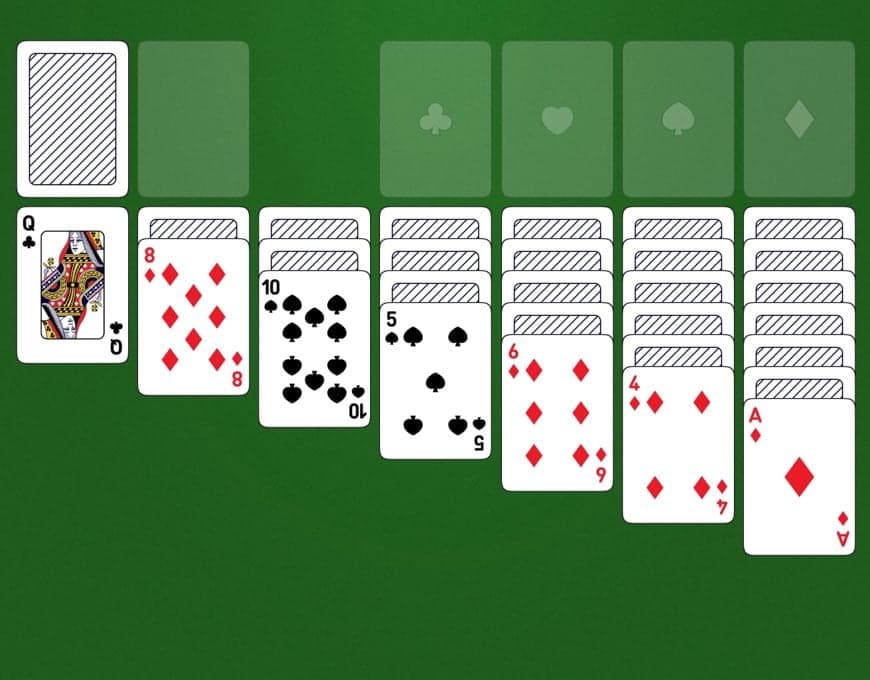
Klondike Turn 1 is a very rewarding game. On average, forty-eight percent of the games are won, and it takes a little more than six minutes to play it. So just get cracking!
Turn 1 is a lot easier than Solitaire Turn Three. However, you still get to challenge yourself and develop your strategic muscles.
It has all the features you could want from the classic Solitaire card game, and it's free, so you don't ever have to pay for anything. You can download the game or play solitaire online, whatever you prefer. Either way, you can choose a winnable deal, a random shuffle, or the daily challenge. And you get unlimited hints and undos, so help is only a click away.
Have fun, and stay sharp!
Holger
4.8
5771 ratings

You don't even notice that this game of Patience is wearing on your Patience because you get so into it that you forget time and place.
Billy Mattson
When I'm bored, this is my go-to game. It cures every bit of boredom in a jiffy.
Becky Kincaid
How to play Klondike Solitaire Turn 1
Playing Klondike Turn 1 is just like playing Klondike Turn 3 - only a lot easier to win. If you need detailed instructions on how to play the game, please check out my thorough tutorial on how to play Solitaire.
What's special about Klondike Turn 1 is that it only shows one card at a time from the stock. That means you will see every card there and have a much better chance of finding every useful card immediately.

Take it easy as you look through the tableau to find out if and where the card from the stock can be placed. When moving cards, you move a black card onto a red and vice versa. When placing a card on another card, that sequence of cards must be ordered by rank from high to low. So you can put a nine of diamonds upon a ten of clubs and that upon a jack of hearts.
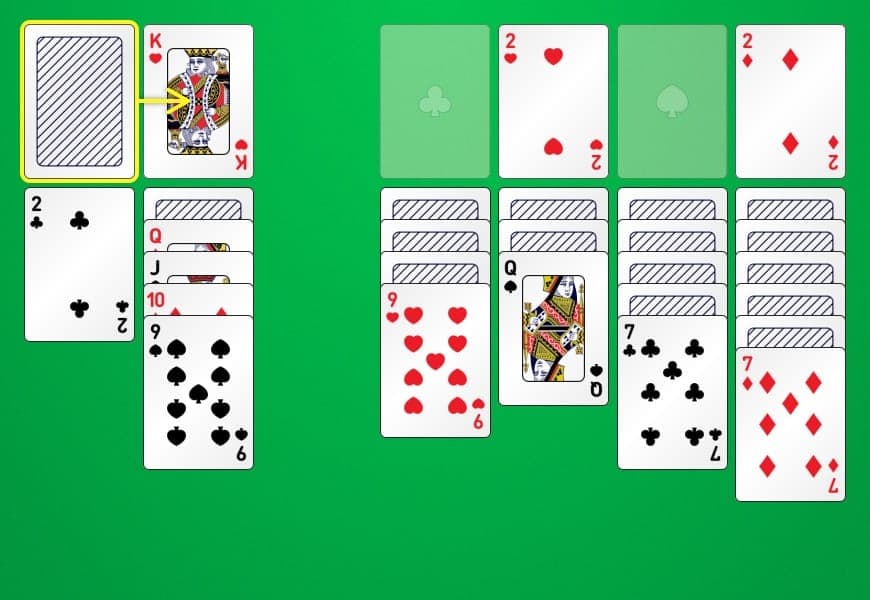
In the end, all cards should be stacked on the four foundation piles. Here, they must be organized by suit and in running order from ace to king. When an ace appears either from the stock or from the tableau, you can move it to its place on the foundation. This can be done either manually or automatically by clicking autoplay in settings. When the next card in line appears - whoopty! that goes on top of the foundation.
Your winning chances are great, but your chances get even greater if you check out my tips on how to win the game.
Good luck!
Turn 1 Strategy
Because nothing in the stock stays hidden the way it does in Turn 3, the slow, deliberate player wins far more Turn 1 games than the fast one. Here's how I squeeze the most out of that one-card draw.
Scout the whole stock before you commit
Since every stock card is playable in Turn 1, take a slow first pass and just watch what comes by. See where the low cards and the Kings are hiding before you settle on a plan. Knowing the 4♠ is buried near the bottom of the stock changes how badly you need the 3♠ up on its foundation.
Turn face-down tableau cards first
Every face-down card is a little mystery blocking a whole column, so go for the move that flips one. If the 6♣ is sitting on top of a face-down card and can move onto the 7♦, take that move over one that only tidies up cards you can already see.
Don't rush every card to the foundation
An ace or a 2 belongs on the foundation right away, but higher cards often do more work down in the tableau. If the 7♥ can go to either the tableau or the foundation, and you still have a black 6 needing a home, keep it in play. You can always send it up later.
Plan the entire stock pass as one sequence
In Turn 1 you can see exactly which stock cards you'll reach, so think a few draws ahead. If you know the 9♠ is coming and will need a red 10, move your 10♥ onto a black Jack before the 9♠ shows up, so its landing spot is ready and waiting.
Build long alternating runs you can move as a unit
A tidy run like J♠-10♥-9♠-8♥ can be lifted as one piece onto a red Queen. Building these runs frees up columns faster than nudging single cards around, and Turn 1 lets you see enough of the deck to put them together on purpose.
Only break open a column when a King is ready
Empty columns are gold, but only a King may claim one. Turn 1 lets you scout the entire stock, so count the Kings you can actually reach before tearing down a pile.
Use the redeal to your advantage
You can pass through the stock again, so a card you skip isn't lost forever. If a stock card has no good home yet, leave it and keep cycling through. Often a later move opens up the exact spot it needed.
Keep colors balanced across the foundations
Try not to race one suit far ahead of the others. When one suit runs way ahead, you often find you still need its middle cards back down in the tableau.
How hard is Turn 1?
Easier than Turn 3, but it still keeps you honest. Here's how the two stack up on this site:
- Turn 1 is won about 48% of the time across 100 million games here
- Turn 3 is the tougher one, won 27% of nearly 300 million games
- Seeing every stock card is what tips the odds your way
- Pick a Winnable deal and there's always a path through
Frequently Asked Questions (FAQ)
If your questions aren't answered by our FAQ below, please reach out at contact@online-solitaire.com, and we'll do our best to help you.
How is Klondike Turn 1 different from Turn 3?
The only rule that changes is how many cards you flip from the stock. Turn 1 deals one card at a time, so every card becomes playable. Turn 3 flips three at once, and only the top of each little group is ready to play. Everything else plays exactly the same.
Can every deal of Turn 1 be won?
No. Some shuffles just can't be won no matter how well you play. If you want a deal that's guaranteed to be winnable, pick the winnable shuffle option before you start.
What card can I move onto an empty column?
Only a King, or a properly ordered run that starts with a King.
When should I use undo?
As often as you like. Undo lets you try a line of play and back out if it dead-ends. And because Turn 1 lets you see the whole stock, undo works hand in hand with scouting ahead. Try the risky move, and if it blocks a card you need, just step back and pick another path.


