Solitaire Guide: Tips on How to Win Solitaire
Solitaire has been a long-time favorite of people to keep their minds sharp. When the game was first created is not known, but we know that it's at least as old as Napoleon, since he passed the time playing Solitaire when he was exiled to the island of Elba.
According to our statistics here at Online Solitaire, about 48% of Solitaire Turn 1 and 27% of Solitaire Turn 3 games are won, making it a challenging game to win.
We've written this guide to teach you how to win at Solitaire, so without further ado, here are our top tips:
1. Learn how to play Solitaire

The first tip is not so much a tip as it is a prerequisite for getting good at Solitaire. It might have been a long time since you've played the game last, or you might never have fully understood the rules. Whatever the case is, learning the game is the first step to mastering the game.
2. Consider colors when filling an empty spot
You've managed to empty a spot on the tableau. Congratulations! Make sure that you consider the color of the King you place on that spot in relation to the colors of the Queens and Jacks you have visible on the tableau. If you have a choice, pick the King that lets you place as many Queens and Jacks on it as possible. Say you clear a column with both a K♠ and a K♥ in hand and only red Queens showing, drop in the K♠, since a red Queen only ever lands on a black King.
3. Only empty a spot if you have a king
Only a king can fill an empty spot on the tableau, so if you move the last card on a tableau to another, you've basically just blocked the tableau. So before you empty a spot, make sure that you have a king to place on it, either on the tableau or in the stock.
4. Distribute piles across the tableau
This might seem counter-intuitive, but trying to complete a single pile is not always the best strategy. If given the choice of maintaining two piles or combining them into a single pile, the best strategy is most often to leave them separated. Unless combining them will reveal a hidden card beneath the first pile, then combining them might make sense.
Leaving the piles separated gives you a large choice of sets to build on, which is especially great when working through the card waste. So if you could slide a 7♠-6♥ run onto the 8♦ but it flips no hidden card, leave them apart, and the 8♦ can still take a black 7 while the 6♥ still wants a black 5.
5. Only move cards if you have a reason to do so
It might be tempting to build piles on the tableau, but doing so can actually be hurtful to the game. When doing so, you end up locking cards of different colors behind the pile, which makes you end up in a situation where you can't win a game because your cards are locked behind a pile. Our advice is only to move cards if it reveals a hidden card below or if you have a good reason for it. It's perfectly legal to slide a red 9♥ onto a black 10♠, but if that move flips nothing and serves no plan, you've just locked the 9♥ away for no gain.
6. Always turn over hidden cards after a move
This might seem like a no-brainer, and it's even done for you if you play online, but it's still worth mentioning. Some people make all their moves on the tableau and then turn over all the hidden cards they've revealed. Make sure always to turn over hidden cards after they've been revealed since it gives you extra options on what your next move should be.
7. Expose cards in large stacks first
If you have the chance to reveal a hidden card from a small stack and a large stack, always choose the large stack! It can be difficult to get to the bottom of large stacks, so the sooner you can start revealing hidden cards on a large stack, the better.
8. Always play the Ace or Deuce if possible
Whenever you get a chance to move an Ace or Deuce (also called a two) to the foundation, make sure to do so. Those cards won't help you build stacks on the tableau but will block other piles. The only card a two can ever hold is an Ace, and that Ace belongs on the foundation anyway. Moving these cards is so much of a no-brainer that it's considered one of the best moves in the game.
Tip 9 (Bonus tip): Identifying a good deal
A good deal is a deal that gives you a high chance of winning. Not all deals are equally easy to win. Some deals can be won effortlessly, some will be hard to win, and some can't be won at all.
Games that are on the easier side tend to share a few attributes. They tend to have higher cards like aces and kings, they tend to have sequenced cards of alternating colors, and they tend not to have any duplicate cards of the same color.
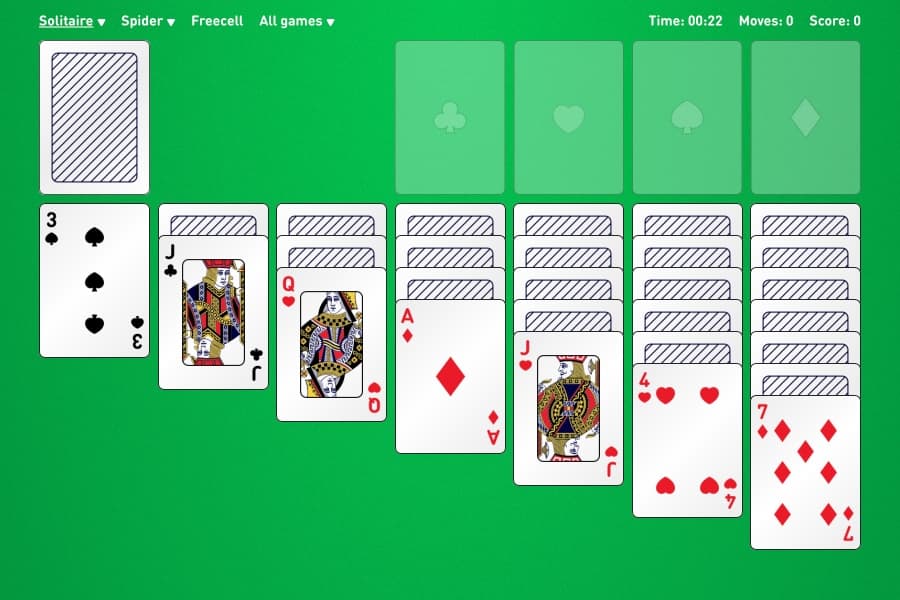
Above, you see an example of how such a deck looks. You can see an Ace that can be moved to the foundation, a Jack that can be moved to the Queen and a Three that can be moved to the Four.
Tip 10 (Bonus tip): Identifying a bad deal
Just as you can be dealt games that are easily winnable, you can also be dealt games that are not so easily winnable. They might not be winnable no matter how much you try. Identifying these types of games can save you a lot of time. On the other hand, you might be the type of person who likes a challenge, which means you'll want to play these types of games.
Games that are on the harder/impossible side share certain attributes. They tend to have no kings or aces, no sequenced cards you can stack, and they might even have duplicate cards of the same color. A hard game might have just one of these attributes, but it might also have all of them. The more of these attributes a game has, the harder it'll be.
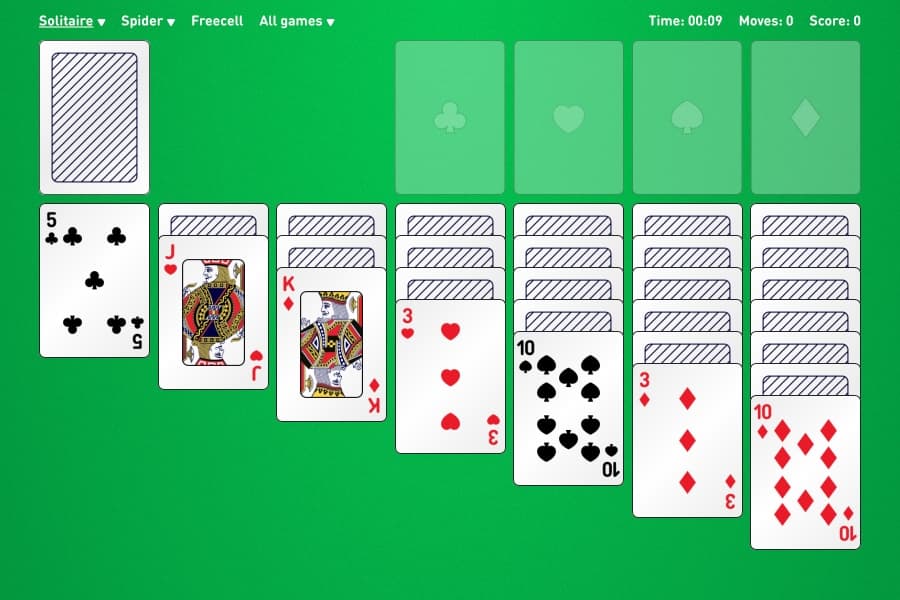
Above you see an example of such a game. You have two Threes in the same color, there are no aces, and on top of that, there are no cards that can be stacked. A game like this might still be solvable, but it's definitely harder than other games.
Tip 11: Keep your foundations balanced
Apart from the automatic Aces and twos from Tip 8, don't rush every card up to the foundation. You can technically pull a card back down off the foundation, but it costs you moves and time, so treat the trip up as one-way. A mid-value card is often more useful as a landing spot than as foundation filler. A good habit is to keep your four foundations within about two ranks of each other, so you always have somewhere to build. If your spades have already climbed to the 6♠ while your hearts sit at the Ace, a 5♥ that turns up can easily have nowhere to park, and that's because the 6♠ went up too soon.
Tip 12: Think two or three moves ahead
The strongest players rarely grab the first legal move they see. Before you commit, trace where the play leads and pick the line that flips the most face-down cards or frees a whole column, and remember that a move that looks fine on its own can quietly close a door two turns later. Say you can send the 8♦ up to the foundation or keep it down to catch a black 7, count what each line flips before you choose.
Tip 13: Know when to stop and re-deal
Not every deal can be won, and stubbornly cycling a dead stock only eats your time, so let Tips 9 and 10 help you spot these boards early. If you've run the whole stock without a single new play opening up, starting fresh is usually the smarter call.
Solitaire odds and winnability
Skill can't rescue every shuffle, but far more games are lost to our own choices than to an unlucky deal. We can see it right here on our own tables, across hundreds of millions of games. Turn 1 players win 48 out of every 100 games on this site, while Turn 3 players win only 27, so the way you draw makes a world of difference. Spider tells the same story, sliding from a 56% win rate at one suit to 32% at two and just 13% at four. In other words, the odds bend to the player, and that's exactly why the tips above are worth practicing.
Frequently asked questions
Is every game of solitaire winnable?
No. Some deals just can't be won by any run of legal moves, no matter how well you play. When you hit one of those, don't blame yourself, just shuffle up and go again.
What's a good solitaire win rate?
It depends on the game and the draw mode, so make sure you compare like with like. The odds section above has our exact Turn 1 and Turn 3 numbers. If your own win rate beats those numbers, you're doing better than the room.
Are Turn 1 and Turn 3 odds different?
Yes, and by a wide margin. In Turn 1 you flip one card at a time, so with enough passes through the stock every card eventually becomes playable. Turn 3 deals three at a time and only the top card of each triplet is available, so cards can stay out of reach until other plays shift the order.
Does using undo count as cheating?
That's really up to you and the game you're playing. In a casual, untimed game we'd never call it cheating - undo is a learning tool, a way to explore a line, watch it dead-end, and back out wiser. In scored or competitive play, undo is usually either switched off or costs you points, so there it genuinely changes the result. Play the way that keeps the game fun.
Final thoughts
Congratulations on going through all of our tips and tricks. You now have a much better chance at winning Solitaire. If you have any feedback or if you have a tip that you feel should be added to the list, feel free to write us at contact@online-solitaire.com. For now, why not play a game of Solitaire to try out your new solitaire strategies?


