Play Gloucestershire Solitaire Online for Free (No Signup Required)
Two full decks, eight staircase-shaped beds, and ranks that wrap from King back to Ace: Gloucestershire doubles Flower Garden's challenge in every direction.
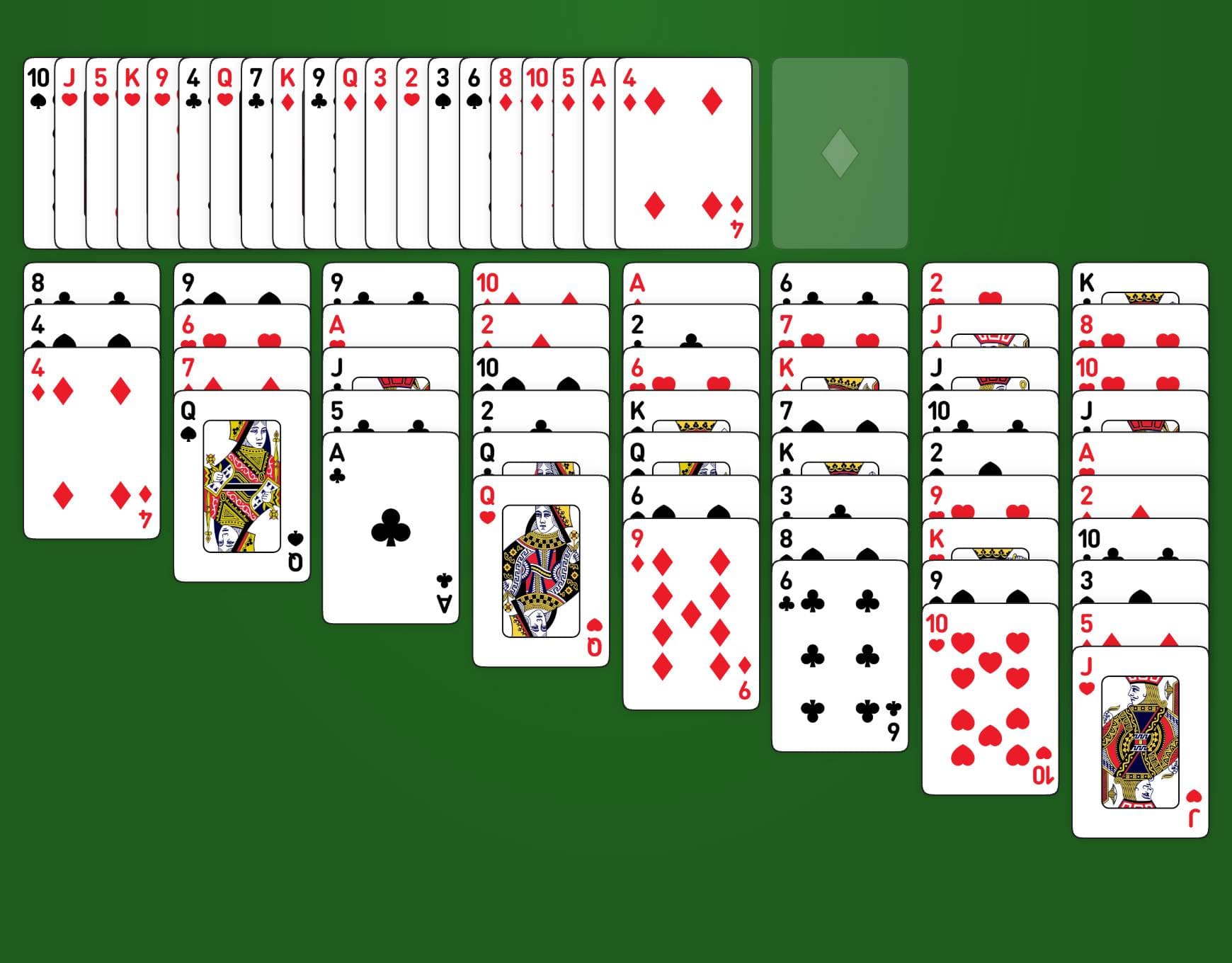
Gloucestershire Solitaire is the two-deck member of the Flower Garden family, named after the English county. Flower Garden itself — also known as The Bouquet — is a nineteenth-century patience, and Gloucestershire doubles it in every direction: 104 cards, eight flower beds instead of six, and a bouquet of 52 cards instead of 16.
The deal is a staircase. The eight beds receive 3, 4, 5, 6, 7, 8, 9, and 10 face-up cards, and the 52 cards left over are fanned out as the bouquet, served up one card at a time. Two rule changes set Gloucestershire apart from its parent: the beds build down in alternating colors rather than in any suit, and ranks wrap around, so a King may be laid on an Ace. The foundations wrap as well, climbing their suits from Ace to King twice for 26 cards apiece.
The game is difficult — the deep beds on the right take patient mining. Two full decks are in play here, and skill carries most of the weight in whether you win.
If the wraparound ranks and staircase beds hook you, Flower Garden Solitaire and Wildflower Solitaire give you more of the same family.
Prefer building without wraparound ranks? The original Solitaire strips that twist back out.
If you run into anything odd or have an idea that would make the game better, please contact me.
Enjoy playing!
How to play Gloucestershire Solitaire
Layout:
4 foundation piles: Build up in suit from Ace to King, twice around, until each pile holds 26 cards. Each foundation takes a different suit.
8 "garden" tableau piles: Build down in alternating colors; ranks wrap, so a King may be placed on an Ace. Only one card may be moved at a time, and any card may fill an empty space. The piles are dealt 3, 4, 5, 6, 7, 8, 9, and 10 cards face-up at the start of the game.
Reserve "Bouquet": The 52 remaining cards, fanned face-up beside the foundations. Only the top card of the fan may be played, to the foundations or the tableau. There is no stock and no redeals.
Foundation:
There are four foundation piles.
Any Ace may be moved to a vacant foundation pile, but no two foundations may begin with the same suit.
A card can be added to a foundation pile only if it's one rank higher and the same suit as the pile's current top card, so the only card that fits on an 8 of spades is a 9 of spades. After the King, the pile wraps: a second Ace continues the climb until the pile holds all 26 cards of its suit.
The top card of each foundation can be moved back into play if another pile will accept it.
Tableau:
Eight tableau piles dealt 3, 4, 5, 6, 7, 8, 9, and 10 cards, all face-up.
A card can be added to a tableau pile only if it's one rank lower and the opposite color of the pile's current top card, so the only cards that fit on an 8 of spades are the 7 of hearts and the 7 of diamonds. Ranks wrap on the tableau, so a King may be laid on an Ace.
Cards on the tableau that are not covered by another card are free to be played onto the foundation or any other tableau pile.
Any card may fill an empty tableau space.
Only one card may be moved at a time; sequences are not permitted.
Reserve:
The bouquet holds the 52 cards left over from the deal, fanned face-up in a single row.
Only the exposed top card of the bouquet is available; playing it to the tableau or a foundation uncovers the next card. No card may be moved into the bouquet, and once it is empty it stays empty.


