Play Calculation Solitaire Online for Free (No Signup Required)
Four foundations climb by ones, twos, threes, and fours, wrapping past King back to Ace: suit never matters, only the number in front of you. Single deck, tough 15% win rate.
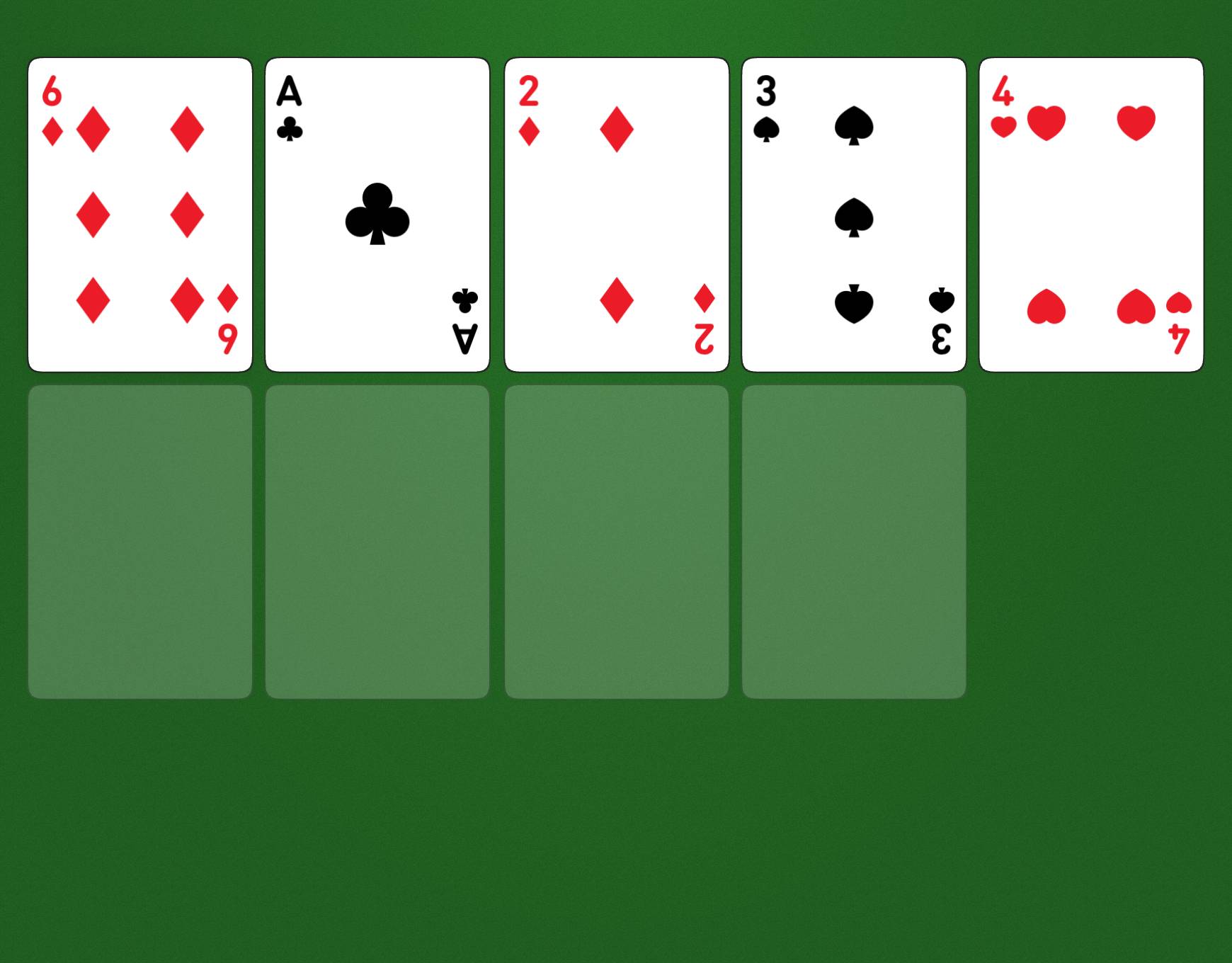
Calculation Solitaire is a solitaire built on arithmetic rather than suit and color. It ignores suits completely: the four foundations start with an Ace, a 2, a 3 and a 4, and each one is built upward by its own fixed step until it reaches a King. That single idea makes Calculation one of the most cerebral games in the solitaire canon, because a thoughtful player wins far more often than a careless one.
The first foundation climbs by ones (A, 2, 3, 4 … up to King). The second climbs by twos (2, 4, 6, 8, 10, Queen, then wrapping past the King back through Ace, 3, 5 …), the third by threes and the fourth by fours, each sequence winding through all thirteen ranks to finish on a King. Suit never matters — only the number on the card.
You turn the stock one card at a time: if a card fits a foundation, play it; if not, park it on one of the four waste heaps below. Those four heaps are the whole game. A card buried under the wrong neighbor is a card you may never reach, so the skill lies in keeping your heaps in a rough descending order and reserving one pile for the awkward high cards you cannot yet use. Think two or three cards ahead before committing anything to a heap.
Expect a difficult climb: roughly 15% of games are winnable, and with only a single deck in the mix, luck sets the order of the stock while skill is how you spread the cards across the four heaps.
If you enjoy the arithmetic puzzle in Calculation, try Sir Tommy Solitaire, the classic ancestor in which you also deal the stock onto free heaps and build the foundations from there.
Once you've got the arithmetic hook of Calculation, the original Solitaire is the natural next stop.
If you run into anything odd or have an idea that would make the game better, please contact me.
Enjoy playing!
How to play Calculation Solitaire
Layout:
4 foundation piles: Built upward regardless of suit. Each is seeded with an Ace, 2, 3 or 4 and completed with thirteen cards ending on a King.
4 tableau piles: Four waste heaps that start empty. You may discard any card from the stock onto any of them, but you can never move a card from one heap to another — only up to a foundation.
Stock: Turned one card at a time, with a single pass and no redeal.
Foundation:
There are four foundation piles, each begun with a different base card: Ace, 2, 3 and 4.
Each foundation is built upward by a fixed interval regardless of suit: the Ace pile by ones, the 2 pile by twos, the 3 pile by threes and the 4 pile by fours. When a sequence passes the King it wraps around and continues, so every pile ends up holding all thirteen ranks, topped by a King.
Cards cannot be taken from a foundation after they have been placed.
Tableau:
There are four tableau piles, used as waste heaps, and they all start empty.
The top card of any heap may be played to a foundation whenever it fits. Cards cannot be built on one another and cannot move from one heap to another, so choose carefully where each unplayable card lands.
Stock:
The remaining cards form the stock, dealt one at a time.
Each card you turn must either be played straight to a foundation or set down on one of the four heaps. There is a single pass and no redeal, so a card placed on a heap stays there until you can send it up.


